*This post may contain affiliate links for which I earn commissions.*
Thanksgiving tables often begin with pumpkins, neutral linens, and familiar shades of brown. This setting takes a more dramatic route. Cranberry fabric covers the table, cobalt dishes anchor each place, mustard napkins add a flash of gold, and amber goblets glow beside tall coral candles.
The centerpiece is equally distinctive. Instead of arranging flowers in a single vase, burgundy foliage and clusters of berries form a low runner through the middle of the table. Pears, persimmons, figs, and other harvest fruit are nestled among the leaves, creating an abundant display that still feels organic.
It is a richly layered table, but the colors are controlled. Nearly every element belongs to one of four families: cranberry, blue, golden yellow, or amber. That discipline is what allows the table to feel expressive without becoming chaotic.
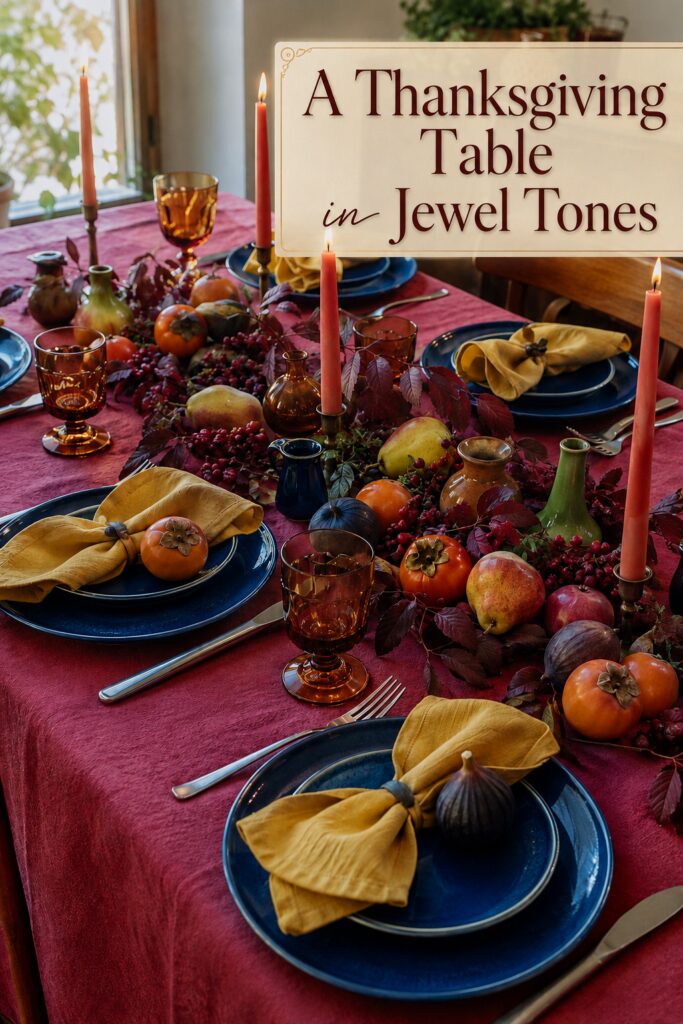
Disclosure: The inspiration image featured in this post was created with AI.
Begin With a Cranberry Foundation
The cranberry tablecloth establishes the mood before any dishes or decorations are added. Its deep berry tone feels festive and autumnal, but it is less expected than pumpkin orange.
Look for a fabric tablecloth with a matte or lightly textured surface. Linen, linen-look fabric, washed cotton, and subtle jacquard can all work. Avoid a pronounced holiday print because the fruit, foliage, and dishes already provide plenty of detail.
A full tablecloth creates the most immersive result. If you prefer to leave some of a wood tabletop visible, substitute a wide cranberry runner and use coordinating placemats beneath the dishes.
Before building the centerpiece, steam or iron the cloth and position it evenly. Once the fruit and foliage are in place, correcting a deep crease becomes much more difficult.
Anchor Each Place With Cobalt Dinnerware
The dark cobalt dishes provide the strongest contrast on the table. Their cool blue color makes the cranberry cloth look richer and gives the mustard napkins greater definition.
Layer a dinner plate with a slightly smaller salad plate or shallow bowl. The image uses simple shapes and minimal pattern, allowing the saturated glaze to become the decorative feature.
Matching every piece perfectly is not essential. Blue dishes with slightly different glaze depths can make the table feel collected. Keep the silhouettes similar and stay within deep navy, ink blue, and cobalt rather than introducing pale or turquoise blue.
If you do not want to purchase an entire dinnerware set, cobalt salad plates can be layered over neutral dishes. Even one blue plate at each setting will create much of the same visual effect.
Fold Mustard Napkins Into Soft Shapes
Mustard napkins provide a warm bridge between the blue dishes and amber glassware. Their relaxed folds keep the place settings from looking stiff beside the loosely arranged centerpiece.
Choose soft cotton or linen-look napkins that will hold a simple gathered shape. Pull each napkin through a small ring or tie it loosely with narrow cord. A dark wood, antique brass, or pewter-toned ring will relate naturally to the candleholders and serving pieces.
The folds do not need to be identical. A little variation supports the table’s abundant, gathered-from-the-garden character.
Small persimmons or figs can be placed on the plates as edible-looking place-setting accents. If you use real fruit, wash it first and avoid placing anything sticky directly on the napkin.
Add Amber Glass for Warmth and Light
Amber goblets catch both daylight and candlelight, producing the honey-colored glow that runs through the setting. Their transparency also prevents the strong color palette from feeling visually solid.
Embossed, paneled, or pressed-glass goblets suit the nostalgic character of the table. Use them for water, wine, or a seasonal drink. Plain amber tumblers can create a similar effect if stemmed glassware is not practical.
A few small amber bud vases are tucked into the centerpiece as well. Mixing those vessels with olive green, caramel, and dark blue pottery creates a collected look without requiring floral arrangements at every point.
Keep the vessels short enough that they do not block conversation. On a dining table, the most useful decorative pieces sit either below eye level or well above it.
Build a Fruit and Foliage Table Runner
The centerpiece is the element that makes this particular table memorable. It appears abundant, but it is constructed as a long, low arrangement rather than a tall floral display.
Begin with several loose stems of burgundy foliage placed along the middle of the table. Let the branches overlap and turn in slightly different directions. Add narrow green stems underneath to soften the edges and provide contrast.
Tuck clusters of deep red berries into the gaps. They should appear in small pockets rather than forming a continuous garland.
Next, distribute fruit at irregular intervals. Pears provide larger golden shapes, while persimmons contribute saturated orange. Dark figs, plums, or miniature pumpkins add smaller areas of contrast. Place some fruit upright and allow other pieces to rest naturally against the foliage.
Real fruit will give the most convincing texture and can often be used after the gathering. Realistic artificial pieces offer a reusable option, especially if the table will be styled several days before Thanksgiving.
Leave enough space around the centerpiece for plates, glassware, serving utensils, and guests’ hands. Abundance should not make the meal difficult to serve.
Use Coral Candles Instead of Traditional Orange
The slender coral tapers repeat the warmth of the persimmons without matching them exactly. That slight color variation makes the scheme feel layered.
Space the candles down the length of the arrangement rather than clustering them in one central group. Holders in antique brass, aged bronze, or dark metal disappear gently into the foliage while adding a little reflective detail.
Varying the candle heights creates movement, but keep the arrangement balanced. Taller candles can sit toward the center, with slightly shorter ones nearer the ends.
For safety, keep leaves, berries, napkins, and fruit well away from open flames. Flameless tapers are a sensible substitute when the centerpiece contains faux materials or when children will be seated at the table.
Let Small Vessels Break Up the Symmetry
The table includes an assortment of petite vases in amber, moss green, ochre, and cobalt. Their differences make the display feel assembled over time.
Use the vessels to fill occasional spaces between larger fruit. Some can remain empty, while others can hold one short leaf stem or berry sprig. Limiting each vase to a simple contribution keeps them from competing with the runner.
This is also an easy place to personalize the design. Small pieces of pottery, inherited bud vases, or colored bottles can be incorporated as long as they repeat colors already present elsewhere on the table.
Keep the Table Rich but Functional
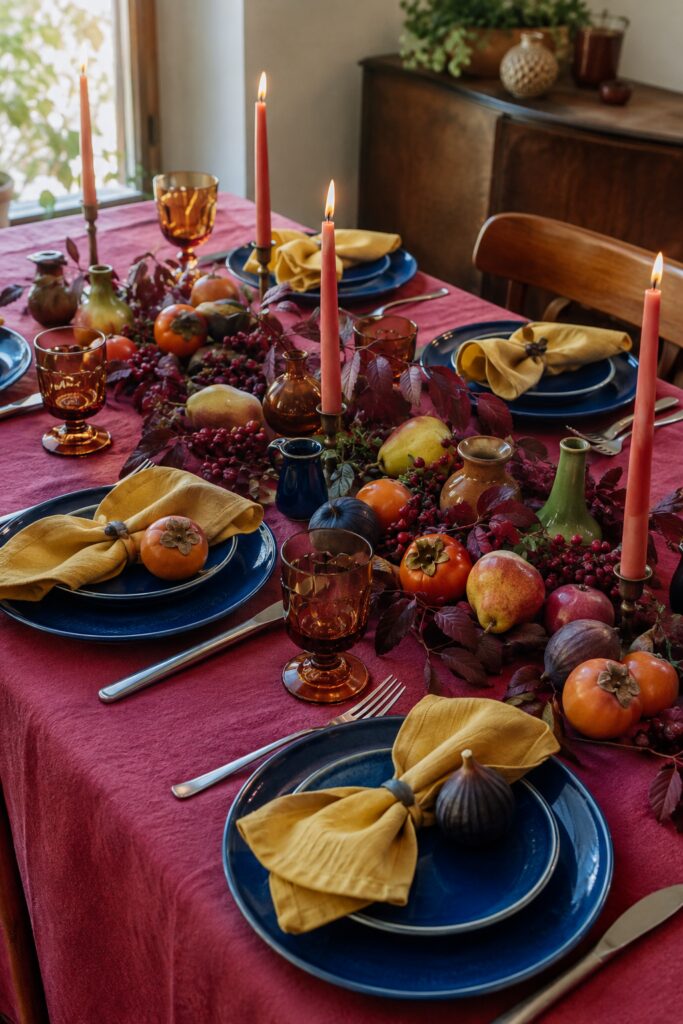
The secret to recreating the look is not adding as many objects as possible. It is layering several strong colors at different heights while preserving room for the meal.
The plates form the lowest structured layer. Napkins and goblets rise slightly above them. Fruit, berries, and foliage move through the middle, while the tapers create the tallest line.
Before guests arrive, sit in several chairs and check the view across the table. Remove any fruit or vessel that blocks conversation. Confirm that every guest has space for a glass and that serving dishes can be passed safely.
The finished setting should feel generous rather than crowded. With a carefully limited palette and a low natural centerpiece, it can capture the abundance of Thanksgiving in a way that feels intimate, jewel-like, and wonderfully unexpected.