*This post may contain affiliate links for which I earn commissions.*
Some Halloween entrances announce themselves with towering skeletons and flashing lights. This farmstead gatehouse takes a quieter path. A trio of cream ghosts floats beneath the timbered eaves while a grain wreath, mellow pumpkins, and glowing lanterns turn the rounded sage door into an inviting autumn focal point.
What makes the scene especially memorable is the way the decorations appear to belong to the setting. The weathered wood, mossy roof, cobbled passage, and arched door already feel as though they came from the pages of an old country tale. The Halloween pieces add wit and seasonal atmosphere without competing with that character.
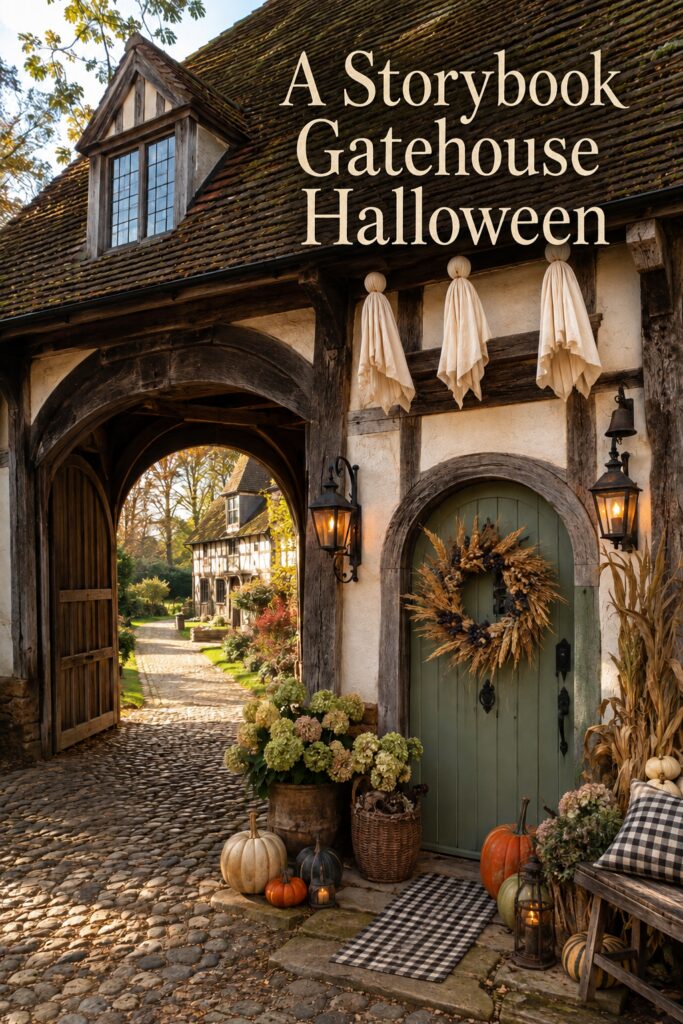
This inspiration image is AI generated, but the decorating ideas can be recreated with readily available seasonal pieces and simple DIY elements.
What Makes This Halloween Entry Work
The architecture remains the star. Rather than covering the facade, the arrangement uses open wall space, the door, and the ground immediately around the entrance. Every piece emphasizes the shape and texture of the gatehouse.
The three hanging ghosts are wonderfully simple. Their cream fabric relates to the pale plaster walls, while their rounded forms provide a playful contrast to the heavy beams. Because they do not have dramatic faces or elaborate accessories, they feel charming and slightly mysterious.
The wreath makes a natural visual bridge between fall and Halloween. Wheat, grasses, seed heads, and dark berry-like accents create a harvest foundation, while the deeper details connect it to the nearby charcoal pumpkins and black lanterns.
At ground level, the decorations frame the door without obscuring it. Pumpkins, hydrangeas, baskets, and crocks form low clusters on either side. This leaves the entrance functional and preserves a clear view of the lovely rounded doorway.
Begin With a Soft Harvest Palette
Instead of relying entirely on saturated orange and black, begin with colors already found in a weathered farmhouse exterior. Cream, muted sage, faded terracotta, natural straw, charcoal, and dark brown will produce a softer result.
Choose pumpkins in several tones. A large pale pumpkin can anchor one side of the door, while smaller orange, charcoal, green, or striped pumpkins fill the gaps. Repeating the sage color from the door among the pumpkins helps the arrangement feel connected.
The black accents should be used as punctuation. Lantern frames, door hardware, dark berries, and a checked textile provide enough contrast without making the doorway feel severe.
Suspend a Trio of Simple Fabric Ghosts
The overhead ghosts give this entry its distinctive personality. Similar decorations can be made with lightweight cream fabric, round foam forms, twine, and clear hanging line.
Drape the fabric over each form and gather it just below the head. Leave the lower edges loose so the layers fall naturally. Slight variations in fabric length will make the group more appealing than three identical decorations.
Hang the ghosts at related but slightly different heights. In this scene, their placement follows the horizontal line of the eaves and draws attention across the timbered wall.
For an exposed outdoor entrance, use lightweight outdoor fabric and secure each hanging line to a suitable structural hook. Keep the decorations away from flames, hot fixtures, doors, and areas where wind could pull them loose.
Give the Door a Grain and Berry Wreath
The wreath is generous enough to suit the substantial rounded door, but it does not cover the sage panels or iron hardware. Its irregular texture also works beautifully against the simple vertical boards.
Look for a wreath made with wheat, dried grasses, oat-like stems, seed heads, or preserved foliage. A few dark berry sprays can be woven through the lower half and sides to introduce a Halloween note.
If a finished wreath looks too formal, loosen several stems around the edge. An uneven outline feels more natural beside weathered timber and old plaster.
Before selecting the size, measure the widest part of the door. A wreath that fills roughly one-half to two-thirds of the available door width should feel substantial without overwhelming the arched surround.
Add Warm Lantern Light
Black wall lanterns provide strong visual structure around the entry. Their tall glass panels echo the vertical boards of the door, while the dark finish connects the wreath, hardware, runner, and pumpkins.
If replacing exterior fixtures is not practical, place one or two portable candle lanterns near the threshold. Flameless candles with a warm flicker can create a welcoming glow while avoiding exposed flames near fabric, dried plants, or corn stalks.
Vary the lantern height by placing one directly on the stone and another on a low riser. This makes the ground arrangement feel collected over time.
Frame the Threshold With Hydrangeas and Harvest Stems
Large, faded hydrangea heads soften the base of the entry. Their rounded forms repeat the pumpkins, while their green, cream, and dusty rose tones reinforce the subdued palette.
Arrange the hydrangeas in an aged crock, galvanized vessel, or heavy outdoor planter. Fill the arrangement generously, but allow some stems to spill outward instead of forming a perfect dome.
A bundle of dried corn stalks adds height on the opposite side. Keeping that tall element near the wall prevents it from narrowing the walkway. Wicker baskets and a rustic bench supply additional texture without introducing another dominant color.
Ground the Door With a Checked Runner
The narrow black-and-cream runner is a small detail with considerable impact. Its graphic checks sharpen the softer flowers and pumpkins while connecting with the gingham cushion on the bench.
For an exterior entry, select a flat-woven rug designed for covered outdoor use. The runner should be narrower than the doorway and short enough that it does not interrupt the main cobbled path.
One repeated check pattern is enough. Use it on the runner and perhaps one pillow, then let the remaining textiles stay neutral.
Style the Arrangement in Uneven Groups
Avoid lining every pumpkin and container into a symmetrical row. Begin with one tall feature, such as the corn stalks, and one broad feature, such as the hydrangea crock. Add pumpkins in groups of three or five, allowing their sizes and colors to vary.
Leave a little breathing room around the door hardware and lanterns. The empty areas are important because they reveal the arched doorway and prevent the seasonal pieces from feeling crowded.
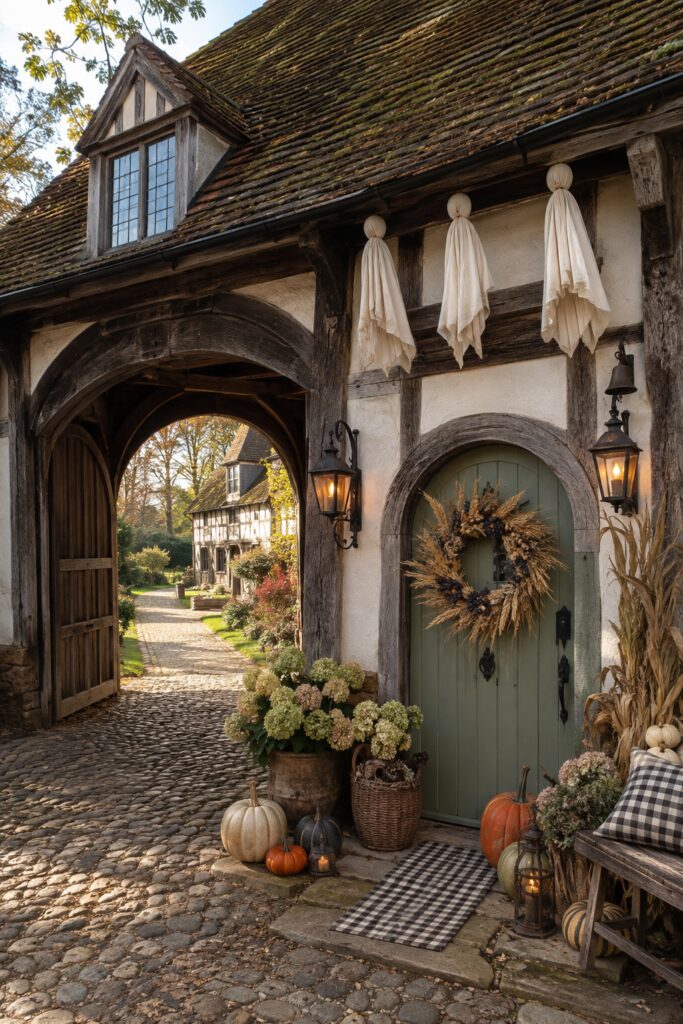
The finished entrance should look gathered rather than installed. Natural fibers, timeworn finishes, restrained Halloween details, and warm light are what give the scene its storybook quality.
A Final Styling Tip
Stand well back from the entrance before making the final adjustments. From a distance, check that the wreath remains the focal point, the ghosts are clearly visible, and the pumpkin clusters balance the doorway. Then walk through the entry to confirm that the runner, lanterns, and containers leave a safe, unobstructed path.