*This post may contain affiliate links for which I earn commissions.*
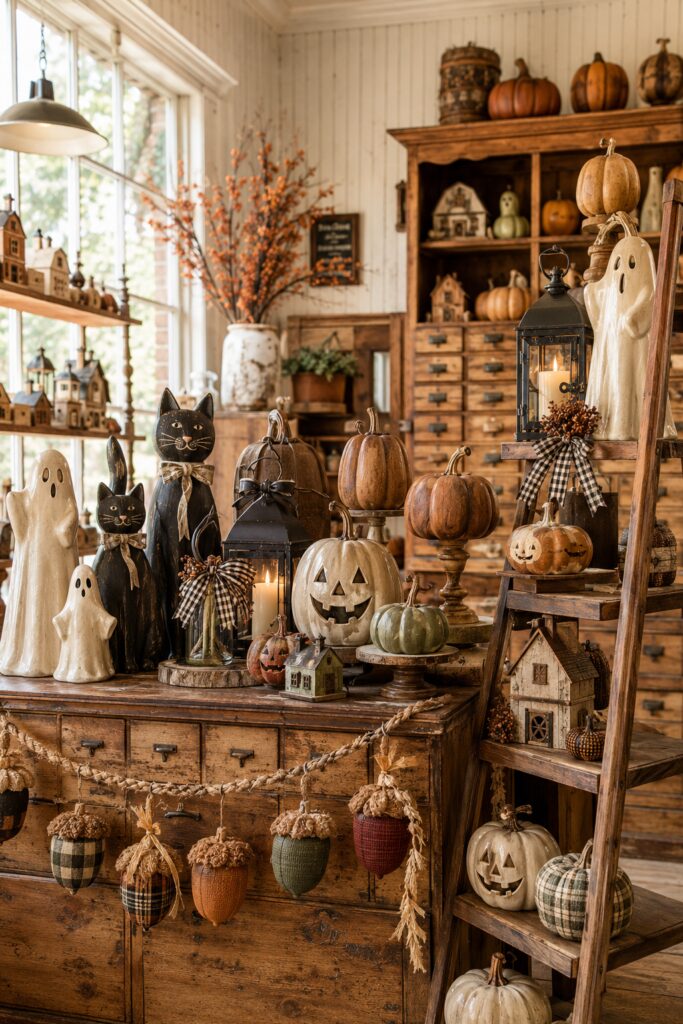
This sunlit feed-store display captures the kind of Halloween decorating that feels gathered, crafted, and kept for years. Folk-art black cats stand beside creamy ceramic ghosts, carved-look pumpkins rise on wooden pedestals, and candle lanterns glow among tiny farmhouse buildings and homespun fabric accents.
The room is full, but it does not feel harsh or chaotic. Its warm wood, cream, black, muted orange, mossy green, and touches of weathered red create a softer version of Halloween. Instead of relying on glossy decorations or a strict orange-and-black palette, the display uses varied materials and visible imperfections to suggest handmade character.
Readers could recreate the overall effect on a console table, kitchen hutch, mantel, dining-room sideboard, open shelving unit, or vintage dresser. The secret is choosing pieces that appear collected rather than perfectly coordinated.
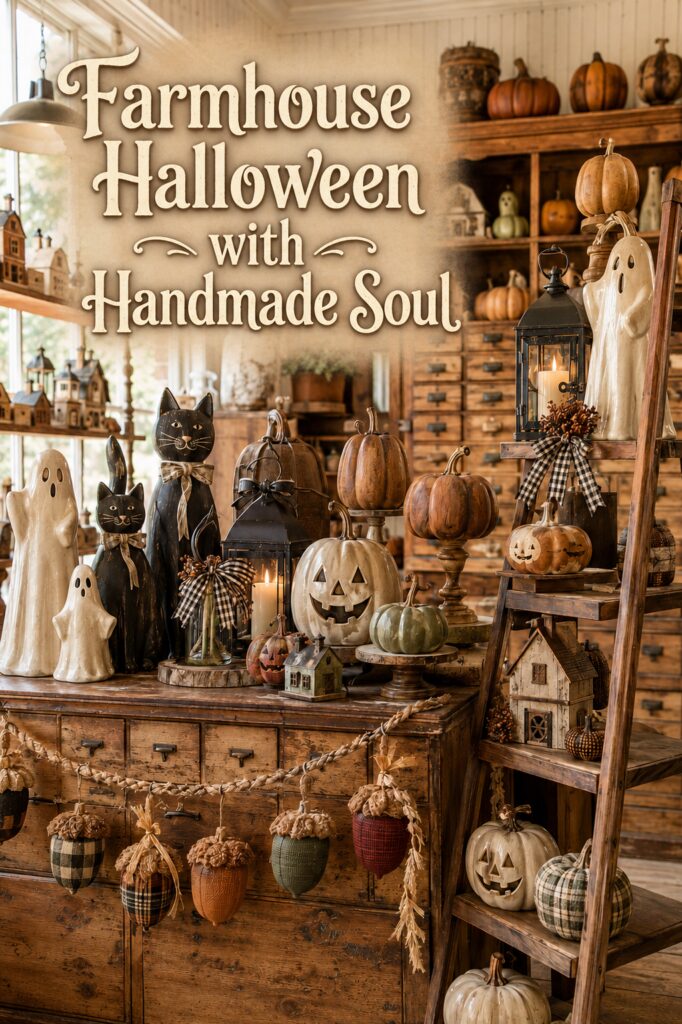
The inspiration image featured in this post was created with AI.
What Gives This Halloween Collection Its Handmade Personality
The scene resembles a small country shop where each decoration has its own story. Some pieces look carved from wood, others resemble glazed pottery, and several pumpkins appear to be sewn from old textiles. Twine, gingham ribbon, rough wood, aged metal, and woven fibers connect the different objects.
There is also a playful shift in scale. Tall black cats and elongated ghosts stand behind smaller pumpkin figures and miniature houses. Large lanterns create strong dark shapes, while tiny acorns and berries fill the spaces between them.
Most importantly, the pieces are not arranged in a straight line. They gather in overlapping groups, rise onto pedestals, and spill from the main counter onto a ladder-style shelf. This makes the display feel discovered rather than staged.
Begin with Folk-Art Black Cats
The two tall black cats immediately establish the Halloween theme. Their narrow silhouettes, painted whiskers, simple eyes, and little neck bows give them the appearance of old-fashioned handmade figures.
One tall cat and one smaller companion can establish the same focal point at home. Look for freestanding cats with uncomplicated faces and matte or lightly distressed finishes. A painted wooden figure will usually blend into this setting more naturally than a realistic cat statue.
If a suitable finished piece is difficult to find, a plain wooden cat cutout can be painted black and given a simple cream face. Add a narrow gingham, burlap, or faded muslin bow around the neck.
Place the larger cat toward the back of the display and offset the smaller one slightly forward. This makes them look like a related pair without creating strict symmetry.
Shop Similar Folk-Art Black Cat Figures
Choose cats with an upright shape, handcrafted details, and enough height to stand above nearby pumpkins.
Mix Ceramic Ghosts in Different Sizes
The ghosts provide a pale counterpoint to the black cats and lanterns. Their glossy cream surfaces catch the window light, keeping the display friendly and easy to study.
The figures do not all match. Some are tall and narrow, while others are short and gently rounded. Their simple open mouths and dark oval eyes give each one a slightly different expression.
Use two or three ghosts rather than filling every shelf with them. Place the tallest one near the edge of a hutch or ladder shelf, then group smaller ghosts on a tabletop at a different height.
Warm ivory and softly antiqued white will work particularly well with weathered wood. Small imperfections in the glaze can contribute to the handcrafted mood.
Look for Cream Ceramic Ghost Figurines
A mixed-height set is useful, but individually selected pieces can make the collection feel more personal.
Add Carved-Look Pumpkins with Aged Finishes
Pumpkins fill nearly every level of the room, yet the display avoids feeling repetitive because their shapes, colors, materials, and treatments vary.
Several resemble turned or carved wood, with pronounced ridges and long sculptural stems. Others have friendly jack-o’-lantern faces or smooth finishes in cream, sage, ochre, and brown. A few are elevated on wooden stands so they read more like folk-art sculptures than ordinary harvest accents.
Choose a combination of plain pumpkins and jack-o’-lanterns. A ratio of roughly two plain pumpkins for every carved-face design will keep the collection from becoming visually noisy.
Matte brown, muted orange, mossy green, warm cream, and lightly distressed finishes will suit this room better than neon orange or heavily glittered surfaces.
Add Rustic Pumpkin Figures and Jack-o’-Lanterns
Look for carved texture, imperfect ridges, natural-looking stems, and enough color variation to form several small groupings.
Use Black Lanterns as Visual Anchors
The lanterns supply much-needed structure among the rounded pumpkins and flowing ribbons. Their black metal frames repeat the cats’ dark silhouettes and give the eye clear resting points.
One lantern occupies the center of the counter, while another sits higher on the ladder shelf. This repeated shape helps connect the two display areas.
At home, use a pair of lanterns in different sizes. Place the larger one in the main tabletop grouping and the smaller one on a shelf or riser. Battery-operated candles are the practical choice around wood, fabric, dried berries, and twine.
A warm flickering flame will complement the aged palette. Cool white lighting would feel too modern against these earthy surfaces.
Shop Black Lanterns with Flameless Candles
Choose narrow farmhouse-style frames, visible candlelight, and simple tops without ornate scrollwork.
Introduce Homespun Pattern Through Fabric Pumpkins
The plaid pumpkin on the lower shelf and the large gingham bows introduce pattern without making the display overly busy. Cream, black, rust, olive, and muted red fabrics also repeat colors found throughout the arrangement.
Fabric pumpkins are useful because they soften the hard ceramic, metal, and wooden surfaces. Their stitched seams and irregular shapes naturally support the handmade theme.
Mix one plaid pumpkin with one or two solid textured pumpkins. Wool-like fabric, woven cotton, velvet, boucle, and linen can all work if the colors remain subdued.
Avoid scattering identical fabric pumpkins everywhere. One memorable plaid piece on a lower shelf may contribute more than an entire matching set.
Look for Plaid and Textured Fabric Pumpkins
Compare the fabric weave, stem material, scale, and color combination before choosing the final pieces.
Make the Acorn Garland a Special Finishing Detail
The oversized acorn garland across the front of the counter is one of the image’s most distinctive ideas. Each acorn appears to be made with plaid or solid fabric and topped with a textured cap. Braided rope and knotted fibers give the strand a rustic, handcrafted finish.
A reader could recreate the effect with ready-made fabric acorn ornaments, jute rope, and small loops of twine. The acorns do not need to match. In fact, a mixture of checks, rust, black, olive, and cream will more closely reflect the inspiration.
Allow the garland to dip naturally rather than pulling it into a tight straight line. Irregular spacing will add to its homespun character.
The strand can hang across a cabinet, mantel, shelf edge, headboard, or kitchen hutch. Individual acorns can also be tied onto cabinet knobs or basket handles.
Add Fabric Acorns to a Rustic Garland
Look for lightweight ornaments that can be attached securely without causing the rope to sag excessively.
Tuck Miniature Houses Between Larger Pieces
Tiny country houses are scattered along the windowsill, counter, shelves, and ladder display. They make the shop feel like a miniature village has grown around the Halloween collection.
These houses are supporting pieces rather than the focal point. Their pale walls, dark roofs, and weathered finishes echo the architecture of an old farm community while filling gaps that are too small for another pumpkin or ghost.
Use only a few houses and vary their positions. One can sit beside a jack-o’-lantern, another can tuck beneath a shelf, and a third can appear in the background.
Look for structures with simple farmhouse, barn, chapel, or cottage shapes. Avoid introducing many highly detailed village pieces, which could shift the display toward Christmas.
Look for Miniature Farmhouse and Cottage Decor
Neutral buildings with rustic wood, metal, or plaster-like finishes will blend most naturally into the scene.
Arrange the Collection Like an Old Country Shop
Start with a weathered table, console, dresser, or hutch. If the surface is small, edit the idea down rather than squeezing in every element.
Place the tallest cat, ghost, or pumpkin toward the back. Position a lantern slightly off-center, then add a second tall piece on the opposite side. Use wooden pedestals, thick books, tree-slice risers, or sturdy boxes to create several levels.
Build small groups rather than one continuous row. A cat and ghost can form one story, while a lantern, pumpkin, and miniature house create another. Leave narrow pockets of open space between the groups.
Add the fabric pumpkin and acorn garland near the end. These softer pieces should connect the arrangement, not disappear behind larger objects.
Finish with a few berry sprigs or muted autumn branches. Their fine texture fills small gaps and prevents the collection from appearing like a lineup of solid figurines.
Final Styling Thought
Choose pieces that share a mood rather than a matching label. When every ghost, cat, pumpkin, and house has slightly different character, the finished display feels less like a seasonal product assortment and more like a beloved collection.