*This post may contain affiliate links for which I earn commissions.*
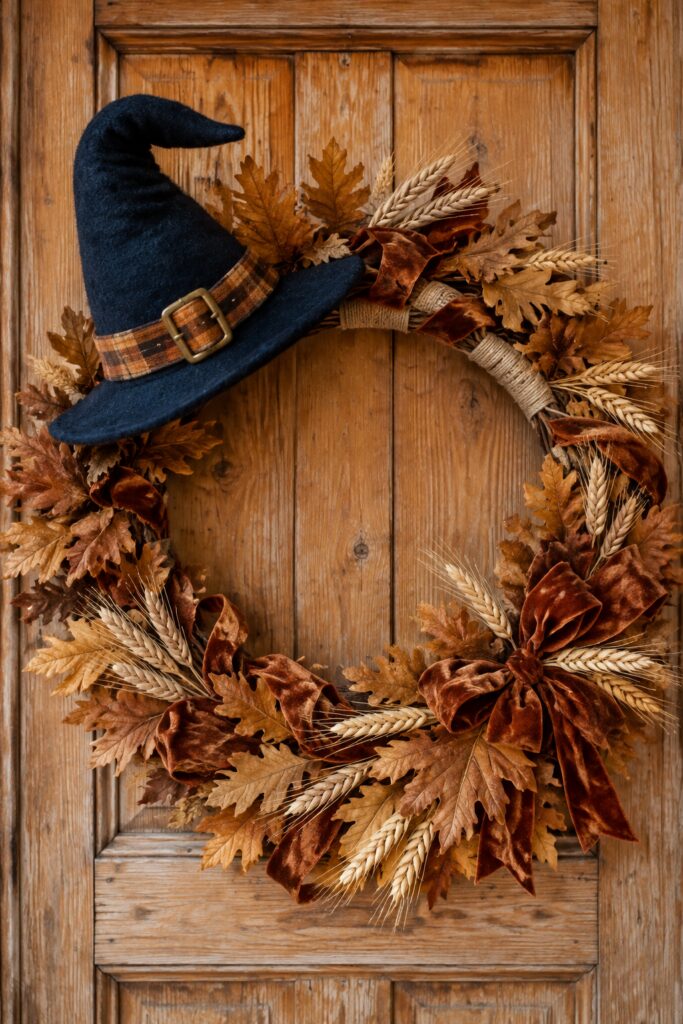
A crooked witch hat perched among autumn leaves gives this wreath the feeling of a harvest gathering with one unexpected guest. Its dark felt-like surface, weathered-looking buckle, and warm plaid band add Halloween character to an otherwise traditional mix of wheat, oak leaves, and rust velvet.
There is plenty to enjoy up close, too. Ribbon disappears beneath the foliage and emerges in soft folds. Pale wheat heads stretch past the leaves. A generous bow settles into the lower right side, balancing the hat without competing with it.
This is a lovely direction for anyone who enjoys farmhouse fall decorating and wants a little witchy personality at the door.
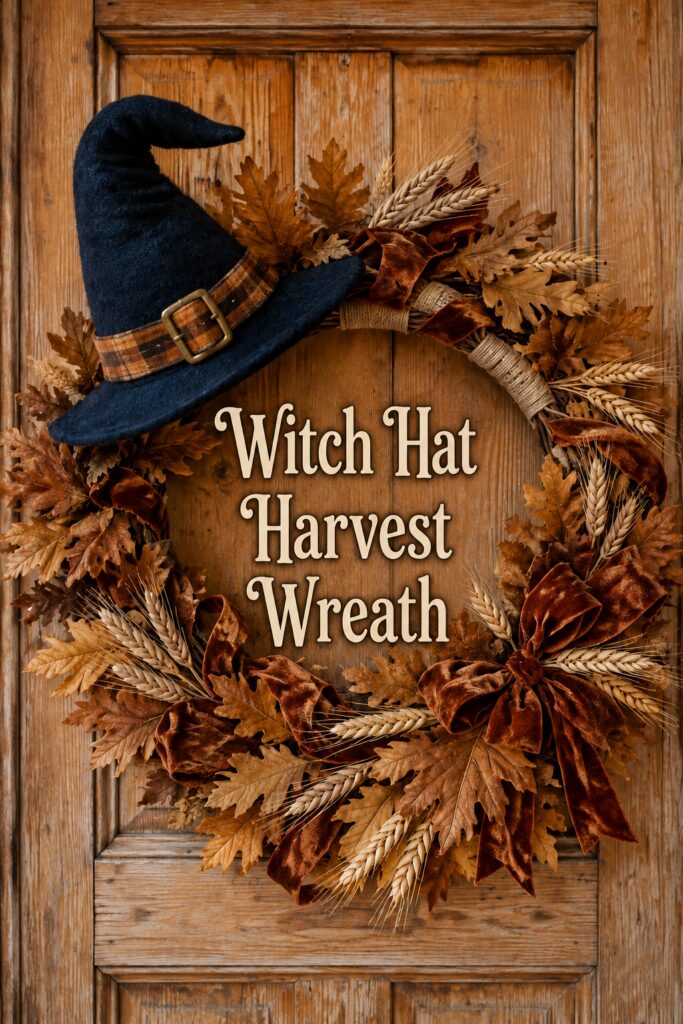
The inspiration image is AI generated. Use it as a guide to recreating the overall effect with similar materials, rather than as a photograph of a finished wreath available to purchase.
A crooked hat makes the harvest details feel like Halloween
The hat does more than introduce a seasonal symbol. Its bent point and tilted brim interrupt the round wreath shape, giving the arrangement a relaxed, slightly mischievous character.
Everything around it stays within a close family of harvest colors. Tobacco brown leaves, pale straw, copper velvet, and the wooden door share a warmth that makes the midnight-colored hat stand out.
The plaid band connects those two parts of the design. Its brown and orange checks echo the foliage, while darker squares relate to the hat. The small buckle supplies just enough metallic detail.
Across from the hat, the large velvet bow provides a second point of interest. This diagonal balance allows the wreath to feel full without requiring identical decorations on both sides.
Start with the hat and build around its proportions
A soft witch hat with a bendable point
Choose a lightweight decorative hat with a broad brim and enough structure to hold its shape. A soft black or very dark navy version will capture the effect more closely than a shiny costume fabric.
Check its size against the wreath opening before attaching anything. The brim should overlap the upper left section while leaving most of the center visible.
If the crown collapses, a small amount of lightweight stuffing can help support it. A few discreet stitches can hold a soft tip in a gentle bend. Aim for an easy curve rather than a sharply folded point.
A warm plaid band and aged-looking buckle
An existing hat can take on a different personality with a strip of brown, rust, and ochre plaid. Wrap the fabric around the crown just above the brim, turning the raw edges underneath for a tidy finish.
A lightweight decorative buckle can suggest the aged brass detail in the image. Choose one that suits the width of the band, and fasten it securely without pulling the fabric out of shape.
Keep the pattern concentrated here. The plaid is more noticeable because the surrounding ribbon and leaves are mostly solid colors.
A vine base with natural twine accents
A sturdy grapevine wreath provides a useful framework for the layered stems and fabric decorations. The inspiration also shows short sections wrapped in pale natural cord along the upper inner curve.
You can suggest that detail by wrapping a few exposed areas with jute or cotton cord. There is no need to cover the whole base, particularly where leaves will conceal it.
Leave the center open enough for the door behind it to become part of the composition.
Oak leaves in weathered autumn shades
Look for foliage with lobed oak shapes and a mixture of tan, brown, and muted golden tones. The leaves should have enough variation to remain distinct when layered together.
Faux stems offer flexibility for arranging. Separate larger sprays into smaller sections so you can direct individual clusters around the curve.
Place some leaves outward and others slightly inward. That uneven edge gives the wreath its gathered appearance without turning it into a rigid band of foliage.
Pale wheat and coppery velvet ribbon
Wheat heads introduce narrow shapes among the broad leaves. Their pale color also helps separate the rust ribbon from the darker foliage.
Use small bundles rather than one thick sheaf. Position the heads so they follow the wreath’s curve, allowing a few fine tips to extend beyond the leaf edges.
For the ribbon, look for rust, cinnamon, or copper velvet with a soft sheen. Wired velvet is useful for holding loose folds; unwired ribbon can work if you secure it at several points.
Weave the ribbon through the harvest layer
Lay the wreath flat and temporarily position the hat at the upper left. Mark where its brim sits, then remove it while arranging the foliage underneath.
Build the leaf layer first, leaving room for the hat and the lower right bow. Tuck wheat bundles between the leaves, varying their direction slightly while maintaining the overall circular movement.
Next, work the ribbon through the arrangement. Secure one end toward the back, draw a loose fold over the foliage, and tuck the next section beneath a leaf cluster. Repeat in a few places rather than wrapping the ribbon tightly around the entire wreath.
This is what gives the velvet its relaxed appearance. Some sections should be visible as broad folds, while others nearly disappear.
Make the main bow separately and place it around the lower right curve. Allow its tails to fall among the leaves, with their ends extending below the wreath.
Finally, return the hat to its position. Attach it to the underlying base at more than one point so the brim does not rotate forward. Sewn loops and ties can provide support for a fabric hat without relying entirely on glue.
Lift the wreath upright before making your final adjustments. Ribbon behaves differently when hanging, and the hat may need another fastening to maintain its tilt.
Style it where the textures can be appreciated
A wooden door complements this palette beautifully, but a cream-painted door would give the foliage more contrast. On a dark door, place a few tan leaves behind the hat’s edge so its silhouette remains easy to see.
Give the bow tails enough clearance from the handle and lock. The hat also projects beyond the wreath, so check that it will not be compressed by a storm door.
For nearby decorations, repeat just one material. A small bundle of wheat in a crock or a plain basket of pumpkins would be enough to connect the entrance without reproducing every detail.
Choose an indoor wall or sheltered doorway for delicate velvet and dried wheat. Materials intended for outdoor use are a better choice where the arrangement will encounter weather.
Shop similar pieces for a witchy harvest doorway
Look for a felt witch hat and autumn plaid
Compare the hat’s brim width with the wreath dimensions. A simple hat with a customized band can capture the idea without requiring an exact finished match.
Shop similar oak leaf stems and wheat bundles
Prioritize leaf shape and restrained colors. Use existing autumn stems where possible, adding wheat to introduce the finer texture.
Add rust velvet ribbon to a vine wreath
Choose enough ribbon for both the loose folds and the main bow. Keeping those details in the same shade helps the arrangement feel connected.
Make the Halloween detail removable
Attach the hat with accessible ties, and the wreath can shift back to a harvest display after Halloween. The plaid supplies its October personality, while the wheat, leaves, and velvet can continue welcoming guests through the rest of fall.