*This post may contain affiliate links for which I earn commissions.*
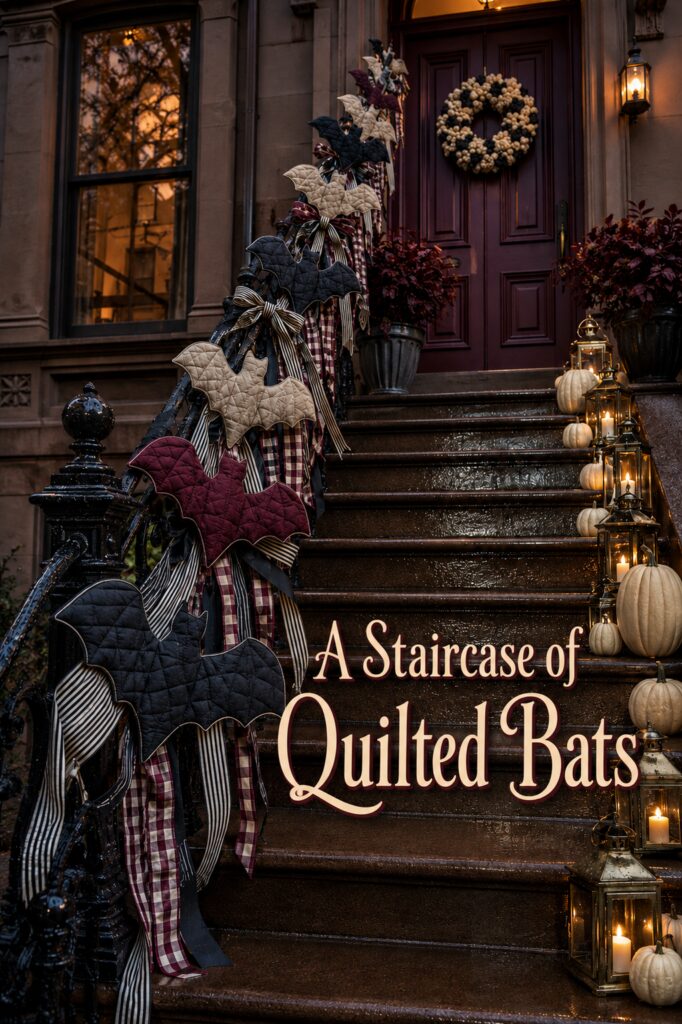
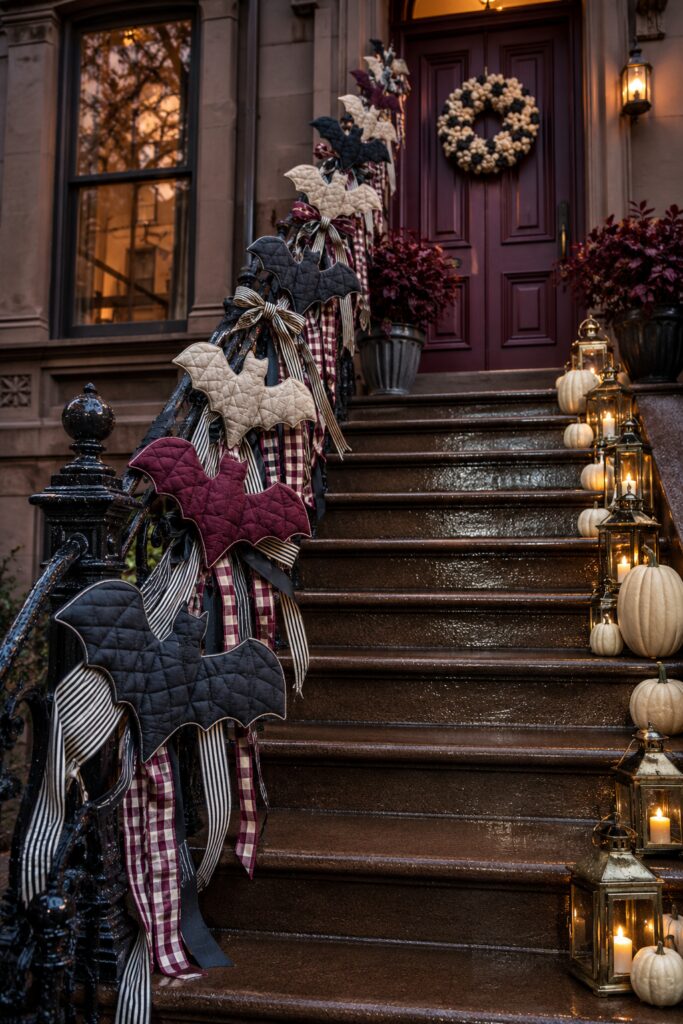
This brownstone staircase transforms an ordinary railing into a sweeping Halloween installation made from quilted bats, trailing ribbons, lantern light, and a restrained collection of ivory pumpkins. Instead of relying on plastic decorations or a familiar orange palette, the design combines handmade textile details with deep burgundy, black, cream, and aged gold.
The bats appear to climb the curving banister toward the front door, giving the entire arrangement direction and movement. Long ribbons flutter beneath their wings, while lanterns and pale pumpkins create a second decorative line along the opposite side of the stairs.
The finished entry feels dramatic but still welcoming. It is imaginative enough to capture attention from the sidewalk, yet its quilted fabric, gingham ribbon, warm candles, and berry wreath give it the comfortable character of something pieced together over many autumns.
This inspiration image was created with AI.
Why This Halloween Staircase Feels So Distinctive
The quilted texture is the most unexpected element. Each bat resembles a miniature textile ornament, complete with softly padded wings, stitched surfaces, and contrasting edging. Black, cream, and burgundy bats alternate up the railing, allowing the shapes to remain visible even after dusk.
The long ribbon tails contribute nearly as much to the design as the bats. Burgundy gingham, black-and-cream stripes, solid black ribbon, and smaller patterned pieces fall at different lengths. Their loose ends soften the hard iron railing and create movement without hiding its architectural detail.
The arrangement also makes smart use of the stairs. The bats climb one side, while ivory pumpkins and lanterns descend the other. This asymmetrical balance keeps the central steps open and turns the full staircase into part of the display.
At the top, a cream-and-black berry wreath and two tall pots of burgundy foliage carry the palette to the front door. These quieter elements prevent the doorway from competing with the elaborate railing.
Make Quilted Bats the Main Feature
Exact quilted bat decorations may be difficult to find, but the shapes can be made with basic sewing supplies. Use solid black, burgundy, and cream fabric so the stitching remains visible. Pre-quilted material offers the fastest approach, while cotton fabric layered with thin batting allows more control over the texture.
Trace several bat silhouettes in different sizes. Each finished bat can be made from two fabric shapes with batting between them. Stitch around the outside, add simple quilting lines across the wings, and finish the edges with narrow piping, binding, or a contrasting decorative stitch.
The image uses generous, softly curved wings rather than pointed, realistic anatomy. That plump silhouette is part of what makes the bats feel charming and handmade.
If sewing is not practical, cut the shapes from felt or use padded fabric ornaments with a similar profile. The repeated silhouette matters more than reproducing every stitch.
Look for Pre-Quilted Fabric
Choose matte fabric with a visible stitched pattern. Black, warm cream, and wine-colored material will reproduce the image’s palette most closely.
Add Bat Templates for Consistent Shapes
A reusable stencil or printable template will help keep the wing proportions consistent while still allowing several sizes.
Build a Ribbon Cascade Beneath the Bats
The ribbon treatment should look abundant but not overly coordinated. Combine at least three patterns so the tails remain visible as they overlap.
Black-and-cream ticking stripes provide the strongest graphic contrast. Burgundy gingham introduces the door color, while solid black ribbon creates darker breaks between the patterns. Narrow metallic or textured ribbon can be added sparingly for another layer.
Tie a relaxed bow beneath each bat, then let several tails fall down the railing. Cut the ends at different lengths. Some can have simple angled cuts, while others can remain softly frayed for a homespun appearance.
The cascade will look more natural if the ribbons occasionally overlap and twist. Avoid straightening every tail or spacing the bows at perfectly equal intervals.
Shop Black-and-Cream Striped Ribbon
Look for fabric ribbon with ticking, cabana, or narrow farmhouse stripes. Wired edges can hold bow loops, but softer unwired ribbon will drape more freely.
Add Burgundy Gingham Ribbon
Select a deep wine or cranberry check rather than a vivid red. The darker shade will connect the railing to the brownstone door and foliage.
Arrange the Cascade Up the Railing
Begin with the largest bat near the bottom, where it can establish the theme at sidewalk level. Continue upward with medium and smaller bats, changing their colors as you go.
Angle some bats slightly toward the stairs and others toward the street. This variation gives the impression that the group is moving upward instead of forming a static row.
Use removable outdoor ties, coated floral wire, or reusable fastening straps to secure each bat and bow to the railing. Attach decorations without scratching painted ironwork, and trim or cover any sharp wire ends.
Keep long ribbon tails away from walking surfaces. The lowest pieces should be secured closely enough that they cannot trail underfoot or catch on the railing gate.
Light the Opposite Side With Lanterns
A series of black and aged-gold lanterns balances the fabric cascade. Their warm glow reflects beautifully from the dark stone steps and gives the pale pumpkins a soft golden cast.
Use several lantern heights rather than repeating one size. Place the tallest lanterns near the upper and lower landings, then position smaller ones between them. This keeps the line of light varied while still guiding the eye toward the door.
Flameless candles with automatic timers are the safest choice for a stairway. They can provide a realistic flicker without exposing ribbons, plants, or visitors to an open flame.
Look for Graduated Outdoor Lanterns
Choose weather-resistant lanterns in black, aged brass, or a brushed black-and-gold finish. Clear panels and warm flameless candles will create the closest visual effect.
Tuck Ivory Pumpkins Between the Lanterns
The pumpkins are deliberately limited to one side of the staircase. This prevents them from competing with the bats and gives the steps a clean, intentional rhythm.
Combine a few large pumpkins with smaller round and elongated shapes. Cream and ivory are more harmonious here than stark white because they relate to the quilted bats, berry wreath, and warm lantern light.
Place the largest pumpkin where the steps widen or beside a tall lantern. Use smaller pumpkins to fill gaps without blocking the walking path.
Add Assorted Ivory Pumpkins
Look for a set with visibly different sizes and shapes. Matte finishes and realistic ribbing will suit the traditional brownstone setting.
Frame the Door With Burgundy Foliage
Tall pots of deep burgundy foliage create a strong transition from the decorated stairway to the wine-colored front door. Their leaves add volume without introducing another busy pattern.
Existing porch planters can be refreshed with artificial burgundy eucalyptus, mums, coleus-style leaves, or dark fall branches. Mixing several leaf shapes will produce a fuller, more natural-looking arrangement.
Keep the planters relatively simple. The railing already carries substantial texture, so the foliage should reinforce the color palette rather than demand equal attention.
Look for Burgundy Outdoor Stems
Choose long stems with flexible branches and foliage that can tolerate a sheltered porch. Dusty wine and plum tones will blend more naturally than saturated red.
Finish the Door With a Berry Wreath
The wreath echoes the round pumpkin forms and softens the dark rectangular door panels. Cream berries dominate, while scattered black berries provide a subtle Halloween reference.
A simple berry wreath is particularly effective because the staircase already contains so many patterns. Avoid adding a large bow unless it is made from one of the ribbons used on the railing.
Center the wreath high enough that it remains visually separate from the foliage below. That small amount of breathing room helps the doorway feel composed.
Shop Cream-and-Black Berry Wreaths
Look for densely clustered berries on a grapevine or twig base. A muted cream-and-black palette will connect the wreath to the quilted bats without overwhelming the door.
Adapt the Look to a Smaller Entry
A large staircase offers plenty of room, but the same concept can work on a shorter railing. Use three quilted bats instead of a full procession, then attach several long ribbon tails beneath each one.
For a porch without railings, arrange the bats vertically on a tall branch secured inside a planter. Another option is to suspend them from removable hooks beside the door, allowing the ribbons to form a narrow cascade.
Add two lanterns and three ivory pumpkins on the opposite side. The design will still feel balanced as long as the quilted shapes rise vertically and the warm light remains closer to the ground.
A Final Styling Thought
Let one handmade detail lead the display. When the quilted bats remain the clear focal point, ribbons, pumpkins, lanterns, foliage, and the wreath can support the story without making the entrance feel crowded.