*This post may contain affiliate links for which I earn commissions.*
A covered dogtrot passage is naturally suited to seasonal decorating. Its long walkway, repeated doors, open rafters, and view into the garden create a sense of arrival before anyone reaches the entrance.
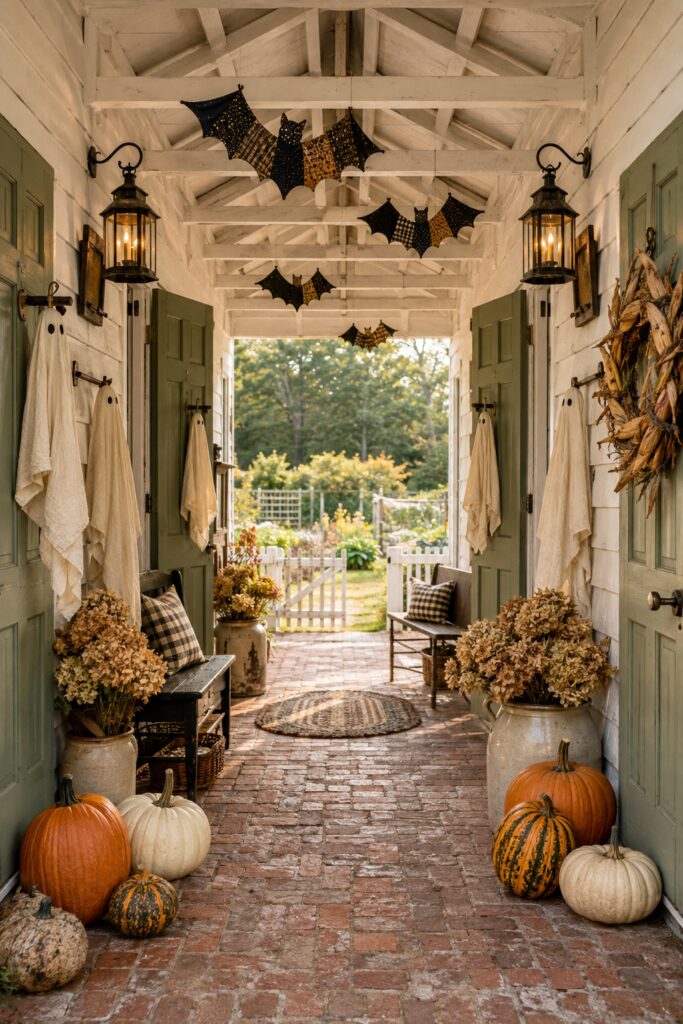
In this farmhouse Halloween scene, quilted bats appear to fly beneath the ceiling beams while cream fabric ghosts wait beside the doors. Glowing black lanterns, gathered pumpkins, crock planters, checked pillows, and dried hydrangeas make the passage feel inviting rather than eerie.
Although this look takes advantage of a traditional dogtrot layout, its ideas can be adapted to a covered porch, breezeway, enclosed entry, apartment hallway, or mudroom. The essential approach is to decorate the path through the space, not just the doorway at the end.
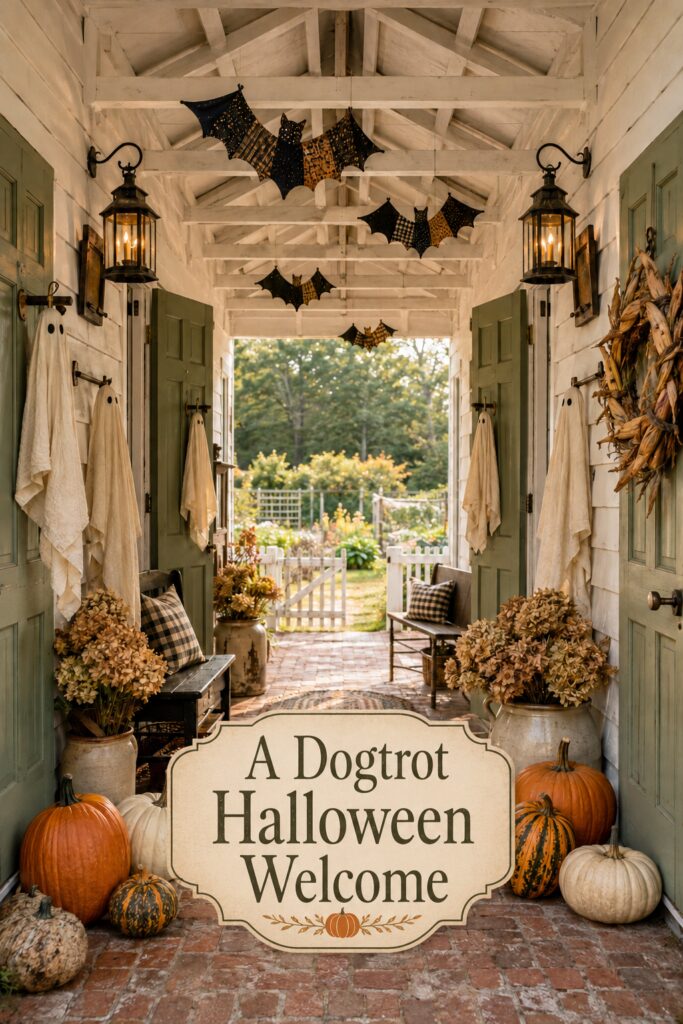
Image disclosure: This decorating inspiration image was created with AI.
What Makes This Farmhouse Halloween Entry Work
The long passage becomes part of the display
The decorations follow the architecture from front to back. Large bats hang closest to the viewer, with progressively smaller ones continuing toward the garden. Ghosts repeat along both walls, and pumpkin groupings frame the beginning of the walkway.
This arrangement gives the eye a clear route through the space. It also makes the entry feel decorated from every viewpoint rather than concentrated around one door.
In a shorter entry, the same idea might use three bats overhead, one ghost on either side, and pumpkins gathered near the threshold.
Quilted bats add pattern overhead
The bats are the most unusual part of the design. Their black, ochre, plaid, and patchwork surfaces resemble old quilt pieces transformed into flying decorations.
They contrast with the pale rafters and draw attention to the full height of the passage. Because their coloring coordinates with the checked pillows and pumpkins below, they do not feel disconnected from the farmhouse setting.
A handmade version could be created from stiff felt, quilted fabric, fusible interfacing, and nearly invisible hanging line. The bats should remain lightweight and should never hang near hot bulbs or obstruct doorways.
Cream ghosts soften the darker accents
Rather than using harsh white or gray, the hanging ghosts are made from warm cream fabric with subtle woven texture. They resemble old linens or small quilts draped over simple forms.
Their black oval eyes connect them to the bats and lantern frames. Their uncomplicated faces keep the scene playful enough for a family entry.
The ghosts are positioned at varying heights, which gives them more personality than an identical row would have.
Symmetry supports the farmhouse architecture
The paired sage doors, matching lantern sconces, benches, planters, and pumpkin groups establish balance. Within that framework, the decorations are allowed to vary.
One side has a larger orange pumpkin and more visible bench seating. The other includes a striped gourd and a larger crock arrangement. This combination of symmetry and variation keeps the passage orderly without making it rigid.
Natural textures keep Halloween grounded
Brick, dried hydrangeas, corn husks, woven baskets, braided fibers, pottery crocks, quilts, and pumpkins make up most of the visible texture.
These elements give the passage a late-harvest feeling that could remain in place throughout fall. The bats and ghosts provide the Halloween layer, while the rest of the arrangement can continue into November.
Key Pieces for This Dogtrot Halloween Look
Patchwork Hanging Bats
The overhead bats need to be large enough to remain visible against the rafters. Mix black fabric with mustard, brown, cream, and small-scale checks.
For the dimensional effect, use stiff felt or lightweight foam as the base. Cover selected sections with fabric, or join fabric scraps before cutting the bat shape. Bend the wings slightly so they do not hang completely flat.
Draped Cream Ghosts
Use cream muslin, gauze, cheesecloth, or lightweight textured fabric. A round foam form or small lightweight ball can create the head.
Keep the eyes simple and position each ghost on a sturdy hook. If the area is exposed to wind, secure the fabric discreetly so it cannot blow across a doorway or become tangled in a lantern.
Black Farmhouse Lantern Sconces
The tall black lanterns frame the passage and supply warm evening light. Their traditional silhouettes suit the board walls, paneled doors, and old hardware.
If replacing permanent fixtures is not practical, similar battery-operated wall lanterns or hanging candle lanterns could imitate the effect without electrical work.
Crock Planters with Dried Hydrangeas
Large cream pottery vessels give the lower arrangement weight and help balance the tall, narrow ghosts. Their aged surfaces feel appropriate beside the brick floor and painted wood.
Fill the crocks generously with dried-looking hydrangeas in oatmeal, faded tan, or muted green. The arrangements should be full but not so wide that they narrow the walking path.
Mixed Orange and White Pumpkins
The pumpkin groupings contain traditional orange, creamy white, green-striped, and mottled varieties. Their natural differences make the entry feel gathered from a farm stand rather than assembled from matching decor sets.
Use three pumpkins on each side, varying the heights and shapes. A large orange pumpkin can provide the anchor, with smaller white and striped gourds filling the lower spaces.
Checked Pillows and a Braided Rug
Black-and-cream checked pillows repeat the patterns found in the quilted bats. The oval braided rug adds another quiet layer of country texture without interrupting the brick walkway.
Choose outdoor-safe textiles if the passage receives moisture. Keep the rug low-profile and use a suitable pad so it does not become a tripping hazard.
Style the Look in a Real Entryway
Begin by protecting the walking path. Open every door, measure the narrowest part of the entry, and make certain that planters and pumpkins will not interfere with foot traffic.
Hang the largest bat near the front of the passage. Continue with smaller bats at varied heights, creating a loose flight path toward the far opening. Avoid spacing them in a perfectly straight line.
Add ghosts to wall hooks or secure mounting points. Alternate their heights and fabric lengths. Leave enough clearance around lanterns and electrical fixtures.
Place one large crock near each end of the seating area. Add dried-looking hydrangeas, then position the benches slightly behind or beside them.
Arrange pumpkins near the front corners instead of scattering them through the center. This frames the entrance while keeping the brick path open.
Finish with checked pillows and a small braided rug. The textiles should repeat the black, cream, and warm brown colors found overhead, helping the upper and lower parts of the display feel connected.
Shop Similar Pieces
Gather Materials for Patchwork Hanging Bats
Combine stiff black felt, plaid fabric remnants, fusible interfacing, and clear hanging line to make lightweight overhead bats.
Look for Cream Hanging Ghosts
Choose ghosts with simple faces, soft draping, and flexible hanging loops that can be attached to wall hooks.
Shop Black Farmhouse Wall Lanterns
Look for traditional black frames, clear or seeded glass, and warm bulbs that suit a covered farmhouse entry.
Add Crock Planters and Dried Hydrangeas
Pair aged cream pottery with full bunches of tan or faded-green hydrangea stems.
Shop Mixed Farmhouse Pumpkins
Combine orange, white, striped, and mottled pumpkins in several sizes rather than using one uniform set.
Look for a Small Oval Braided Rug
Choose black, tan, or brown braided fibers that complement brick flooring and sage-painted doors.
Final Styling Tip
Use the entry’s natural lines as your guide. When the bats, ghosts, pumpkins, and lanterns lead visitors comfortably through the space, the decorations feel like part of the farmhouse rather than additions placed around it.