*This post may contain affiliate links for which I earn commissions.*
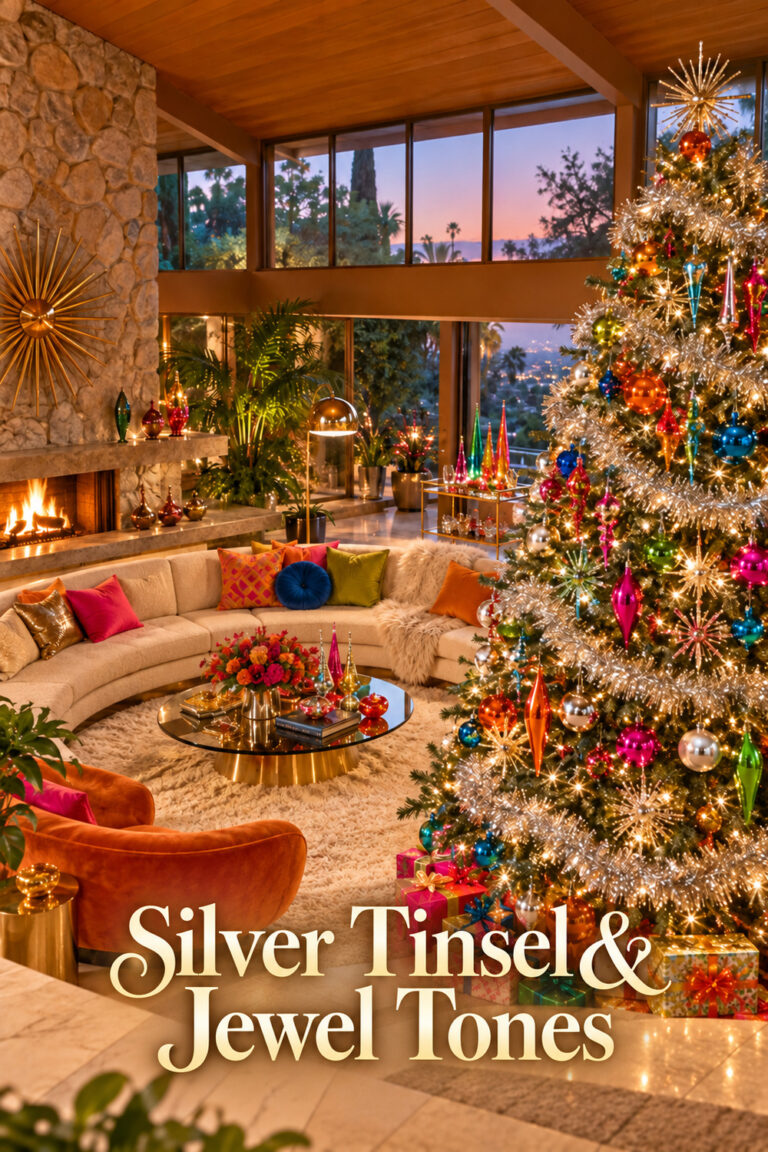
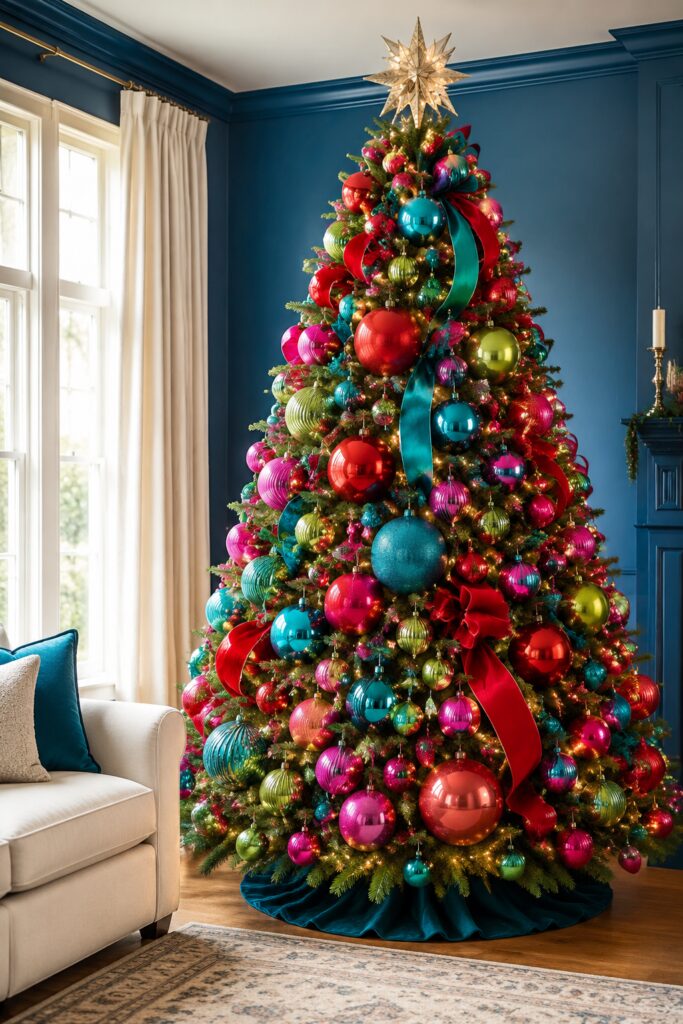
This exuberant Christmas tree proves that traditional holiday decorating can feel elegant without relying on a restrained palette. Oversized ornaments in turquoise, ruby red, fuchsia, lime green, and warm coral cover nearly every visible branch, creating a lavish display with exceptional depth and presence.
Wide red and teal ribbons cascade through the tree, while hundreds of warm lights soften the stronger colors. A dimensional starburst topper and deep teal velvet tree skirt complete the design. Against the dark blue walls, the finished tree feels dramatic, polished, and wonderfully festive.
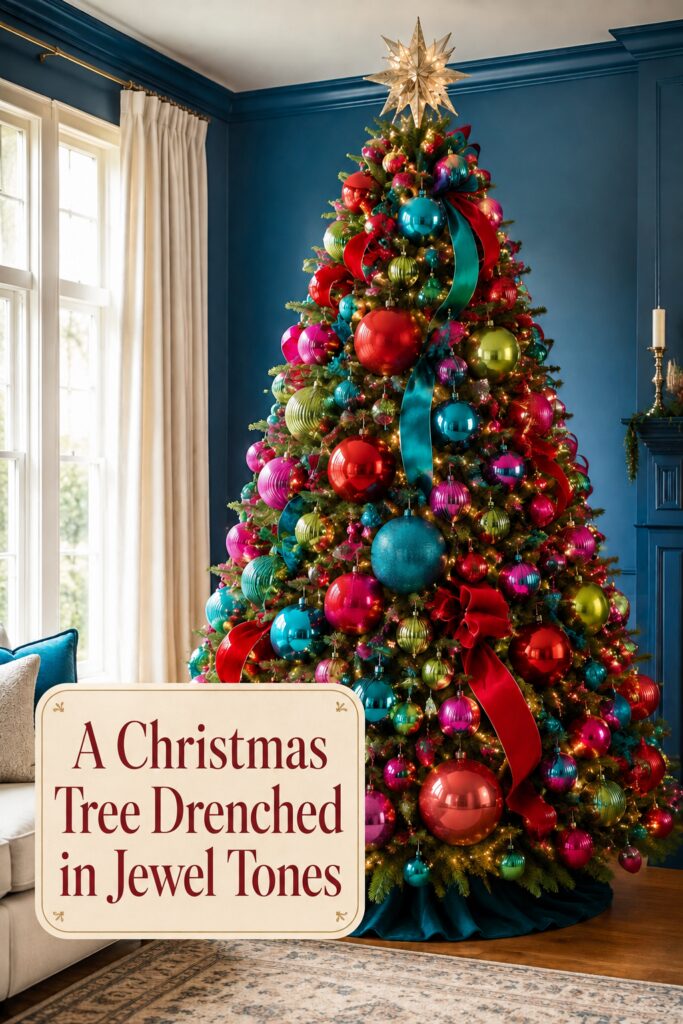
The inspiration image featured in this post was created with AI.
What Makes This Ornament-Filled Tree Work
The tree’s impact comes from more than the number of decorations. Scale, repetition, placement, and lighting all work together.
The oversized ornaments establish the design first. They are distributed from the upper branches to the base rather than being concentrated only near the bottom. Medium and small ornaments then fill the spaces around them, giving the tree a dense appearance without hiding every bit of greenery.
Color is repeated evenly across the tree. Turquoise appears near the top, through the middle, and around the base. The same is true of red, pink, and green. This repetition allows the eye to move through the entire arrangement instead of stopping at one concentrated patch.
The warm lights are another important element. Their golden glow connects the jewel tones and prevents the blue, pink, and lime ornaments from feeling cold or disconnected.
Build the Palette Around Saturated Jewel Tones
Start with a defined group of four or five colors. This tree combines turquoise, fuchsia, ruby red, lime green, and coral, with small touches of gold.
Turquoise and red serve as the dominant colors. They appear in the largest ornaments and in the wide ribbons, giving the design a clear foundation. Pink and lime add energy, while coral introduces a softer transition between the cooler blue and hotter red tones.
You do not need to find one enormous ornament collection containing every shade. Combining several smaller coordinated sets often produces a more interesting assortment of sizes and finishes.
Glossy, ribbed, matte, glittered, and subtly textured ornaments can all work together when the palette remains consistent.
Begin With the Largest Ornaments
Oversized balls are the defining feature of this tree. Some are nearly as wide as the visible sections of the tree itself, making them read almost like decorative sculptures.
Place the largest ornaments before adding ribbon or smaller decorations. Start with one near the upper third, several across the middle, and the remaining pieces around the lower branches.
Nestle each ornament slightly into the greenery instead of hanging it from the outermost tip of a branch. Floral wire or sturdy ornament ties can help secure large pieces close to the tree’s center.
Keep the heaviest-looking ornaments away from delicate branch tips. Lightweight shatterproof balls are a practical choice because they provide the necessary scale without pulling branches downward.
Look for Oversized Shatterproof Ornaments
Choose several diameters if possible. A combination of approximately 5-inch, 6-inch, and 8-inch balls will look more natural than repeating one jumbo size throughout the tree.
Fill the Gaps With Smaller Jewel-Tone Baubles
Once the largest ornaments are secure, add medium balls around them. Use these pieces to repeat each color from top to bottom.
Smaller ornaments belong deeper inside the tree as well as along the outer branches. Decorations placed near the trunk catch the lights and create the impression that the tree glows from within.
Avoid placing every ornament at the same depth. Some should sit close to the trunk, some midway through the branches, and a final group near the outer greenery. This layering creates the abundant effect visible in the inspiration image.
Ribbed ornaments are especially useful because their grooves catch and reflect nearby lights. Glossy balls add sharp highlights, while glittered pieces produce a softer sparkle.
Shop Similar Jewel-Tone Ornament Sets
Look for assortments that include at least three of the main colors. Additional single-color sets can fill any gaps in the palette.
Weave Wide Velvet Ribbon Through the Branches
The ribbon is not wrapped around the tree in one continuous spiral. Instead, broad sections appear to emerge from the branches, form generous loops, and disappear again.
This technique makes the ribbon feel integrated into the tree rather than laid on top of it.
Cut the ribbon into manageable lengths. Secure one end inside the tree, form a loose loop, and tuck the ribbon back into the greenery several inches below. Repeat the process in staggered sections.
Use wired ribbon so the loops can hold their shape. Red velvet provides warmth and richness, while teal ribbon repeats the room’s blue walls and the largest turquoise ornaments.
The two ribbon colors do not need to follow identical paths. Let them cross occasionally, but distribute each one throughout the full height of the tree.
Add Red and Teal Velvet Ribbon
A width of approximately 4 inches creates the dramatic folds shown in the image. Narrow ribbon may disappear among ornaments of this scale.
Crown the Tree With a Dimensional Star
The glowing starburst topper provides a strong finishing point without introducing another saturated color. Its warm metallic finish also connects with the golden tree lights.
Look for a dimensional star with long, narrow points rather than a flat five-point silhouette. A Moravian-style or faceted star can produce a similar architectural effect.
Check the topper’s dimensions and weight before purchasing. A large topper needs enough visual presence to balance the ornaments, but it must still be supported safely by the upper tree branches.
If the top stem bends, attach the star to a sturdy dowel secured vertically against the tree trunk.
Look for a Lighted Starburst Tree Topper
Warm white illumination will coordinate better with the tree lights than a cool blue-white glow.
Use Plenty of Warm White Lights
Dense decorations can block part of a tree’s original lighting. Additional strands may be needed to keep the finished arrangement luminous.
Wrap lights closer to the trunk first, then move outward along selected branches. This creates multiple layers of illumination instead of placing every bulb along the tree’s surface.
Warm white lights complement the red and coral ornaments while softening turquoise and lime. They also create beautiful reflections in the glossy balls.
If using flashing or animated lights, choose a subtle twinkle setting. The ornaments already provide considerable visual movement, so an aggressive flashing pattern could make the tree feel restless.
Add Warm White Cluster Lights
Cluster-style strands place bulbs closer together and can produce the concentrated glow seen between the ornaments.
Finish the Base With Deep Teal Velvet
The tree skirt is easy to overlook, but it plays an important role here. Its deep teal color grounds the tree and connects it to the room’s painted walls.
Velvet is particularly effective because its soft surface contrasts with the shiny ornaments. The gently gathered edge also echoes the curves of the ribbon without introducing another pattern.
Choose a skirt wide enough to extend beyond the lowest branches. A crowded tree benefits from a simple base, so avoid heavy embroidery, plaid, or busy appliqué.
Look for a Teal Velvet Christmas Tree Skirt
Seek a generous diameter, rich blue-green color, and enough fabric to form soft folds around the stand.
Adapt the Look to a Real Home
A tree this full requires a considerable number of ornaments, but the idea can be scaled down. Use six to eight jumbo ornaments on an average tree, then supplement them with pieces you already own.
You can also simplify the palette to turquoise, red, and pink while retaining the same exuberant mood. Repeating each shade evenly matters more than using every color shown in the image.
Arrange the tree in stages and photograph it after each layer. A photograph can reveal color clusters, gaps, or uneven ribbon placement that are difficult to notice while standing close to the branches.
Final Styling Tip
Treat the jumbo ornaments as the tree’s framework rather than its finishing touches. Once those anchors are balanced, the ribbon, smaller baubles, lights, and star can be layered around them with much greater control.