*This post may contain affiliate links for which I earn commissions.*
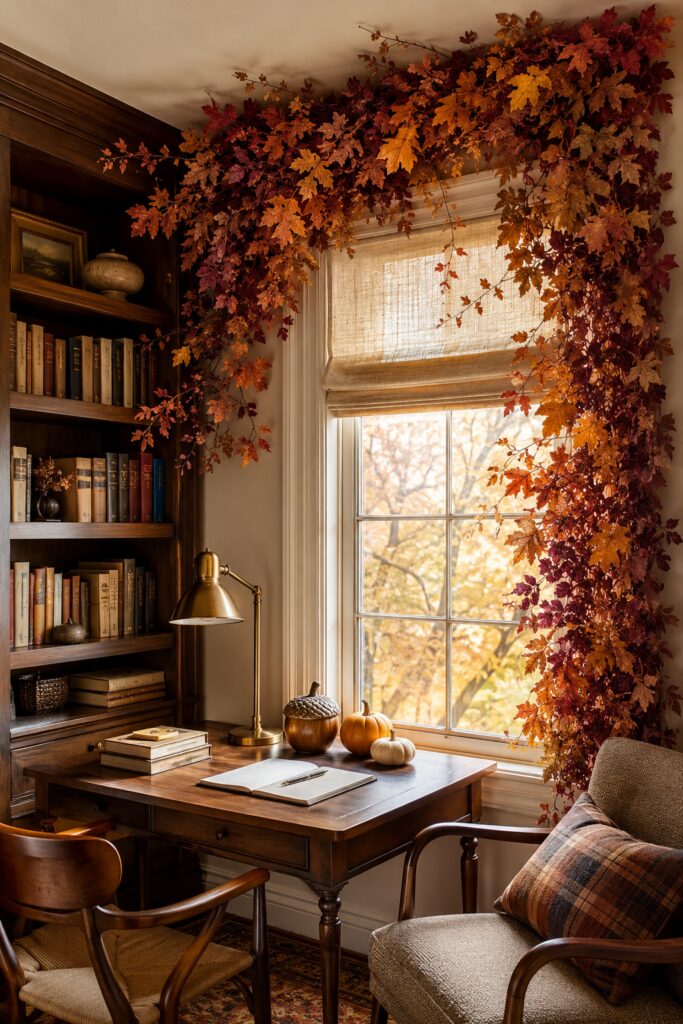
A small home office becomes an immersive autumn retreat in this scene, thanks to a dense canopy of oak and maple leaves that sweeps over the window and cascades nearly to the floor.
The leaves move through deep burgundy, rust, copper, amber, and muted gold. Warm daylight passing through the window intensifies those shades, while dark wood furniture, old books, a brass task lamp, and a classic plaid pillow give the room the feeling of a private library in fall.
The leafy installation is dramatic, but the desk remains simple and usable. Just a few pumpkins and an oversized acorn decorate the work surface, allowing the window canopy to remain the unmistakable focal point.
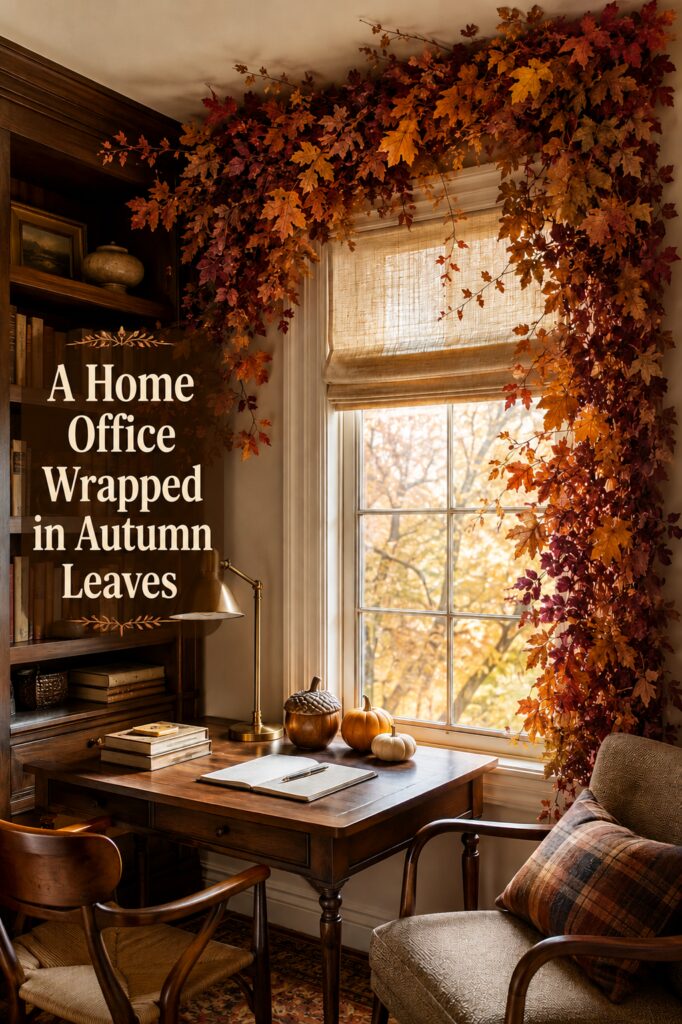
This inspiration image was created with AI. It is intended to help you imagine a similar seasonal workspace using artificial garlands, leaf stems, removable mounting supplies, and understated harvest accents.
Why the Autumn Canopy Feels So Enveloping
The installation works because it does more than outline the window. It gathers densely near the ceiling, extends toward the adjacent bookcase, and spills down the right side in a long irregular cascade.
This creates the sense that fall foliage is growing into the room rather than hanging as a conventional garland.
The leaves also vary in size, shape, direction, and color. Large oak leaves create volume, while smaller maple leaves and delicate branching stems soften the outer edges.
The canopy is deliberately asymmetrical. It is fullest across the upper-right corner, then narrows as it travels toward the bookcase. On the right, the foliage becomes a waterfall of trailing leaves.
That uneven composition makes the arrangement feel more natural than matching garlands hung identically on both sides.
Build the Foundation With Flexible Garlands
Several flexible autumn garlands can form the base of the installation. Choose wired garlands that can be bent around the upper window trim without springing back into a straight line.
Begin with darker burgundy or brown foliage near the outer edges. Place orange and golden leaves closer to the window, where sunlight will bring out their warmer tones.
The garlands do not need to match. Combining oak, maple, and smaller trailing leaves will create more believable depth than repeating one identical strand.
Before mounting anything, arrange the garlands on the floor. Overlap their ends and determine where the densest areas should appear.
Measure the window and calculate the total garland length needed. The canopy shown in the image would require substantially more foliage than a single six-foot strand.
Add Fullness With Individual Leaf Stems
Garlands establish the shape, but individual stems create the lush, layered appearance.
Insert wired picks between the base garlands, pointing some outward and allowing others to trail downward. Long stems can extend toward the bookcase or across the ceiling.
Use deeper leaves behind the arrangement and lighter gold or orange pieces near the front. This creates depth and prevents the canopy from looking like one flat band.
Leave a few stems extending beyond the main outline. Their irregular tips help disguise the attachment points and give the installation a naturally overgrown quality.
If the arrangement looks too uniform, add several smaller burgundy branches and delicate berry-free sprigs. Not every stem needs to be covered with large leaves.
Create the Long Side Cascade
The foliage on the right side of the window reaches from the upper corner almost to the chair. This vertical section is essential because it turns a simple window garland into a canopy.
Attach the longest strands near the upper corner and allow them to fall in loose curves. Layer shorter pieces over them to hide the starting points.
Keep the foliage away from the glass and any window hardware. The window should still open safely if it is intended for ventilation.
The woven shade also needs room to move. Test it throughout its full range before completing the arrangement.
A shorter cascade may be more practical in a working office. Ending it at windowsill height will preserve the effect while keeping it away from chairs, outlets, and floor-level traffic.
Mount the Leaves Without Damaging the Trim
A dense artificial canopy can become heavier than expected. Do not assume that small adhesive dots will support the finished arrangement.
Determine the approximate weight before selecting hooks or clips. Use several attachment points so the load is distributed rather than concentrated in one area.
Removable decorating clips may work for lightweight strands on compatible surfaces. Heavier installations may require a more secure method appropriate for the wall, ceiling, or trim.
Always follow the mounting product’s instructions and weight limits. Test adhesive products in an inconspicuous place and allow them to cure for the recommended amount of time.
Keep foliage away from light bulbs, heaters, vents, and other heat sources. Make sure the installation does not interfere with smoke detectors, sprinklers, or necessary ventilation.
Use the Window Light as Part of the Design
The location of the canopy is especially effective because daylight passes through the leaves.
Translucent fabric leaves will glow more naturally than thick, opaque plastic. Look for varied color within each leaf rather than one solid printed shade.
Place several golden leaves where direct light reaches them. Reserve the darkest burgundy pieces for areas against the white wall, where their silhouettes will remain visible.
A natural woven shade filters the sunlight and reinforces the warm neutral palette. The shade does not need to be replaced if the room already has simple window coverings. The leaf canopy can be adapted to what is present.
Keep the Desk Decor Small and Sculptural
Only three harvest pieces sit on the desk: a large acorn, one orange pumpkin, and one smaller white pumpkin.
Their rounded forms contrast with the branching foliage without requiring a conventional centerpiece. They also leave enough space for an open notebook, lamp, and stack of books.
Use an odd-numbered grouping and vary the heights. Place the tallest object toward the back and the smallest slightly forward.
Choose matte or softly textured pieces instead of glossy decorations. Wood, ceramic, resin, or velvet will complement the traditional office furniture.
Avoid scattering loose leaves across the work surface. The overhead canopy already supplies abundant texture, and a clear desk will be easier to use.
Bring In Warm Brass Light
The antique-brass task lamp adds a small metallic highlight against the dark wood. Its curved shade and adjustable arm suit the traditional office without competing with the foliage.
A warm bulb will preserve the golden atmosphere after sunset. Choose a color temperature that feels comfortable for reading and desk work.
Keep the lamp and its bulb well away from artificial leaves. The canopy should never rest against the shade or extend over a hot light source.
If an existing lamp has the right shape but the wrong finish, changing only the shade or selecting a compatible lower-temperature LED bulb may be enough to integrate it into the scene.
Repeat the Fall Palette With Plaid
The reading chair carries a single plaid pillow in rust, brown, cream, and charcoal. It repeats the foliage colors without adding another botanical pattern.
A pillow cover is an easy seasonal change because it can be stored flat after fall. Look for woven fabric with a subtle texture rather than a flat printed plaid.
Keep the chair’s other upholstery neutral. The richly colored canopy needs a quiet foundation, and too many patterned textiles could make the office feel crowded.
Let Dark Wood Ground the Foliage
The wooden desk, chairs, and bookcase give the room its substantial, library-like character. They balance the abundance of artificial leaves and prevent the installation from feeling like temporary party decor.
You do not need an entire matching furniture set to reproduce this mood. A wood desk, a bookcase, or even a few leather-bound books can provide enough visual weight.
Woven baskets and a natural-fiber shade introduce lighter brown tones that bridge the dark furniture and golden foliage.
Key Pieces for Recreating the Office
The most useful elements are:
- Flexible fall garlands in burgundy, rust, and gold
- Individual oak and maple leaf stems
- Removable clips or suitable mounting hardware
- A warm brass desk lamp
- Small pumpkins and an oversized acorn accent
- A rust and brown plaid pillow cover
The canopy can be scaled to one upper corner of the window. Preserving the layered colors and one trailing side will communicate the idea without requiring a room-sized installation.
How to Assemble the Canopy
Measure the window, ceiling clearance, and distance to nearby furniture. Confirm that the shade and window can still operate.
Install the darkest base garlands first. Build the shape across the upper trim and extend it toward one adjacent wall or bookcase.
Add gold, rust, and orange garlands over the darker layer. Insert individual stems to fill gaps and create irregular edges.
Build the vertical cascade last, beginning with the longest strands. Step back frequently to make sure the installation feels full without obscuring too much of the window.
Finish the room with three small desk accents, a plaid pillow, and warm task lighting.
Shop Layered Fall Leaf Garlands
Look for wired garlands containing several leaf shapes and multiple shades of burgundy, rust, orange, gold, and brown.
Add Oak and Maple Leaf Stems
Use longer artificial branches to create the canopy’s irregular outer edges and the cascading section beside the window.
Find Clips for a Removable Installation
Choose mounting supplies based on the total weight, surface material, and manufacturer’s instructions. Use enough attachment points to distribute the load.
Bring In an Antique-Brass Desk Lamp
A warm metal task lamp will complement dark wood furniture and make the office feel inviting after daylight fades.
Add Small Harvest Accents to the Desk
Group an orange pumpkin, a smaller white pumpkin, and one acorn-shaped object for a restrained seasonal arrangement.
Finish the Reading Chair With Plaid
A rust, brown, cream, and charcoal plaid pillow cover can carry the foliage palette into the lower part of the room.
Final Styling Tip
Build the canopy in layers from dark to light. Deep burgundy foliage creates the shadowed foundation, while a smaller number of golden leaves placed near the window will make the entire arrangement appear illuminated.