*This post may contain affiliate links for which I earn commissions.*
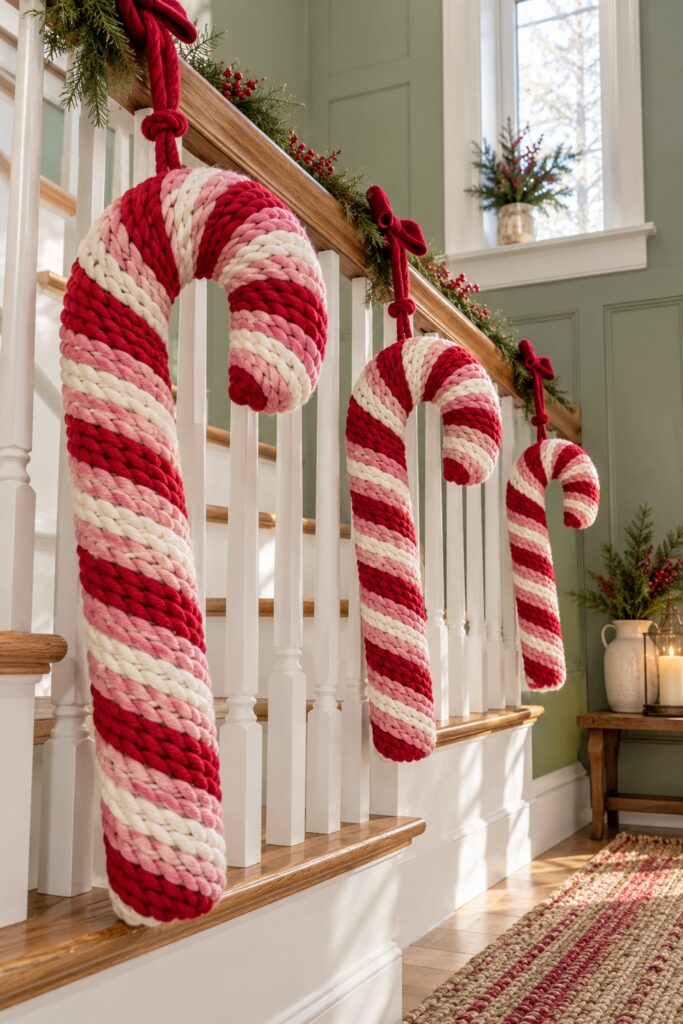
Three oversized candy canes follow the rise of this cottage staircase, with red, pink, and ivory yarn giving their familiar stripes a softer finish. The nearest cane is large enough to show the individual strands. Two smaller companions carry the same curved shape farther up the rail, so the display has movement without needing lots of different ornaments.
The oak handrail, white balusters, and sage wall make a quiet setting for all that texture. A little greenery adds Christmas context, but the yarn is the part worth noticing. You can adapt the idea through scale, repetition, and a carefully chosen hanging position rather than duplicating the whole staircase.
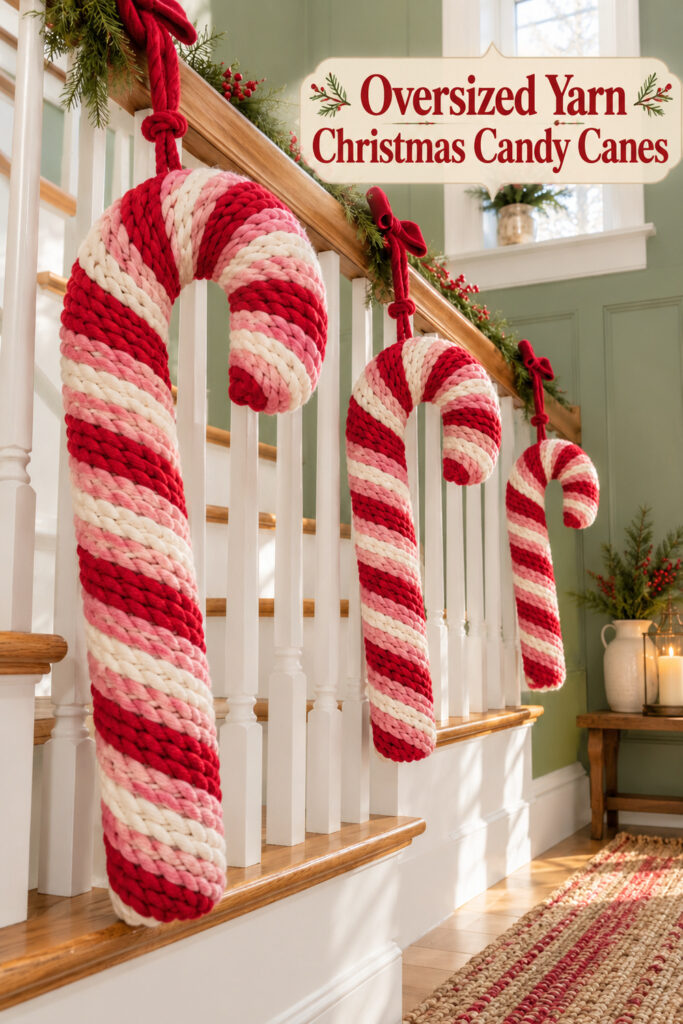
The inspiration image was created with AI and represents a decorating concept rather than actual products shown for sale.
Why the Repeated Candy Cane Shape Works
A staircase already gives your eye a diagonal line to follow. Repeating one curved shape along that line makes the decoration feel connected to the architecture. The large foreground cane introduces the idea, while the smaller ones continue it. Their curved tops soften the straight balusters and the hard edge of the wooden rail.
Find Chunky Cotton Yarn
Browse current Amazon options that can help you recreate this look.
Browse Chunky Cotton Yarn on Amazon →As an Amazon Associate I earn from qualifying purchases.
Pink is the small change that makes this palette distinctive. Red and ivory still suggest traditional candy stripes, but the pink bridges them and reduces the stark contrast. You could use a softer rose or a stronger raspberry depending on your existing decorations. Keep the lighter strand visible so the spiral pattern remains readable.
The thick yarn gives the shapes substance. A thin ribbon wrapped around a narrow form could repeat the colors, yet it wouldn’t have the same chunky appearance. If texture is what drew you to this inspiration, make that the priority when choosing similar pieces. Other details, including the exact shade of the wall, can be left to your own home.
Key Pieces for the Yarn Candy Cane Display
Oversized Candy Cane Forms
A finished textile candy cane or a suitable lightweight form can establish the silhouette. Look for a clear curve and enough thickness that the stripes don’t become a tiny surface pattern. The image is imagined, so an exact braided version shouldn’t be assumed available. Similar decorations can achieve the same rhythm with a different yarn arrangement.
For a handmade approach, the support needs to hold its curve under the chosen covering. Select a form intended for decorative use rather than improvising a heavy hanging object over a stairwell. Check how its size relates to the baluster spacing. A form that looks manageable on a table can become awkward once its curved top sits beside a moving hand.
Red Pink and Ivory Yarn
Choose yarn with a visible twist or braid if you want to retain the substantial surface. Lay the three colors next to one another before wrapping or assembling anything. A cream that looks gentle alone can seem yellow beside a cool pink. Viewing them together in the stairway light helps avoid that surprise.
The strands don’t need to have identical color strength, but similar thickness will give a more balanced surface. If one is much finer, it can disappear between larger strands. A coordinated cord or braided textile decoration offers another route when separate yarn components are more work than you want to take on.
Soft Hanging Ties
Red ties continue the strongest stripe color and keep the attachment visually connected to the candy canes. Similar fabric ties or suitable cord can work, provided the attachment method suits the object and location. A bow is a decorative finish, not proof that a hanging piece is securely supported. Check the actual fixing separately.
Place decorative pieces on the outside face of the balustrade only where they won’t reduce access to the handrail or project into the stairs. If that can’t be achieved on your staircase, use the same grouping on a wall rail or a broad landing wall instead. The repeating shape can survive a change of setting.
Restrained Evergreen Garland
A slim line of greenery supports the candy cane theme in the inspiration. Small red berry details relate to the yarn, while the branches add a finer texture beside the thick strands. Choose garland with a manageable profile. A deep, bulky swag would compete with the canes and can make a handrail harder to use.
You can also leave greenery off the stair rail and place a small arrangement on the landing. This is particularly useful when the handrail needs to stay completely clear. The decorating effect comes mainly from the curved stripes, so preserving the safe use of the stairs won’t cost you the central idea.
Arrange the Canes Around Your Own Staircase
Start by checking the stairway in everyday use. Note where people grip the rail, where bags brush the balusters, and how much space exists outside the railing. Those practical details should decide whether this is an appropriate location at all. Never narrow the walking surface or obstruct a handhold for the sake of a photograph.
If the location works, test the largest shape first using a safe temporary arrangement supported from the floor where possible. Stand at the normal approach and look at the curved top as well as the straight lower section. It should read as a whole candy cane, rather than as a striped tube with its hook hidden behind greenery.
Next, add the smaller shapes at a rhythm that suits the railing. The image uses three, but a short run might need only two. An evenly repeated motif matters more than a fixed count. Leave visible balusters between decorations so the architecture still frames the textile pieces.
Consider the lowest ends from a child’s height as well as an adult’s view. Hanging ornaments should stay out of reach where pulling would create a problem. Avoid loose loops near moving people, and check the setup again after the ties settle. A wall display away from the stair route is a sensible alternative for active households.
Let nearby furniture remain quiet. In the inspiration, sage paint and pale trim already provide the backdrop. You can repeat red in a small arrangement elsewhere, but there’s no need to add stripes to rugs, cushions, and windows as well. Too many matching patterns would dilute the effect of the oversized canes.
Look at the display in daytime and under the lighting you actually use in the evening. Deep red can become less distinct in dim light, while ivory continues to define the spiral. If the whole group seems heavy after dark, increasing the visible light-colored yarn is more useful than adding more ornaments around it.
Shop Similar Pieces for Textured Christmas Stripes
Look for Lightweight Candy Cane Decorations
Compare overall size, construction, and hanging provisions before considering small surface details. A securely supported textile version is a better starting point than a much heavier object chosen only for its outline. Similar shapes can express the idea without pretending to be exact matches to the inspiration.
Shop Similar Chunky Yarn and Decorative Cord
Check the strand thickness and texture in close views, then assess the colors together. Yarn or cord samples can help if the display needs to coordinate with existing ornaments. The combination should remain clear at a distance, since this is a room-scale decoration rather than a close-up craft display.
Add Suitable Ties and Sparse Greenery
Use compatible fixings for the chosen location and read their instructions. Buy greenery only after you’ve confirmed the available space. A few branches or a landing arrangement may be enough to place the striped shapes firmly in the Christmas season.
Final Styling Tip
Choose the largest cane first and let the smaller pieces follow its proportions. A clear spiral and an unobstructed handrail matter more than copying the number of decorations in the image.