*This post may contain affiliate links for which I earn commissions.*
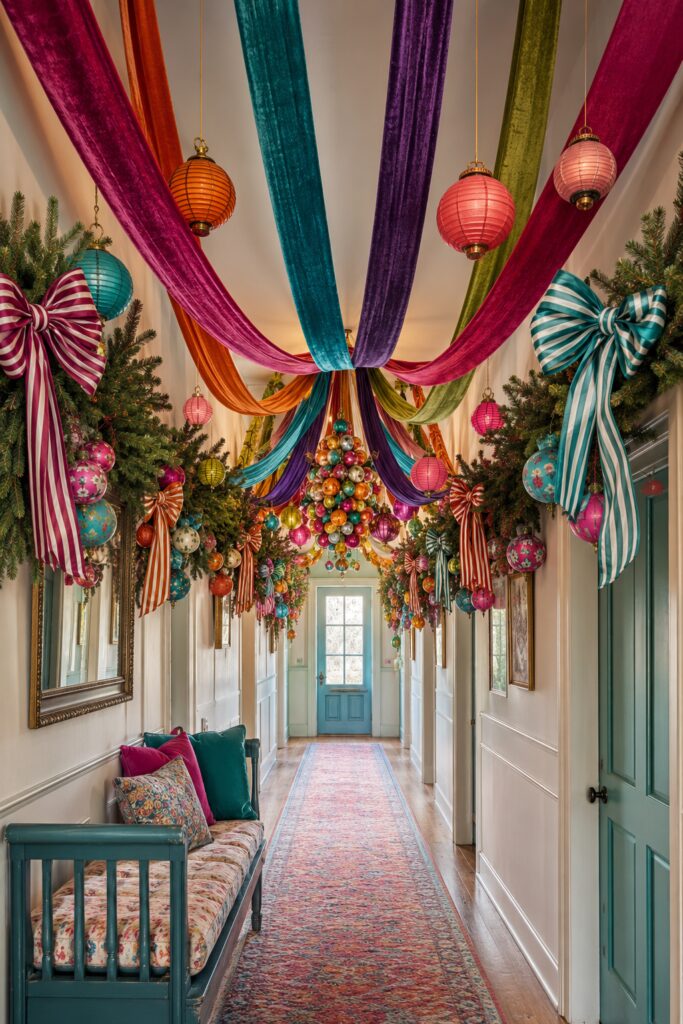
A hallway may be a pass-through space, but this extraordinary Christmas display turns it into one of the most memorable areas of the home. Long panels of jewel-toned fabric sweep across the ceiling, creating a dramatic canopy in magenta, burnt orange, teal, purple, olive green, and fuchsia.
Evergreen garlands line the upper walls beneath the fabric. Oversized striped bows, colorful ornaments, round lantern-style decorations, and a suspended cluster of baubles continue the saturated palette from one end of the corridor to the other.
The finished hallway feels immersive, theatrical, and celebratory. Instead of walking past a few scattered decorations, guests pass directly through the Christmas display.
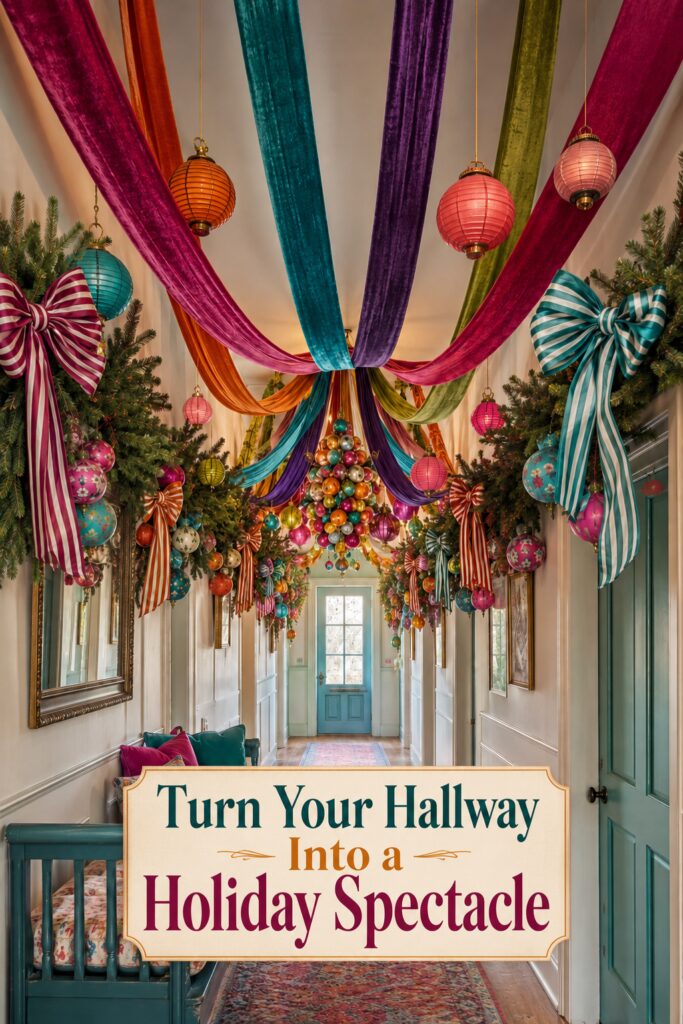
This inspiration image was created with AI to help visualize the decorating idea. You can recreate the overall effect with similar fabric, greenery, lightweight decorations, and a carefully planned color palette.
What Makes This Christmas Hallway So Striking
The ceiling becomes the main decorating surface
The fabric canopy is the feature that transforms this from a decorated hallway into a holiday experience.
Wide panels begin near the hallway’s outer edges and sweep toward a central gathering point. From there, additional swags continue toward the far end of the corridor. The gentle curves soften the long, narrow architecture and draw the eye toward the ornament cluster and blue door.
Because the fabric covers only sections of the ceiling, the white background remains visible between the colors. That negative space prevents the canopy from feeling heavy or enclosed.
Rich velvet creates depth
The fabric has a plush, lightly reflective appearance that changes as it curves toward and away from the light. Velvet or velour would produce a similar effect, but lighter textiles could also be used to reduce the weight of the installation.
Magenta and teal are the most prominent shades. Purple, orange, olive, and fuchsia add contrast without straying from the jewel-toned palette.
The colors do not follow a strict repeating pattern. They feel balanced because each major shade appears in several areas of the hallway.
Evergreen garlands frame the walkway
Thick evergreen swags run along the tops of the walls beneath the canopy. The greenery provides a familiar Christmas foundation for the unconventional color scheme.
It also fills the visual gap between the ceiling fabric and the wall decorations. Without the garland, the canopy could appear disconnected from the ornaments and bows below it.
Striped bows break up the solid colors
Oversized bows in teal and white, magenta and white, and orange and white appear at intervals along the garland.
Their crisp stripes contrast with the solid velvet panels and natural greenery. The long tails also create vertical movement, leading the eye from the upper walls toward the ornaments below.
Lantern shapes introduce another scale
Round lantern-style decorations hang between the ceiling panels in coral, pink, teal, orange, and green. Their ribbed surfaces and soft globe shapes distinguish them from the smaller Christmas balls.
The lanterns are suspended at different heights, which makes the ceiling treatment feel layered rather than flat.
Lightweight paper lanterns could recreate this shape more safely and affordably than oversized glass or metal ornaments.
A suspended ornament cluster creates a destination
Near the middle of the hallway, dozens of colorful ornaments form a tapered hanging cluster. This central feature acts almost like an upside-down Christmas tree or chandelier.
Its position gives the long corridor a visual destination. It also repeats nearly every color used elsewhere, helping unify the fabric, lanterns, bows, and wall decorations.
Key Pieces to Recreate the Look
Jewel-toned fabric panels
Look for lightweight velvet, stretch velvet, velour, satin, or flame-resistant event-draping fabric in magenta, teal, purple, orange, olive, and fuchsia.
True upholstery velvet may be unnecessarily heavy for an overhead installation. A lighter fabric with a short pile can provide a similar visual richness while placing less strain on the supports.
If six colors feel excessive, simplify the canopy to three shades. Teal, magenta, and purple would preserve much of the jewel-box effect.
Full artificial evergreen garland
Plain unlit garland will be easiest to customize. Choose a flexible style that can follow the upper walls and bend around doorways or architectural details.
Layer two thinner garlands if one strand does not provide enough fullness. Decorations can then be wired to the greenery rather than attached directly to the wall.
Round paper lanterns
Use lightweight lanterns in several sizes and colors to imitate the ribbed globe ornaments. Gold cord, tassels, or metallic caps can make basic party lanterns look more like oversized Christmas decorations.
Leave them unlit unless the product is specifically designed for lighting and can be used safely within the installation. Battery-operated lights should also be kept away from fabric according to their instructions.
Jewel-toned shatterproof ornaments
Collect ornaments in turquoise, magenta, pink, orange, green, purple, and gold. Mixing multiple sizes and finishes will create a richer display than using one uniform set.
Shatterproof plastic is the practical choice for overhead decorations and frequently used hallways.
Wide striped ribbon
Choose wired ribbon in teal and white, pink and white, orange and white, or similar combinations. The bows need to be generously scaled so they remain visible among thick greenery and large ornaments.
A multi-ribbon bow could substitute when an exact striped color is unavailable. Layer a wide solid ribbon with a narrower contrasting stripe.
Secure installation materials
The appropriate attachment method depends on the ceiling construction, wall material, fabric weight, and total load.
Possible components may include properly rated ceiling anchors, cup hooks secured into framing, curtain wire, drapery cable, ceiling track, floral wire, and removable hooks rated for both the surface and direction of pull.
Do not rely on a hook’s advertised maximum weight without also checking surface compatibility and whether it is approved for overhead use. Adhesive hooks can fail on textured, dusty, newly painted, or unsuitable surfaces.
How to Build a Practical Version at Home
Begin by measuring the hallway’s length, width, ceiling height, door clearance, vents, smoke detectors, light fixtures, and other obstacles.
Sketch the canopy before purchasing fabric. Mark the proposed attachment points and estimate the distance each panel must span, including the extra length needed to form the swags.
Install the overhead support system before adding decorations. For a large treatment, seek help from someone experienced with ceiling-mounted installations. A professional installer may be appropriate when the ceiling construction or load capacity is uncertain.
Attach the fabric one panel at a time. Start with the most prominent colors, distribute them evenly, and then fill the remaining spaces with supporting shades.
Keep every swag high enough that people cannot touch it while walking underneath. The installation must not interfere with doors, lighting, vents, cameras, sprinklers, alarms, or emergency equipment.
Once the canopy is secure, install the evergreen garland along the upper walls. Add the largest striped bows first, then distribute ornaments around them.
Use lightweight paper lanterns for the overhead globes. Suspend them above head level and away from door swings, light fixtures, electrical equipment, and heat sources.
The central ornament cluster can be created on a lightweight hoop or frame before it is hung. Attach ornaments at graduated lengths, with the widest group near the top and fewer ornaments toward the bottom.
Test every attachment and inspect the installation regularly. Remove or repair anything that loosens, stretches, or begins to sag.
A Simpler Version for an Everyday Home
The inspiration image is intentionally extravagant, but the central idea can be scaled down.
Try three fabric panels instead of six. Swag them across the ceiling near the entry or at one end of the hallway rather than covering its full length.
Add one evergreen garland to each side, two large striped bows, and a few lightweight lanterns or ornaments. This smaller arrangement would still create a colorful overhead moment without requiring a full corridor installation.
Another option is to recreate the canopy above a console table, interior doorway, or short entry passage. Concentrating the decorations in one zone can make the idea easier to install and store.
Shop Similar Pieces
Shop Jewel-Toned Fabric for the Canopy
Look for lightweight velvet or velour sold by the yard in magenta, teal, purple, orange, olive, and fuchsia.
Find Full Evergreen Garland
Choose undecorated artificial greenery that can be customized with colorful ornaments and striped ribbon.
Add Round Lantern-Style Decorations
Lightweight paper lanterns offer a realistic way to reproduce the oversized ribbed globes.
Shop Jewel-Toned Shatterproof Ornaments
Combine assorted ornament sets with individual colors to build the installation’s vivid palette.
Make Oversized Striped Bows
Use wide wired ribbon so the loops and long tails retain their shape among the greenery.
Choose an Appropriate Hanging System
Match all hooks, anchors, cables, and supports to the actual ceiling, walls, materials, and total installed weight.
Final Styling Tip
Choose three dominant colors and use the remaining shades as accents. That hierarchy will preserve the abundant, theatrical feeling while keeping the hallway visually coherent.