*This post may contain affiliate links for which I earn commissions.*
A golden crescent moon covered in autumn leaves makes an inviting home for a few velvet-winged visitors. This Halloween wreath pairs three dark bats with cream oak leaves, mustard tones, and tiny metallic stars. It feels a little enchanted, with enough homespun texture to suit a cozy entryway or a favorite corner indoors.
The appeal comes from the combination of shapes and materials. A sweeping moon gives the arrangement movement, while soft leaves and plush-looking bats make it feel almost like something lifted from an illustrated autumn tale.
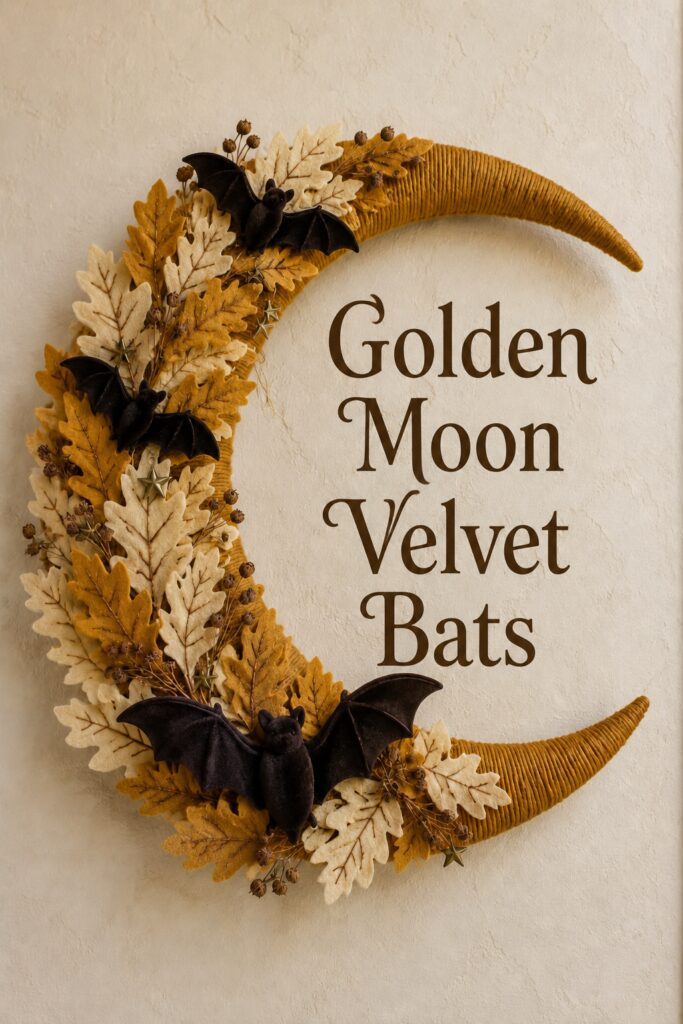
The inspiration image is AI generated. Use it as a decorating concept for arranging similar materials rather than as a photograph of an available finished wreath.
The crescent gives every detail room to stand out
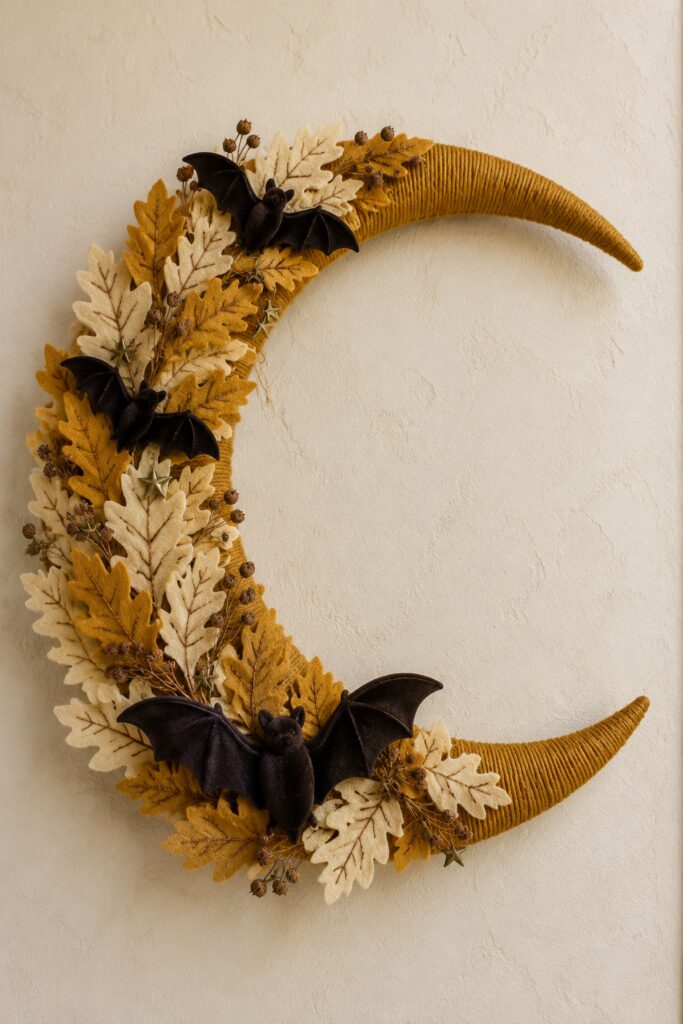
Instead of filling a complete circle, this design follows the generous left curve of a crescent. The two golden points remain uncovered, making the moon recognizable even with a substantial layer of foliage.
That restraint matters. If leaves covered both tips or stretched too far across the opening, the finished piece could lose its defining shape.
The colors also do a great deal of work. Ochre and cream provide a mellow harvest backdrop, while the black bats supply the Halloween character. Small bronze-toned stars connect the autumn leaves to the moon without introducing another strong color.
Texture keeps the limited palette interesting. Closely wrapped yarn creates orderly ridges, fabric leaves have softly irregular edges, and the bats appear velvety against the flatter foliage. Fine seed stems add a wiry contrast between those larger elements.
Choose materials that preserve the moon shape
A crescent base with golden yarn
Look for a sturdy crescent craft form that can support decorations along its wider curve. A dimensional base will come closest to the rounded profile in the inspiration, although a flat wooden crescent can suggest the same silhouette.
Wrap it with matte mustard or golden ochre yarn, placing the strands closely enough to conceal the surface underneath. Work in manageable sections and secure the ends on the back.
The color here is more like warm wool than shiny metallic gold. Keeping the wrapped surface matte allows the little stars to provide the occasional glint.
Cream and ochre fabric oak leaves
The foliage is unusually important in this arrangement. Long, lobed oak leaves overlap along the curve, with brown vein details that make them readable against one another.
Choose felt or fabric leaves in two related colors rather than a mixed bag of strongly contrasting autumn shades. If suitable finished leaves are difficult to find, cut simple oak shapes from cream and ochre felt and add veins with embroidery thread or a fabric marker.
A mixture of sizes will help fill narrow spaces without burying the crescent beneath oversized pieces.
Soft black bats in graduated sizes
Three bats establish a loose trail down the wreath. The largest sits near the bottom, while two smaller ones occupy the upper and middle sections.
Velvet or flocked bat ornaments would give a similar softness. Felt bats are another workable option, especially if their wings have enough structure to remain open.
Look at wing shape before facial details. The broad, scalloped silhouettes are what make these decorations recognizable from across a room. Small, simple faces will keep the mood gentle.
Fine brown stems and small metal stars
Delicate seed-head stems thread through the leaves and extend slightly beyond their edges. They make the foliage feel less like a solid fabric band.
Use small dried stems or faux botanical picks with a similarly fine scale. Thick sprays could compete with the bats and make the wreath cumbersome.
Antique-brass-colored star charms finish the celestial theme. A few scattered among the leaves will be more effective than a dense strand that obscures the yarn or wings.
Arrange the foliage before attaching the bats
Set the crescent on a table with its opening facing right. Position the largest bat near the lower curve first, leaving enough room for its wings to spread. Place the two smaller bats farther up the left side.
Take a quick photograph of that arrangement, then lift the bats away while you build the foliage underneath.
Begin with the larger leaves. Angle them along the curve, overlapping their bases while leaving their lobed ends visible. Alternate cream and ochre in loose groups rather than a strict repeating pattern.
Step back occasionally and check that both moon tips remain clear. The foliage can be generous along the left side, but the ends need that uninterrupted golden wrapping.
Slip small seed sprigs between the leaves, then return the bats to their planned positions. Make sure the foliage does not swallow their wing outlines. A cream leaf behind part of a black wing can improve the contrast considerably.
Fasten the decorations to the underlying form using attachment methods suited to the materials. Sewn loops or discreet ties can support fabric ornaments; floral wire can hold stems against a suitable frame. Avoid relying on loose surface yarn to carry the weight of the larger pieces.
Add the stars last, where little gaps invite a metallic accent.
Give it a quiet place to hang
The pale textured wall in the inspiration allows the golden crescent and dark bats to read clearly. You can achieve a similar effect on an ivory wall, a light interior door, or a simple panel above an entry table.
A dark background changes the balance. The cream leaves may stand out beautifully, but the bats could disappear. Before choosing a location, hold a black fabric scrap against the surface and view it from several feet away.
Nearby decorations can stay simple. A small bowl for keys, a stack of worn books, or a plain ceramic vessel will leave the wreath as the main attraction.
An indoor setting also suits the soft materials. If you prefer a porch display, choose a sheltered location and materials intended for those conditions. Felt, yarn, and dried stems are better kept away from rain.
Shop similar pieces for a golden crescent wreath
Look for crescent forms and ochre yarn
Prioritize a clear moon silhouette and a base that can carry the finished arrangement. Check its dimensions against your intended wall space before choosing the decorations.
Shop similar fabric leaves and soft bat ornaments
Compare the bats’ wingspans with the width of the crescent. A small selection of well-proportioned pieces will work better than a large assortment that overwhelms it.
Add seed stems and antique-style stars
Use these as finishing details. You may already have suitable pieces in an autumn floral arrangement or a box of ornament-making supplies.
Let the uncovered points finish the design
When the wreath feels nearly complete, resist filling every remaining gap. The exposed golden tips and open center are what turn a collection of lovely autumn materials into a recognizable Halloween moon.