*This post may contain affiliate links for which I earn commissions.*
A raspberry pink piano is not the most predictable choice for fall decorating, and that is precisely what makes this music room so captivating. The saturated color turns an everyday instrument into a piece of functional art, while orange foliage, striped pumpkins, botanical prints, and richly layered textiles bring the room into the season.
Rather than relying on a conventional brown-and-orange fall palette, this room surrounds its autumn accents with cobalt blue, olive green, mustard, cream, and raspberry. The effect feels collected, creative, and welcoming.
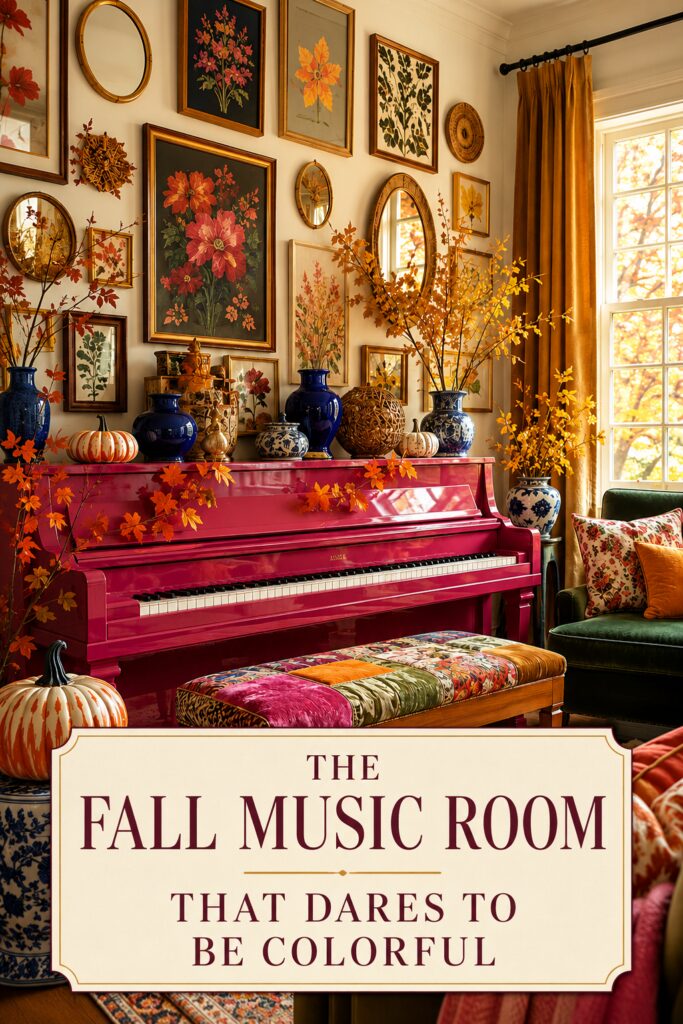
Image disclosure: This inspiration image was created with AI. It is intended to provide decorating ideas rather than represent specific products available for purchase.
Why This Colorful Fall Music Room Works
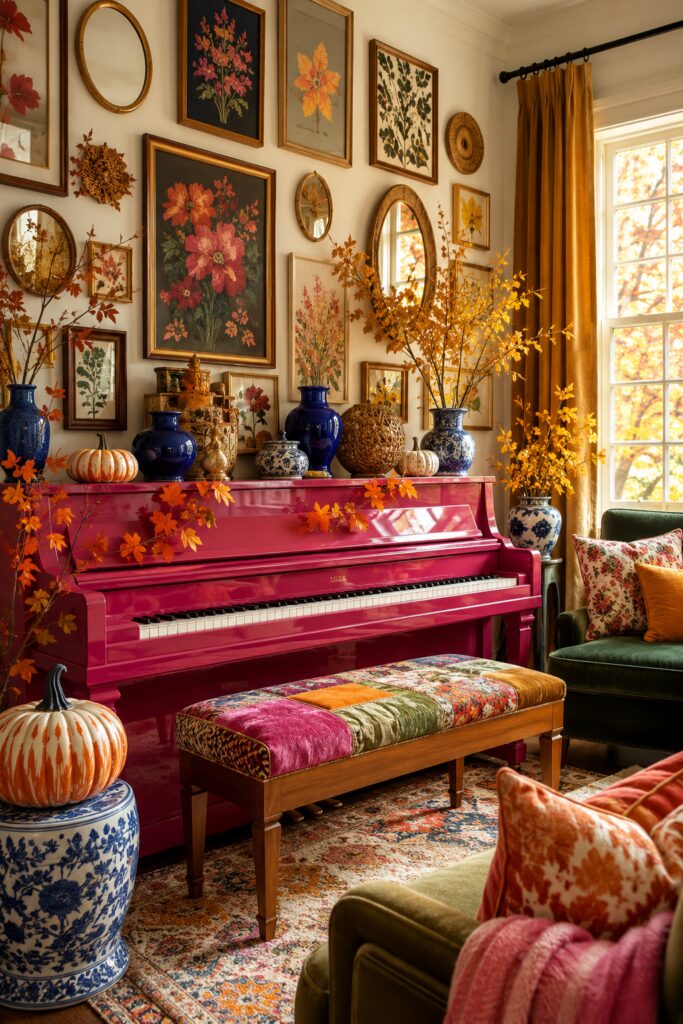
The piano is the clear focal point. Its glossy raspberry finish immediately catches the eye and gives the room a strong visual identity.
Because the piano makes such a bold statement, the rest of the room needs enough character to support it. A sparse arrangement would make the color feel isolated. Here, an abundant botanical gallery wall, patterned upholstery, sculptural ceramics, and autumn branches create a layered setting where the piano feels intentional.
Color repetition is especially important. Raspberry appears again in the piano bench, floral artwork, and nearby textiles. Orange travels from the foliage to the pumpkins, rug, artwork, and accent pillows. Cobalt blue is concentrated in the ceramic vessels, producing a cool contrast against the warm piano and leaves.
Olive chairs, woven objects, wood frames, and a distressed rug act as grounding elements. They soften the brighter colors and give the room an established, collected-over-time quality.
Begin With a Raspberry Statement Piece
A colorful piano creates the most dramatic interpretation of this idea, but painting an instrument should be approached carefully.
Before altering a piano, consider its age, value, existing finish, and mechanical condition. A valuable or historically significant instrument should be assessed by a qualified piano technician or restorer. If painting is appropriate, limit the work to suitable exterior case surfaces. Protect the keys and internal components, and keep paint away from hinges, pedals, strings, the soundboard, and other moving or musical parts.
You can also capture the effect without painting a piano. A raspberry console, cabinet, desk, or sideboard can provide the same burst of saturated color. What matters most is choosing one substantial piece to serve as the room’s visual anchor.
A glossy or softly polished finish reflects light and intensifies the berry color. For a gentler version, choose a muted cranberry, wine, or deep rose finish.
Build a Collected Botanical Gallery Wall
The wall behind the piano is almost as important as the instrument itself. Botanical prints, floral paintings, mirrors, and woven wall pieces fill the vertical space with color and movement.
To recreate this treatment, combine several types of artwork instead of purchasing one perfectly coordinated set. Look for vintage-style botanicals, dark floral prints, pressed-leaf illustrations, small landscapes, and decorative mirrors.
Mix wood, antique-gold, and dark frames. Vary the sizes and orientations, then arrange the pieces from the center outward. A few circular mirrors or woven discs will interrupt the rectangular frames and make the grouping feel more organic.
Leaving modest, fairly consistent gaps between pieces helps an abundant wall look deliberate rather than crowded.
Layer Blue Ceramics Across the Piano
Deep cobalt vessels give this room an unexpected cool note. Their smooth, reflective surfaces also contrast with the branches, woven accessories, and soft velvet upholstery.
Use a mixture of solid blue vases and blue-and-white patterned jars. Vary their silhouettes and heights, but repeat the blue in at least three places so it reads as part of the room’s palette.
Avoid arranging everything in a straight, evenly spaced row. Start with a tall vase at one side, balance it with a substantial jar closer to the center, and fill the remaining areas with lower vessels and smaller objects.
Leave enough open space around the tallest pieces so the display does not disappear against the gallery wall.
Add Autumn Branches With Height and Movement
Long branches carrying orange, amber, or burgundy leaves bring the clearest seasonal cue. Their loose shapes extend beyond the vessels and connect the piano display to the artwork above it.
Choose branches with flexible stems so they can be bent into a natural silhouette. Begin with two or three stems, directing some outward and others upward. Add more only if the arrangement still looks too thin.
One larger arrangement can be paired with a smaller branch placed asymmetrically at the opposite end of the piano. This creates balance without making both sides identical.
Real clippings can work beautifully when available, but faux branches offer longer-lasting color and are easier to reposition throughout the season.
Use Pumpkins as Small Punctuation Marks
The pumpkins in this room are accents rather than the entire decorating scheme. Cream pumpkins with orange stripes stand out against the piano without competing with it.
Look for small or medium pumpkins in ivory, pale peach, soft orange, or muted green. If striped versions are difficult to find, start with plain faux pumpkins and add narrow hand-painted lines.
Place them between ceramic vessels, beside a stack of books, or near the piano bench. Repeating only two or three pumpkins will provide a recognizable fall detail while allowing the room’s art and color to remain the main story.
Give the Piano Bench a Patchwork Effect
The patchwork bench brings many of the room’s colors together in one useful piece. Blocks of raspberry, olive, orange, velvet, and floral fabric make it feel artistic and slightly bohemian.
This effect can be recreated with a patchwork cushion, a removable bench cover, or a simple upholstery project. Select fabrics that repeat colors already present in the room. Combining solids with one or two vintage-inspired patterns will create a calmer result than using a different pattern in every section.
If reupholstering is not practical, place a narrow patterned cushion on the bench or fold a richly colored textile across the seat.
Ground the Brighter Colors With Traditional Textiles
A distressed Persian-style rug gives the room visual history and keeps the raspberry piano from feeling too contemporary. Look for a faded design containing rust, blue, cream, rose, or muted green.
Olive velvet chairs provide another grounding layer. Floral pillows and an orange cushion connect the seating to the gallery wall and seasonal foliage. Mustard curtains frame the window with warmth and reinforce the golden tones in the frames.
You do not need all these pieces to achieve the effect. A traditional rug and one deep green or mustard textile may be enough to balance the brighter colors.
Shop Similar Pieces
Look for Raspberry Furniture Paint and Finishing Supplies
Choose a rich berry tone with enough depth to hold its own beside orange, blue, and olive. Confirm that every primer, paint, and protective finish is compatible with the surface being painted.
Shop Vintage-Style Botanical Wall Art
Mix floral studies, leaf illustrations, mirrors, and varied frames to develop an art wall that feels collected rather than purchased as a single arrangement.
Add Cobalt and Blue-and-White Ceramic Vessels
Search for vases and jars in multiple heights. A combination of solid cobalt and patterned porcelain will provide the most interesting result.
Shop Artificial Autumn Branches
Look for long, flexible stems with small leaves and varied shades of orange. An open branch structure will appear more natural than a dense bundle.
Look for a Patchwork Piano Bench Cushion
Choose a cushion or upholstery fabric that combines raspberry, olive, rust, and vintage floral details.
Add a Distressed Rust and Blue Area Rug
Select a faded traditional pattern large enough to connect the piano, bench, and surrounding seating.
A Final Note for Making the Look Your Own
Let one bold piece lead the room, then repeat its color in two or three smaller details. Surround it with art, natural textures, and familiar fall accents, and even a fearless raspberry statement can feel beautifully at home.