*This post may contain affiliate links for which I earn commissions.*
Some Christmas ornaments are too beautiful to disappear among the branches of a full tree. Glass finials, with their elongated shapes, ribbed surfaces, and reflective finishes, can become a tabletop display all their own.
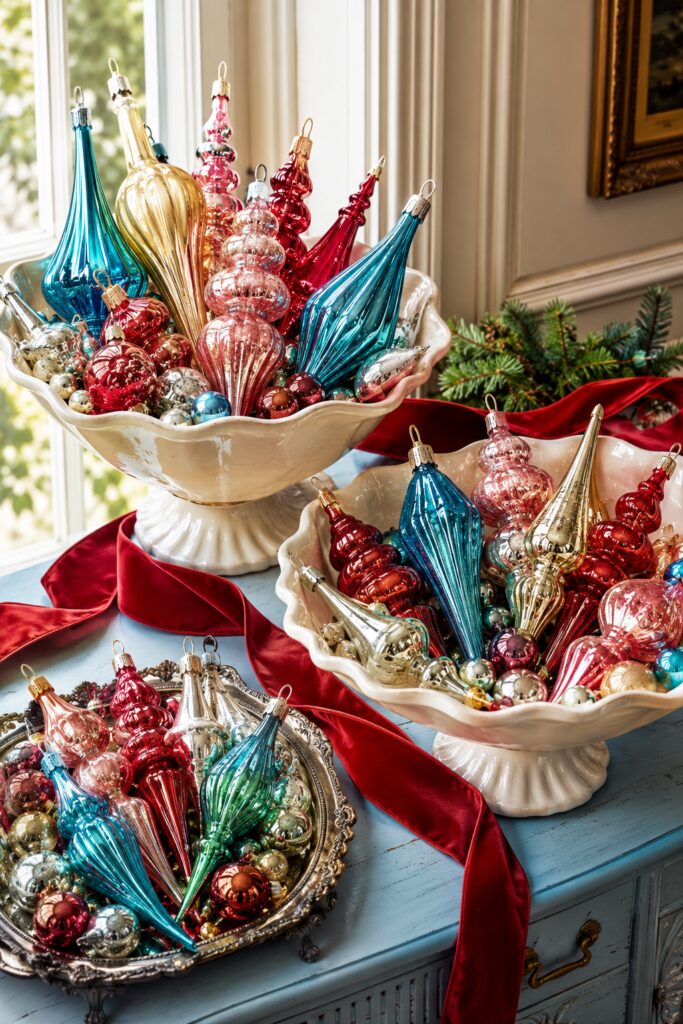
Here, ruby, teal, pink, green, silver, and champagne ornaments fill two cream footed bowls and an ornate silver tray. The finials rise above clusters of small round ornaments, giving the display the appearance of a holiday jewel box.
Wide red velvet ribbon loops around the vessels rather than being tied into formal bows. That relaxed movement softens the ceramic and metal pieces while connecting the separate arrangements across the top of the blue cabinet.
A display like this can be adapted to a dining room sideboard, entry table, mantel, bedroom dresser, or any surface that offers enough depth to protect the ornaments.
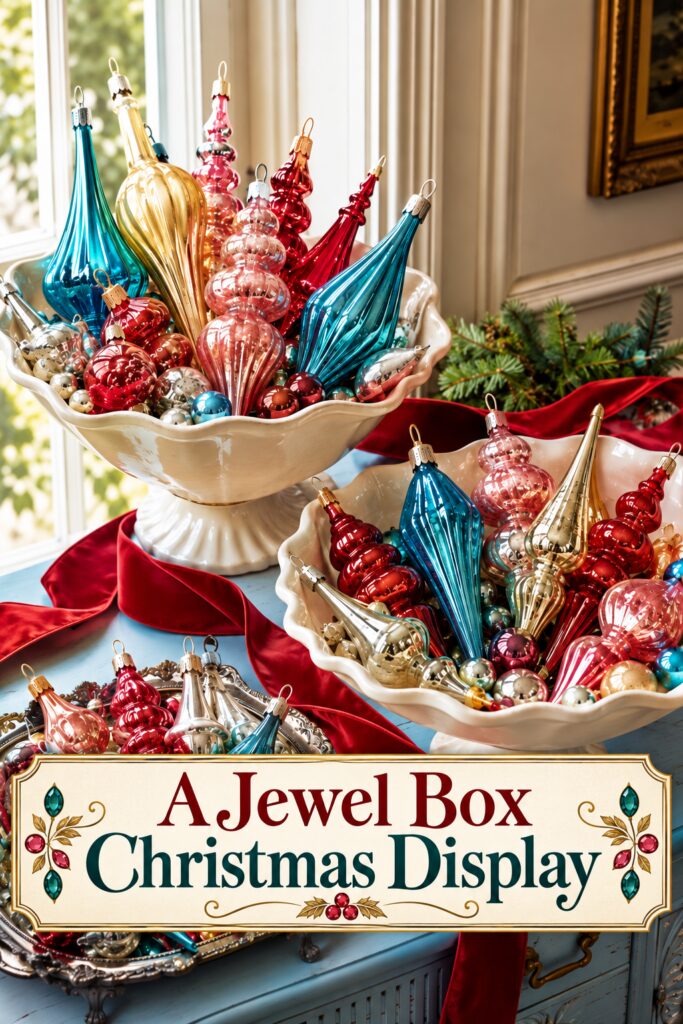
The inspiration image for this decorating idea was created with AI.
Why the Ornament Collection Looks So Striking
Finials provide height and elegant shapes
The long finial ornaments are the stars of the arrangement. Some are slender and pointed, while others have stacked rounded sections or deeply ribbed teardrop forms.
Their varied profiles keep the display interesting even where the colors repeat. A tall teal finial looks dramatically different from a shorter red spiral, although both have the same reflective glass quality.
Finials also create vertical movement. Without them, a bowl filled only with round ornaments would sit much lower and read as a simple container of Christmas balls. The taller pieces transform it into a composed centerpiece.
Find Large Glass Finials
Browse current Amazon options that can help you recreate this look.
Browse Finials on Amazon →As an Amazon Associate I earn from qualifying purchases.
Smaller ornaments do important supporting work
Small round ornaments fill spaces between the finials and conceal the bottoms of their stems. They create a dense, abundant base that allows the elongated pieces to appear as if they are rising from a pool of color and shine.
They may also help stabilize lightweight finials when placed carefully around them. For fragile glass ornaments, soft filler beneath the visible layer is a safer choice than relying on one ornament to support another.
Use smaller pieces in silver, gold, red, teal, and rose to distribute the full palette throughout each vessel.
Cream vessels give the colors room to shine
The scalloped footed bowls are decorative, but their neutral cream finish does not compete with the ornaments. Their curved edges echo the rounded glass shapes, and their raised bases lift the collection above the cabinet.
Matching bowls make the display feel coordinated, while their different positions prevent it from looking too formal. One sits farther back near the window, and the second occupies the middle ground.
A reader could achieve the same balance with compotes, pedestal bowls, footed serving dishes, or sturdy decorative vessels. Exact matches are not necessary. Similar cream finishes and related silhouettes will be enough to connect them.
The silver tray introduces a third level
The low silver tray in front creates a gradual step down from the taller bowls. This produces a layered composition rather than one straight row of equally sized containers.
Its ornate rim and aged metallic finish also introduce a vintage note. Against the painted blue cabinet, the silver has enough contrast to remain visible without distracting from the stronger jewel colors.
A tray is particularly useful for displaying shorter finials that might disappear inside a deep bowl.
Building a Balanced Jewel-Toned Palette
The display uses several saturated colors, but red and teal carry most of the visual weight. They appear repeatedly in the tall finials, smaller ornaments, and surrounding ribbon.
Rose pink provides a softer transition between the bold red and pale champagne pieces. Silver and gold reflect the window light and act as flexible neutrals.
Emerald appears in a smaller amount, which makes it feel like an accent rather than the beginning of a conventional red-and-green scheme.
To develop your own palette, select two leading colors, one softer supporting shade, and one or two metallic finishes. Repeat every leading color in each bowl so the vessels feel related.
If you prefer a traditional arrangement, use cranberry, forest green, gold, and silver. For a softer version, combine blush, pale blue, champagne, and pearl. Deep plum, emerald, ruby, and antique gold would produce a moodier jewel-box effect.
Key Pieces for Recreating the Display
Elongated glass finial ornaments
Look for several finial shapes rather than one matching set. Ribbed teardrops, narrow points, stacked rounds, and twisted silhouettes will give the display its distinctive height and variety.
Select different sizes so every ornament cap does not sit along the same line. A few tall pieces should rise well above the bowl, while medium finials fill the spaces around them.
Small round ornaments
Miniature and standard round ornaments provide the base layer. A mixture of shiny, mercury-style, matte, and lightly textured finishes can make the arrangement look collected over time.
These pieces should support the color story without competing with the finials.
Footed cream bowls
Choose bowls with a stable pedestal and enough depth to hold several layers of ornaments. Scalloped or fluted rims will complement the curved glass pieces, although a simpler vessel can work just as well.
Before filling a serving bowl with ornaments, make sure it is not needed for food during the season.
An ornate metallic tray
A low silver, pewter, or antique gold tray can hold smaller ornaments and extend the display across the surface. A raised or detailed rim helps contain the pieces.
The tray does not need to match other metal finishes in the room exactly. Slight variation can contribute to the collected appearance.
Wide velvet ribbon
Deep red velvet ribbon adds rich texture among all the hard, reflective surfaces. Instead of forming multiple bows, allow it to sweep around the bases of the bowls and trail naturally across the cabinet.
Wired ribbon can be shaped into gentle folds, while unwired ribbon will create a softer drape.
Evergreen branches
A small amount of fresh or faux evergreen behind the bowls adds recognizable Christmas texture. It also gives the eye a quiet, matte surface between the glass ornaments and the background.
The greenery should remain secondary. Too much could hide the finial shapes that make the display special.
Arranging Finials Without Making the Bowls Look Crowded
Begin by lining each bowl with a soft, hidden material that will protect fragile ornaments. Fabric, tissue, or another cushioned filler can reduce movement and raise the visible pieces closer to the rim.
Position the tallest finials first. Set them at slightly different angles, but keep each one supported so it cannot tip easily. Avoid forcing a narrow ornament into a position where pressure is placed on its delicate cap or pointed end.
Add medium finials around the tall pieces. Vary their colors and shapes, turning ribbed ornaments so their details catch the light.
Fill the remaining openings with small round ornaments. Allow some of them to sit near the rim, but do not pile them so high that they could roll onto the floor.
Use the same general method on the silver tray. Since it is shallow, reserve it for shorter ornaments and finials that can rest securely.
If valuable or especially fragile ornaments are part of the collection, place them farther from the vessel edges or display them in a protected glass cabinet instead.
Connecting the Three Vessels
Place the tallest footed bowl toward the back, preferably where natural or soft lamp light can illuminate the glass. Set the second bowl slightly forward and to one side.
Position the tray at the front on the opposite side. This creates a loose triangular arrangement and gives each layer its own visible area.
Unroll the velvet ribbon between the vessels in wide curves. Let it disappear briefly behind one bowl and return in front of another. The ribbon should look relaxed, but it should not hang where it could be pulled accidentally.
Finish with a short evergreen branch behind the middle bowl or along the back edge of the cabinet. Leave some blue or wood surface visible so the display retains its shape.
Shop Similar Pieces for a Jewel Box Christmas Arrangement
Shop Similar Glass Finial Ornaments
Look for elongated ornaments in several profiles and a coordinated mix of ruby teal rose silver and champagne.
Add Small Metallic Ornaments
Use miniature and standard round ornaments to fill spaces around the finials and distribute color through every vessel.
Look for Cream Footed Bowls
Choose sturdy pedestal bowls with enough depth to support layered ornaments and a rim that complements their curved shapes.
Shop Similar Vintage Style Trays
A low metallic tray provides a secure place for shorter pieces and completes the tiered arrangement.
Add Deep Red Velvet Ribbon
Wide ribbon introduces soft texture and visually connects the separate containers across the tabletop.
Look for Faux Evergreen Stems
A few realistic branches can add quiet seasonal contrast behind the reflective ornament collection.
A Final Styling Thought
Give the tallest finials room to stand above the bowls, then surround them with smaller ornaments, soft ribbon, and neutral vessels so every jewel tone has a chance to sparkle.