*This post may contain affiliate links for which I earn commissions.*
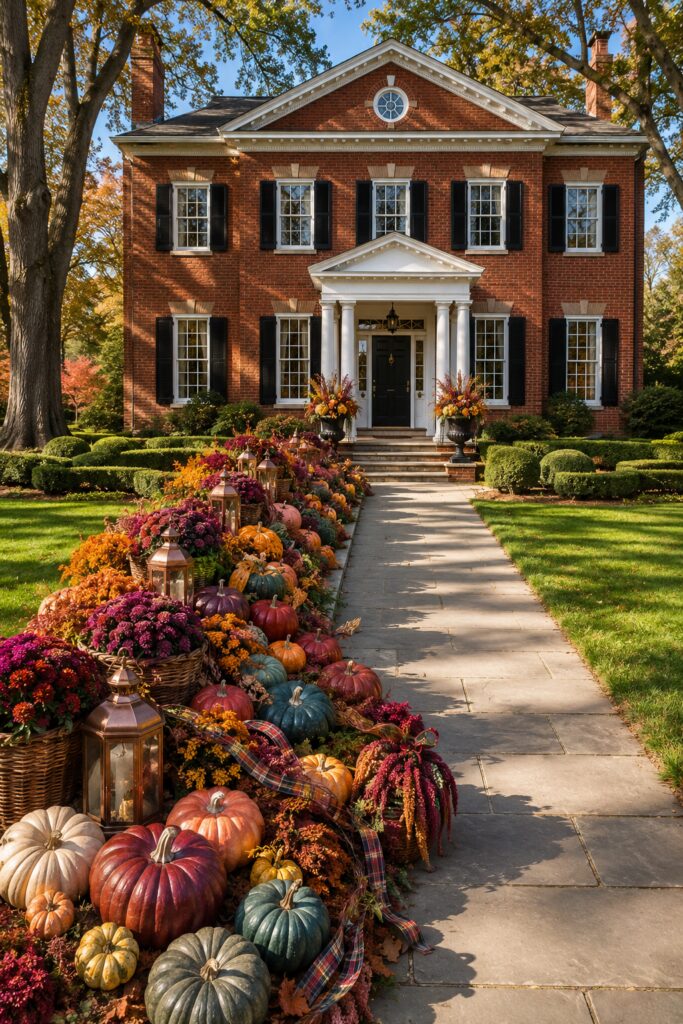
A sweeping border of pumpkins, overflowing flower baskets, copper lanterns, fallen leaves, and plaid ribbon turns this formal Georgian lawn into a richly layered fall welcome. The arrangement begins near the foreground, follows a graceful curve beside the stone walk, and narrows as it approaches the front steps.
This crescent-shaped design feels abundant without disturbing the home’s symmetry. The red brick facade, black shutters, white portico, and clipped boxwood provide a tailored architectural backdrop, while the harvest display introduces relaxed color and texture at ground level.
Instead of relying exclusively on orange, the arrangement combines burgundy, plum, coral, muted teal, cream, mustard, and raspberry. Those deeper shades give familiar pumpkins and fall flowers a more distinctive character while still feeling natural against brick, stone, and autumn foliage.
The same approach could be adapted to a much smaller front yard. The important idea is the curving progression from a full foreground grouping to a narrower display near the entrance.
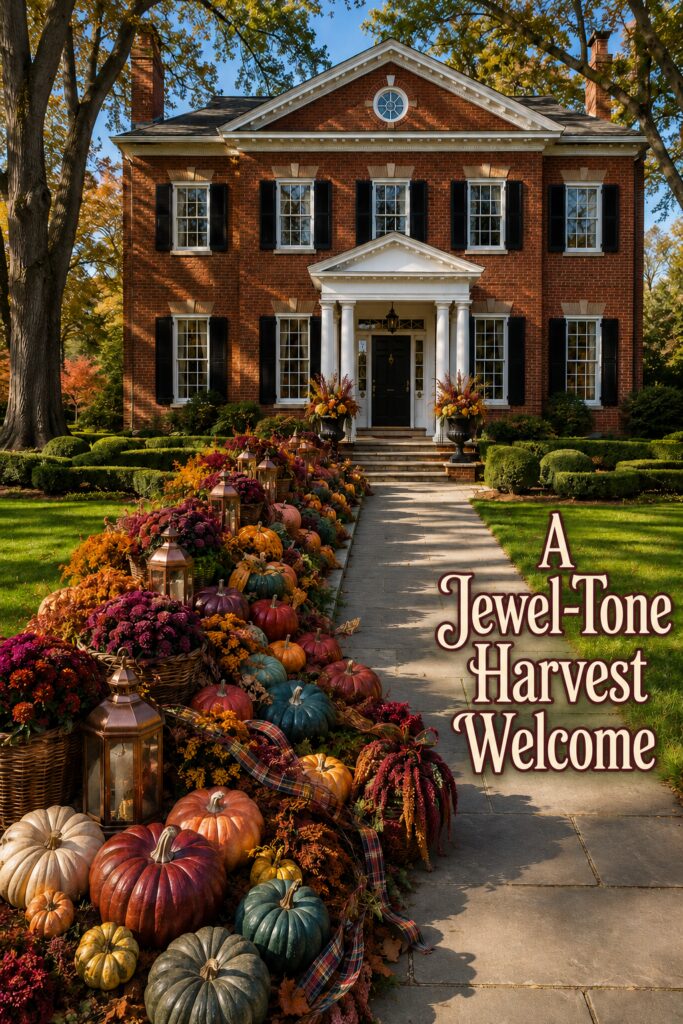
Image disclosure: This inspiration image was created with AI.
Why This Harvest Crescent Works So Well
The display creates movement without blocking the walkway. Its outer edge follows the path toward the portico, naturally guiding the eye and making the entrance feel like the destination.
The curve is widest near the front of the lawn, where large pumpkins, substantial baskets, and tall lanterns can be appreciated from the sidewalk. As it travels toward the house, the pieces gradually become smaller and more closely grouped.
That change in scale creates perspective. It makes the arrangement seem longer while preventing the area near the front steps from becoming crowded.
The crescent also introduces asymmetry to an otherwise highly balanced property. The house, windows, shutters, steps, and hedges remain formal, while the harvest border feels loose and garden-inspired. The contrast gives the entire scene energy.
Want to Recreate This Look?
I’ve put together a convenient Amazon supply list featuring hand-picked, well-rated products that complement the inspiration project shown in this post.
See My Hand-Picked Supply ListAs an Amazon Associate I earn from qualifying purchases but this doesn’t increase your price at all!
Jewel Tones Give Fall Decorations Greater Depth
Pumpkins in teal, burgundy, plum, coral, cream, yellow, and traditional orange create the foundation of the palette. Although the colors vary, their softened finishes help them look coordinated.
Real pumpkins are cheaper than resin or foam but if you plan on using them for several years, then it might make sense to invest in fake ones.
You can spray paint both fake and real ones but if you do pain real ones, wash them thoroughly first, dry them well, and then paint them.


Deep raspberry and purple flowers repeat the darker pumpkin tones. Golden blossoms and rust-colored foliage bring warmth, while green leaves and boxwood connect the display to the surrounding landscape.


These colors are especially effective in front of red brick. Cool teal and green pumpkins stand apart from the facade, while burgundy and orange pieces blend more gently with it. Cream pumpkins provide small points of light among the deeper shades.
For another exterior, the palette can be adjusted while preserving the same principle. Choose two deep colors, two warm harvest shades, one cool accent, and a neutral. Repeating those colors throughout the curve will make a varied collection feel intentional.
Pumpkins Establish the Shape of the Crescent
Large pumpkins anchor the foreground, where the crescent is widest. Their rounded forms overlap slightly and create a strong beginning to the display.
Medium pumpkins continue the curve, while smaller gourds fill spaces near the flower baskets and lanterns. The sizes decrease as the arrangement nears the front door, which supports the sense of distance.
Not every pumpkin faces the same direction. Some sit upright, others lean gently, and a few are partially tucked behind flowers or foliage. This keeps the border from looking like a row of evenly spaced decorations.
To recreate the look, place the largest pumpkins first. Use them to map the outer curve before filling the interior with smaller pieces. Keep them close enough to read as one display, but leave occasional openings for flowers, leaves, and ribbon.
Flower-Filled Baskets Add Height and Texture
Woven baskets filled with mums, celosia, amaranth, and other fall-inspired flowers interrupt the low line of pumpkins. They add softness and create several taller points along the crescent.
The baskets vary in shape and size, which reinforces the collected quality. Some are broad and low, while others lift their flowers higher above the pumpkins.


Trailing burgundy stems are particularly effective near the curve’s edge. They spill toward the walkway and make the arrangement feel lush without requiring every container to be densely packed.
A real display could combine planted mums with cut stems or high-quality faux florals. Using a mixture may make it easier to maintain the fullness throughout the season.
Copper Lanterns Create a Formal Rhythm
Tall copper-toned lanterns rise at intervals among the flowers and pumpkins. Their straight edges contrast with the rounded produce and loose foliage.
The lanterns also relate to the Georgian architecture. Their classic shapes feel appropriate beside the symmetrical facade, while their warm metal finish complements the red brick and autumn colors.
Real copper lanterns can be expensive and hard to find but you can get beautiful wood ones with a metal-look finish that will be just right for this kind of display.


Varying the lantern heights prevents the arrangement from becoming repetitive. Place the tallest one near the foreground, use medium lanterns through the center, and reserve smaller styles for the area closest to the steps.
Flameless candles can provide a gentle evening glow without introducing open flames near dried leaves, ribbon, baskets, or flowers.

Plaid Ribbon Threads the Pieces Together
Lengths of dark plaid ribbon weave through the foreground display, appearing between pumpkins, beneath flowers, and along the inner edge of the curve.
The ribbon does not form large bows. Instead, it moves loosely through the arrangement, providing a subtle pattern that links the separate groupings.
Choose wired ribbon wide enough to remain visible among the pumpkins. Burgundy, navy, mustard, forest green, and cream can reinforce the jewel-tone palette without making the border feel overly decorative.

Outdoor fabric, plaid scarves, or narrow lengths of weather-resistant textile could create a similar effect. Secure the material discreetly so wind cannot pull it across the walkway.
Style a Harvest Crescent on Your Own Lawn
Begin by viewing the yard from the street or main approach. Choose a starting point that will accommodate the largest grouping without interfering with the sidewalk, driveway, or lawn maintenance.
Use a garden hose or length of rope to sketch the crescent. The curve should begin wide, sweep toward the entrance, and narrow before reaching the steps. Leave enough open space beside the path for comfortable walking.
Place the largest pumpkins and baskets first. These pieces establish the overall scale. Add the tall lanterns next, spacing them unevenly while gradually reducing their height toward the house.
Fill the spaces with medium pumpkins, mums, trailing flowers, and leafy stems. Add smaller gourds along the outer edge to soften the line. A scattering of natural leaves can help blend the display into the lawn.
Weave plaid ribbon through selected areas rather than running it continuously from beginning to end. Several shorter sections will be easier to secure and will look more natural.
Complete the entrance with two substantial urns or planters beside the portico. They should repeat the flowers and foliage from the lawn without copying the full crescent. This small repetition visually connects the end of the display to the front door.
For a compact yard, reduce the arrangement to one wide grouping near the sidewalk and a narrow trail of pumpkins leading toward the porch. Three baskets, three lanterns, and pumpkins in several sizes can still establish the same sweeping movement.
Shop Similar Pieces
Shop Similar Jewel-Tone Pumpkins
Look for faux pumpkins in burgundy, plum, muted teal, coral, cream, mustard, and deep orange.
Look for Woven Harvest Baskets
Choose a combination of handled baskets, low market baskets, and round planters to create varied flower heights.
Add Fall Flowers and Trailing Stems
Mix mums with amaranth, celosia, leafy branches, or cascading faux stems in raspberry, rust, gold, and burgundy.
Shop Similar Copper Lanterns
Classic lanterns in several sizes will introduce height, structure, and a warm metallic finish throughout the crescent.
Look for Dark Plaid Ribbon
Choose wide wired ribbon in burgundy, navy, mustard, green, or cream to weave between pumpkins and baskets.
Add Flameless Candles
Warm LED candles can give the lanterns an inviting evening glow while remaining practical around flowers and dry leaves.
A Final Styling Tip
Use the largest objects to define the crescent before adding flowers, ribbon, and smaller pumpkins. When the underlying curve is clear, even an abundant collection will look graceful rather than scattered.