*This post may contain affiliate links for which I earn commissions.*
Three little fabric ghosts seem to have found a comfortable place among the harvest decorations. With stitched edges, gingham patches, and simple oval eyes, they give this Halloween wreath a personality that feels homemade and welcoming.
Orange velvet pumpkins gather around the lower edge, while rust-colored leaves and berry sprigs wind through the grapevine above. The mix has the familiarity of traditional fall decorating, with enough playful detail to make someone pause at the door for a closer look.
You can borrow the arrangement without matching every ornament. Focus on soft ivory ghosts, warm orange pumpkins, checked fabric, and plenty of visible vine.
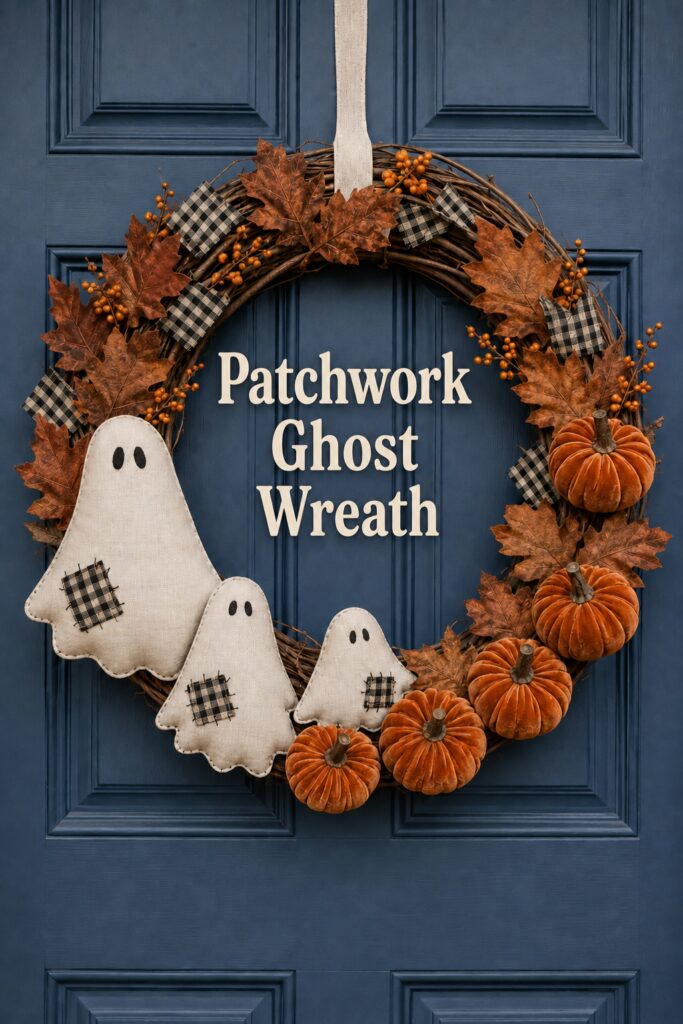
The inspiration image is AI generated. The wreath is a decorating concept that can be interpreted with similar ornaments, craft supplies, and materials you already own.
Three patched ghosts set the tone
The ghosts are the first things you notice because their pale fabric stands out against both the brown grapevine and the navy door. Their slightly uneven shapes, scalloped hems, and visible stitching suggest small handmade keepsakes.
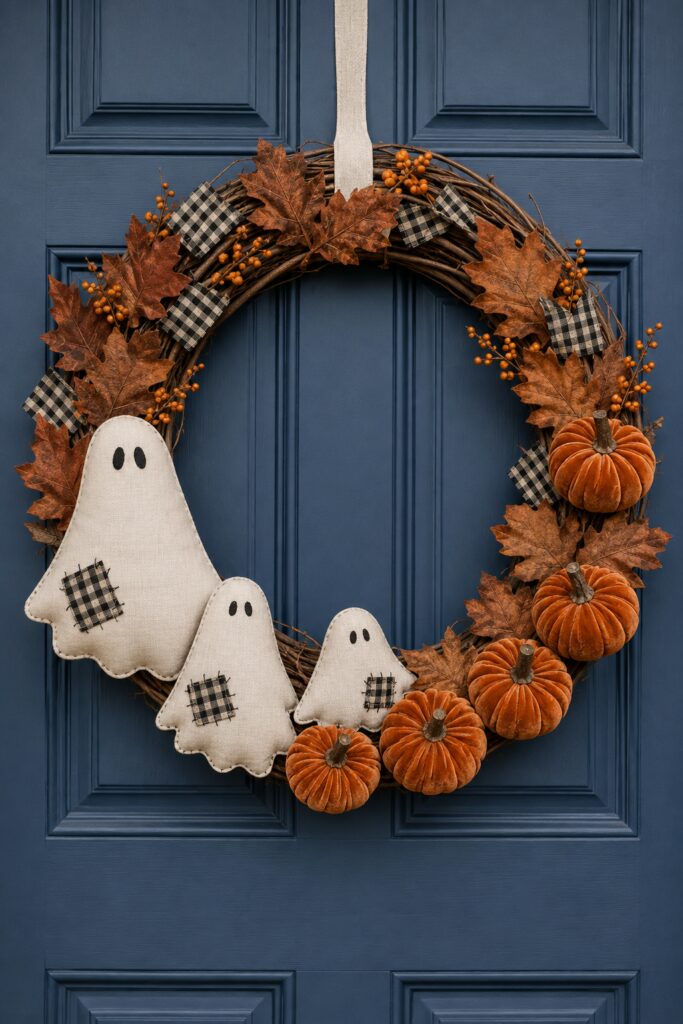
Each carries a gingham patch, and that same checked pattern reappears in scraps tucked around the wreath. This repetition ties the character decorations to the foliage instead of leaving them looking like separate ornaments attached at the end.
The pumpkins provide a different kind of softness. Their gathered orange surfaces and short brown stems contrast with the flatter ghost shapes. Arranged along the bottom and right, they balance the larger ghost on the left.
Above them, the decoration becomes lighter. Leaves and berries leave sections of grapevine uncovered, preserving the rustic framework and keeping the lower cluster as the focus.
Gather the pieces that give it character
An open grapevine wreath
Choose a grapevine base with a generous center opening. You need room for the ghosts and pumpkins around the lower edge without closing off the middle.
The twisting branches are part of the finished look, so there is no need to conceal every gap. An irregular vine surface also gives you places to tuck stems and route discreet attachment wire.
Check the overall dimensions against your door before purchasing ornaments. A wreath that looks roomy on a worktable can become crowded once several fabric figures are added.
Ivory ghosts with simple stitched details
Look for small fabric ghost ornaments with plain faces, or make your own using unbleached cotton, muslin, or linen-blend fabric.
For a handmade version, cut paired ghost shapes, add the eyes and gingham patch to the front, then stitch around the edges with a little stuffing inside. Keep them fairly shallow so they sit against the wreath instead of projecting far forward.
The inspiration uses three sizes. That variation creates a gentle progression from the tall ghost on the left to the smallest near the bottom center.
A few visible stitches around each patch will echo the homespun character. They do not need to be perfectly uniform.
Rust orange velvet pumpkins
Small fabric pumpkins with gathered sides are a strong match for the lower cluster. Choose a warm burnt orange rather than a very vivid plastic-looking finish.
A mixture of sizes allows the group to curve around the base. The smallest pumpkins can fill the bottom, with larger ones continuing up the right side.
Lightweight ornaments are easier to support than heavy tabletop decorations. Check that each one offers a practical place for a tie, sewn loop, or other secure attachment.
Black and cream gingham
The checked fabric works in two ways: as patches on the ghosts and as little accents between the leaves.
Use the same fabric for both if possible. Even a small amount can make the arrangement feel coordinated.
Fold short scraps into soft tabs and tuck their bases into the vine. Avoid adding a large bow automatically. In this design, the scattered checks supply the pattern while a plain hanging ribbon keeps the top uncluttered.
Autumn leaves and orange berries
Rust and copper-colored maple leaves fill the spaces between the larger ornaments. Their pointed edges contrast nicely with the rounded pumpkins and scalloped ghosts.
Fine orange berry stems add small dots of color farther up the wreath. Choose short, flexible picks that can follow the vine rather than stiff sprays that jut straight outward.
Keep these supporting materials close to the pumpkin palette. The gingham already provides a strong pattern, so additional colors are unnecessary.
Build the lower arrangement first
Before attaching anything, lay the grapevine flat and place the three ghosts along the lower left. Let their edges overlap slightly, keeping every face visible.
Next, arrange the pumpkins from the bottom toward the right side. The goal is a curved grouping, with different sizes nestled together rather than a row of identical shapes.
Photograph the arrangement before lifting the pieces away. This gives you a useful reference as you secure the supporting leaves.
Thread foliage around the sides and top, following the direction of the vine. Leave some branches showing, particularly across the upper arc. Add berries in small clusters, then tuck in the gingham tabs.
Return the ghosts and pumpkins to their positions. Anchor substantial pieces to the grapevine itself using suitable ties, wire, or sewn attachment loops. Glue may help position lightweight details, but the larger ornaments need dependable support.
Cover visible fastenings with a leaf or a small fabric fold. Then lift the wreath upright and check for movement before hanging it.
Let your doorway influence the finishing touches
The navy door in the inspiration makes the ivory ghosts and orange pumpkins especially noticeable. You do not need to change your door color to use the idea, but it helps to consider which details will stand out against your own background.
On a white door, keep grapevine and rust leaves visible behind the ghosts so their outlines remain clear. On stained wood, the ivory fabric can provide the strongest contrast.
Use a hanger appropriate for the finished weight and the surface. A plain linen-colored ribbon can recreate the visual effect of the inspiration, provided it is part of a secure hanging arrangement.
This fabric-heavy wreath also works on an interior door or entryway wall. If you display it outside, protect it from rain and choose materials suited to the location.
There is little need for matching decorations on every side. A simple doormat or a pair of plain planters can give this detailed wreath enough room to be appreciated.
Shop similar pieces for the patched ghost look
Look for grapevine bases and fabric ghost ornaments
Compare ornament dimensions before choosing a base. The ghosts should remain recognizable without taking over the entire opening.
Shop similar velvet pumpkins and gingham fabric
These pieces establish the most noticeable textures. Reusing a checked fabric scrap from another project is an easy way to give the wreath a more personal touch.
Add rust leaves and orange berry picks
Choose a modest quantity first. Small sections can often be clipped from larger sprays and distributed around the vine.
Repeat the patch fabric beyond the ghosts
A few gingham scraps tucked among the leaves make the whole wreath feel connected. That small repeated detail is worth more to this particular look than another layer of ornaments.