*This post may contain affiliate links for which I earn commissions.*
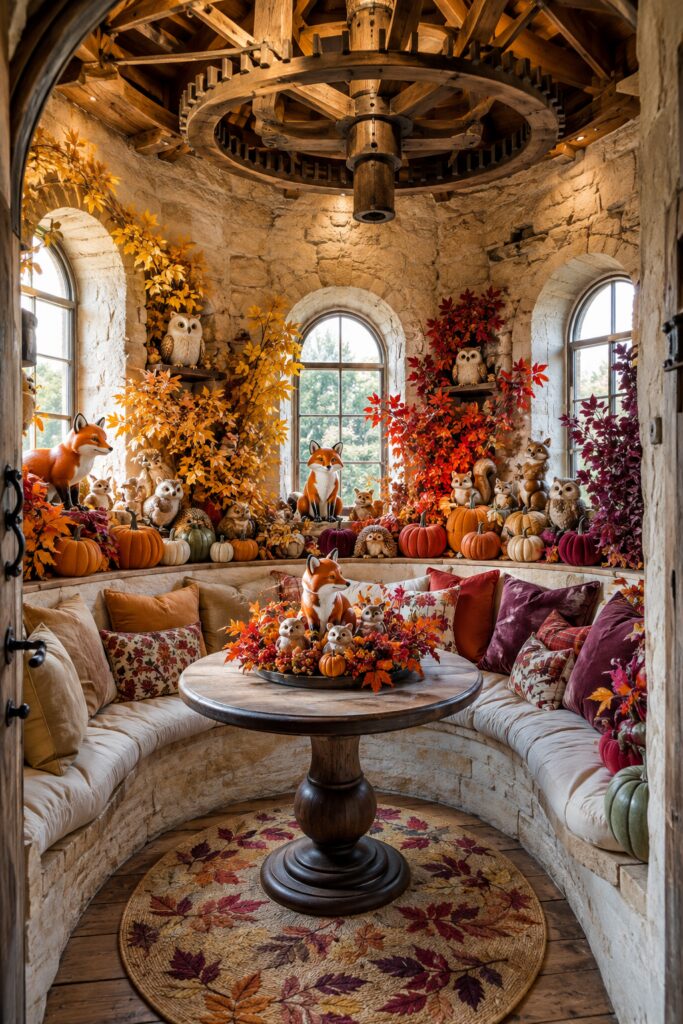
There is something irresistible about a room that looks as though the forest decided to move indoors for fall. In this imaginative windmill nook, foxes, owls, squirrels, rabbits, and hedgehogs gather among pumpkins and sweeping branches of autumn leaves. The stone walls, arched windows, exposed wooden gears, and curved banquette make the room feel centuries old, while the fanciful woodland display gives it a warm storybook personality.
You do not need a converted windmill or an enormous collection of animal figures to capture the same feeling. The effect can be adapted to a breakfast nook, sunroom, enclosed porch, reading corner, or dining area with a thoughtfully arranged mix of woodland creatures, pumpkins, foliage, patterned textiles, and natural wood.
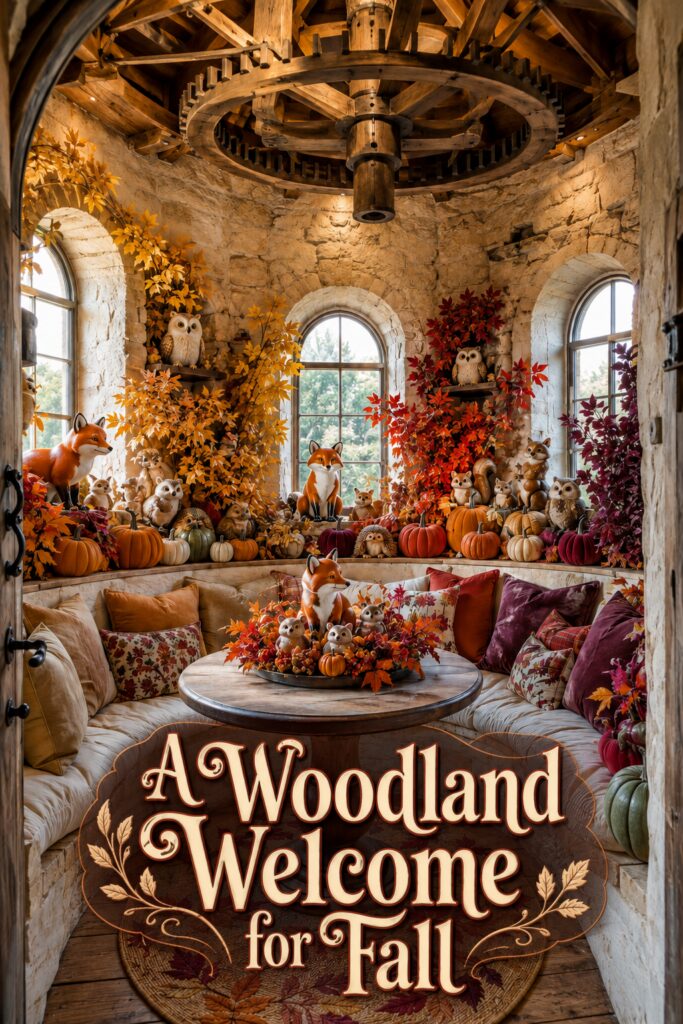
This inspiration image was created with AI.
What Makes This Woodland Gathering So Memorable
The room becomes part of the story
The exposed stone and heavy wood construction give the scene a rustic foundation. Most of the decorations are arranged around the architecture rather than simply placed in front of it.
Owls perch on narrow wall shelves beside the windows. Foxes stand prominently along the curved ledge. Smaller animals fill the spaces between pumpkins and leaves. The room appears to have been discovered by the creatures rather than decorated with them.
In a more conventional home, the same approach could be used around a built-in bench, mantel, bookcase, window ledge, or collection of floating shelves.
Woodland animals replace a traditional floral theme
Fall rooms often depend primarily on pumpkins, leaves, and florals. Here, the animals carry the story.
The larger foxes act as visual anchors. Owls add height, while squirrels, rabbits, raccoons, and hedgehogs create smaller moments throughout the display. Mixing species makes the arrangement feel like a woodland gathering rather than a collection of matching ornaments.
The variety works because the figures share a similar warm, lightly stylized appearance. They are playful without looking overly childlike.
Autumn foliage frames the entire room
Tall branches rise on both sides of the central window, creating an arc of gold, orange, rust, red, and burgundy. This foliage fills the vertical space beneath the wooden windmill gears and visually connects the upper shelves to the pumpkin-lined ledge.
The deeper burgundy leaves are especially important. They bring richness to the golden palette and coordinate with the velvet pumpkins and pillows below.
Circular shapes soften the heavy architecture
The architecture contains numerous curves, including arched windows, a round room, curved seating, a circular table, and a round rug. Even the enormous wooden gear overhead repeats the shape.
That repetition gives the room a reassuring sense of order despite the abundance of decorations. It also keeps the stone and timber elements from feeling too severe.
Layered textures make the nook feel comfortable
Hard stone walls and dark wood could make this space feel cold, but the soft banquette cushions, velvet pillows, upholstered pumpkins, patterned rug, and abundant foliage change the atmosphere.
The contrast between rough and soft surfaces is part of the room’s appeal. A similar balance can make rustic rooms feel much more inviting.
The Key Pieces Behind the Look
Woodland animal figures in several sizes
Begin with a few animals that can establish the theme. A medium or large fox makes a strong centerpiece, while owls work well on shelves. Smaller squirrels, rabbits, raccoons, and hedgehogs can fill gaps around pumpkins and foliage.
The figures do not need to come from one matching collection. Look for compatible finishes and expressions rather than identical materials. Softly painted resin, woven natural fibers, felt, or lightly textured fabric can all work together.
Tall branches in layered fall colors
The foliage in this room is not confined to one small vase. Long branches climb the walls and surround the windows, making the nook feel enveloped by the season.
Combine golden or amber stems with smaller amounts of rust, crimson, and burgundy. Mixing two or three leaf shapes will make the display look fuller and more natural.
Pumpkins with varied finishes
Traditional orange pumpkins are mixed with cream, sage, burgundy, and rust. Some appear smooth, while others have the plush texture of velvet.
This variety keeps the ledge from looking like a line of identical decorations. It also allows the pumpkins to blend with both the animals and the textiles.
Autumn and woodland pillow covers
The curved bench includes solid pillows in rust, mustard, and plum alongside floral and woodland patterns. The solids provide breathing room, while the prints reinforce the fall story.
Pillow covers are an especially practical way to adapt the idea because they can be stored flat after the season and used with existing inserts.
A shallow tray for the woodland centerpiece
The central table display is gathered inside a low, dark tray. This creates a clear boundary around the arrangement and prevents the animals, leaves, pumpkins, berries, and pinecones from appearing scattered.
A tray also makes it easier to move the entire centerpiece when the table needs to be used.
A round autumn rug
The leaf-patterned rug repeats the circular shape of the table and room. It also brings the fall palette down to the floor, completing the design from top to bottom.
In a rectangular room, a round rug can still define a small reading chair, breakfast table, or seasonal vignette.
Building a Woodland Display Without Overcrowding It
Start with one principal animal figure. A fox is especially effective because its orange coat naturally connects with autumn foliage and pumpkins. Place it near the center of a table, mantel, shelf, or window ledge.
Add two or three smaller animals nearby, but turn them at slightly different angles. When every figure faces directly forward, an arrangement can look like a store display. Letting the animals appear to notice one another makes the scene feel more animated.
Position the tallest foliage behind the animals. Use branches to frame the composition rather than allowing them to hide the figures. Golden leaves can fill the larger spaces, while burgundy stems provide deeper accents around the edges.
Next, tuck pumpkins into the gaps. Begin with the largest pumpkin near the main animal, then scatter smaller ones unevenly. Add pinecones, acorns, berry stems, or dried pods where the base still feels sparse.
Repeat a few animals or pumpkins in a second location. For example, place the main woodland gathering on a table and add one owl to a nearby shelf. This carries the theme through the room without requiring a large collection everywhere.
Adapting the Idea to a Smaller Home
A single tabletop arrangement can communicate the entire concept. Place one fox or owl in the center of a shallow tray, surround it with three small pumpkins, and fill the remaining space with fall leaves, acorns, and pinecones.
For a mantel, use one larger animal at each end and run foliage loosely between them. Smaller creatures can peek out from behind pumpkins rather than standing in a straight row.
A bookcase offers another natural setting. Give each shelf a slightly different woodland moment, such as an owl beside amber leaves, a squirrel with acorns, or a rabbit tucked among cream pumpkins. Repeating the same fall colors will make the separate shelves feel connected.
Shop the Storybook Elements
Find Woodland Animal Figures
Choose animals with enough personality to serve as focal points. A mixture of foxes, owls, squirrels, rabbits, raccoons, and hedgehogs will produce the gathered-forest feeling seen in the room.
Layer Golden and Burgundy Fall Branches
Use tall foliage to frame a window, mirror, hutch, or built-in bench. Combine at least two autumn colors so the display has the same depth as the inspiration image.
Mix Traditional and Velvet Pumpkins
Blend familiar orange and cream pumpkins with a few rust, burgundy, or sage velvet pieces. The contrasting surfaces will add dimension even in a small arrangement.
Bring in Woodland or Floral Pillow Covers
Look for prints that contain rust, mustard, burgundy, cream, and muted green. Pair patterned covers with solid velvet pillows so the seating remains comfortable rather than visually busy.
Gather the Centerpiece on a Dark Tray
A black or dark bronze round tray will frame the smaller pieces and provide contrast against orange foliage and pumpkins.
Ground the Nook with Autumn Leaves
If the room needs one larger seasonal element, consider a round rug with a subtle leaf pattern. It can define the seating area while repeating the autumn colors used above it.
A Final Touch for a More Collected Look
Resist the urge to make every animal, pumpkin, and pillow match. A limited fall palette will unify pieces that vary in material and style, creating a woodland display that feels gathered over time.