*This post may contain affiliate links for which I earn commissions.*
A Halloween kitchen shelf can have plenty of personality with just a few well chosen shapes. Here, three rounded glass cauldrons give the display its seasonal identity, while lavender, honey amber, and smoky gray keep the colors softer than a traditional black arrangement.
The interesting part is the glass itself. Hammered surfaces catch the window light, thick rims outline the open pots, and little feet lift each body off the pale stone. You can borrow those relationships even if the pieces you find have different handles or simpler surfaces.
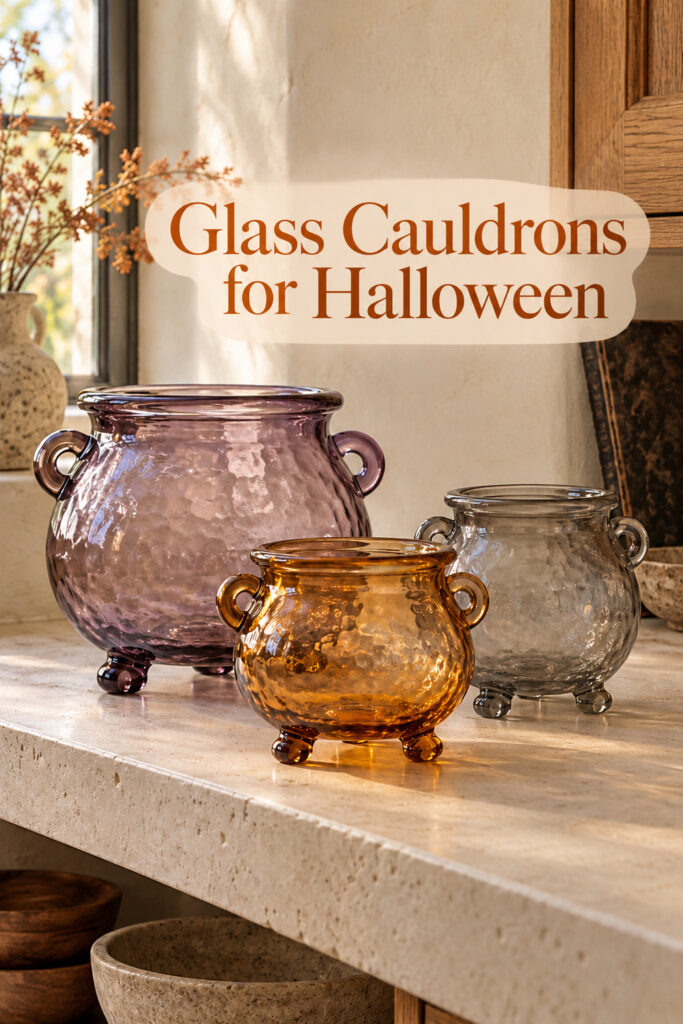
The inspiration image was created with AI.
What Makes These Glass Cauldrons Work
The largest lavender pot sits toward the back left, the gray one balances it on the right, and the smaller amber pot comes forward. That loose triangle gives you three distinct levels to notice. Although the vessels overlap slightly, their rims remain readable, which matters when the shapes are this round.
Find Decorative Glass Bowls for Halloween
Browse current Amazon options that can help you recreate this look.
Browse Decorative Glass Bowls on Amazon →As an Amazon Associate I earn from qualifying purchases.
The cream backing does a lot of useful work. A busier tile pattern would compete with the hammered glass, and a dark wall would make the smoky vessel harder to see. If your kitchen already has patterned tile, try placing a plain board behind the group before changing anything permanent.
Color is concentrated in the collection rather than scattered around it. The dried sprigs and wooden board stay quiet, so your eye goes to the pots first. That restraint is especially helpful in a kitchen where everyday appliances and containers are already adding their own visual activity.
Key Pieces for a Similar Shelf
Rounded Decorative Glass Vessels
Start with the silhouette. A broad belly, an open rim, and a smaller base suggest a cauldron more strongly than a particular shade of purple. Loop handles and little feet strengthen the association, but similar rounded glass bowls can still carry the idea when exact cauldron forms are difficult to locate.
Choose one noticeably larger piece rather than three vessels that only differ slightly. The size contrast lets you arrange the collection without adding stands. Check the shelf depth against the widest part of each bowl, including any handles, rather than measuring only the base.
Amber and Lavender Accents
Honey amber gives the arrangement a warmer center. Because that pot is in front, the concentrated color feels intentional instead of lost behind the larger pieces. If you already own an amber bowl, use it as your starting point and look for quieter companions.
Lavender can be interpreted loosely. A pale purple vessel paired with clear or smoke colored glass will suggest the palette without requiring three exact matches. Avoid collecting every available shade just because the items are glass. A limited range makes their different surfaces easier to appreciate.
A Pale Shelf or Backing
The stone shelf provides a broad, uninterrupted resting surface. A painted cream shelf or a light wood surface can offer a similar contrast. What matters most is that the vessels sit flat and that the background separates their outlines, especially around the handles.
If your surface is dark, test a plain pale tray underneath the group. Choose one that comfortably contains every foot and leaves a little visible border. A tray should act as a base, not squeeze the pots into a row where their shapes disappear behind one another.
One Quiet Supporting Detail
The sprigs at the left soften the hard glass and stone without becoming a second collection. Use one small arrangement with an open shape if you want a similar touch. Keep its lower stems from crossing the rim of the lavender pot when viewed from the front.
A wooden board toward the back adds another matte surface. You may already have a suitable kitchen piece, so look around before buying a decorative substitute. Keep anything used for food preparation accessible and clean rather than turning a working item into a permanently trapped backdrop.
Arranging the Collection at Home
Clear the intended shelf first and set down only the largest pot. Move it slightly off center, then add the second vessel on the opposite side. Bring the smallest forward last. This order makes it easier to judge the overall footprint before little accessories start filling the available gaps.
Look at the display from the doorway and from the spot where you usually work. A handle that appears clear from one angle can merge into another pot from the side. A small change in spacing may be enough; you don’t need to make the arrangement perfectly symmetrical.
Leave the pots empty if their surfaces are the main attraction. Filling them with several different seasonal objects would hide the color variations and turn the display into a different idea. The open rims already say plenty about the cauldron shape, and the empty interiors let the light do more of the decorating.
Check that every foot rests securely and that the collection stays away from the counter edge. These are decorative vessels, so don’t assume they are suitable for cooking, serving, or candles. Place them where routine kitchen tasks won’t require reaching through glass handles to grab something you use every day.
Natural light makes the hammered texture easier to read, but a sunny window is only one possible setting. Try a nearby shelf with indirect daylight and inspect the result before adding extra lighting. If reflections become distracting, moving the vessels a little farther from the window can soften them.
For a very small kitchen, keep the amber piece and one larger companion. You preserve the change in height and the warm against cool color relationship while freeing useful space. A pair arranged at different depths will often look more deliberate than three crowded vessels pressed together.
The rounded handles deserve a little attention when you arrange the group. Keep at least one handle on each pot visible from the main viewing position, even if the other sits partly behind a companion. That small opening helps distinguish a cauldron shape from an ordinary bowl. If the shelf is at eye level, check the undersides as well: the little feet should appear to support the pots rather than vanish behind the front vessel. A slightly wider gap is usually more useful than raising one pot on an extra object.
Shop Similar Pieces
Look for Rounded Glass Bowls
Compare the profile and base stability before worrying about exact color. A simple rounded bowl can be a sensible substitute for an elaborate imaginary cauldron, particularly if it has enough thickness at the rim to remain visually distinct against your wall.
Shop Similar Amber Glass Decor
An amber vessel is the strongest color anchor here. Check whether its shape works with pieces you already own and whether its scale is large enough to read from across the room. Tiny additions tend to disappear beside broad pots.
Add a Plain Display Tray
A cream stone look tray can help organize a mixed collection on a busy counter. Choose a base that leaves room around the feet, and keep the tray itself simple. Strong veining or an ornate rim would compete with the hammered surfaces.
Final Styling Tip
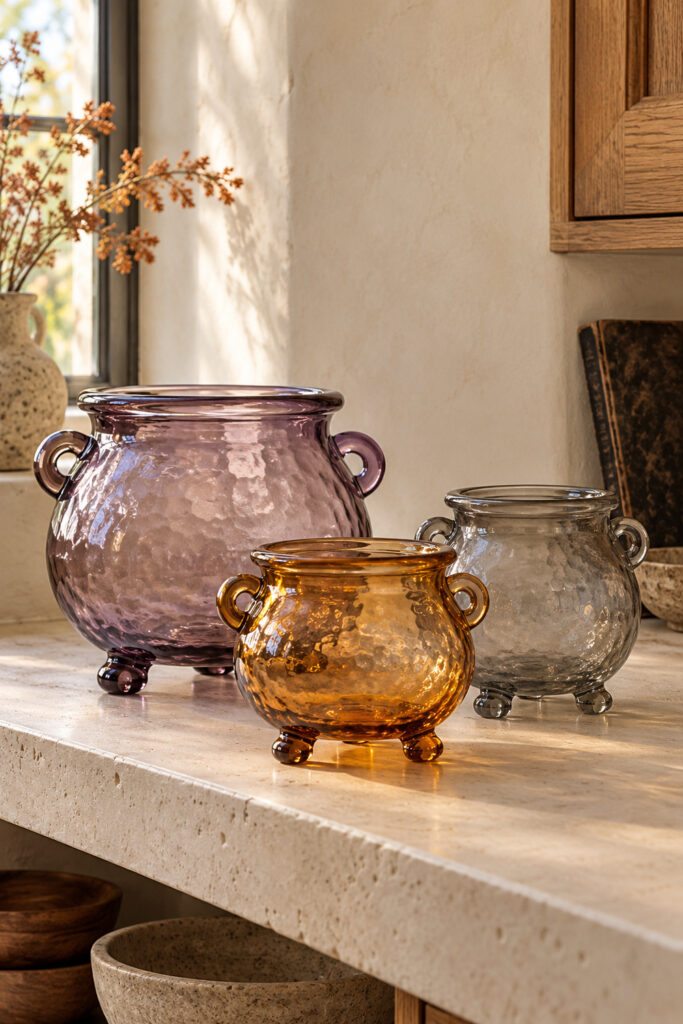
Before adding another Halloween accent, turn the smallest amber pot slightly and step back. A clear rim, visible handle, and little breathing room will do more for this display than one more object squeezed onto the shelf.