*This post may contain affiliate links for which I earn commissions.*
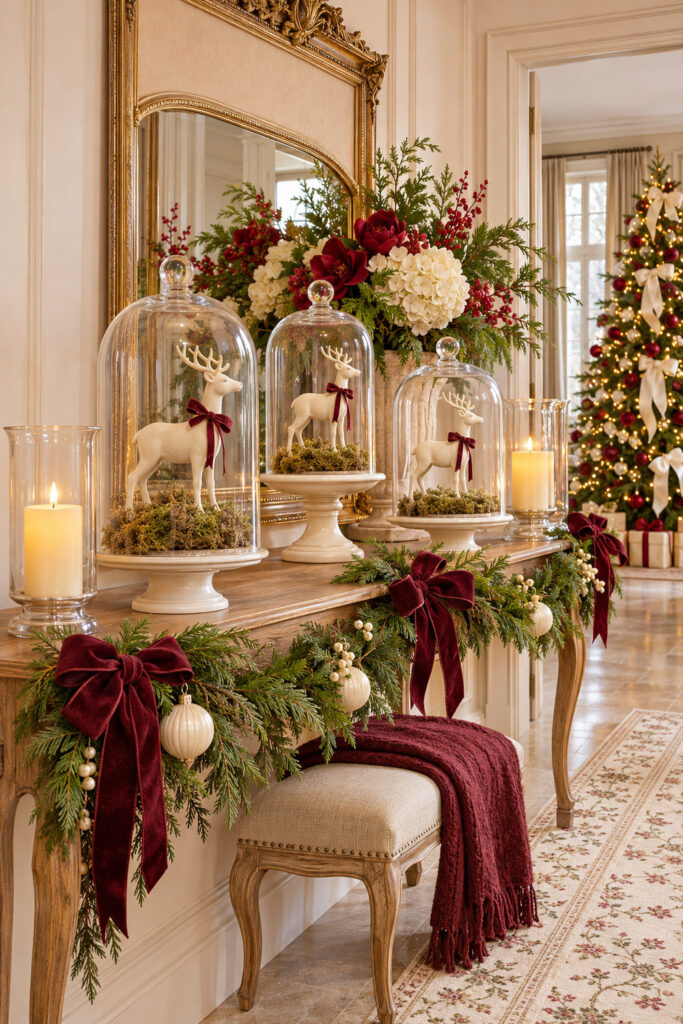
Three glass domes give these little ivory reindeer their own clear spaces on the Christmas hall table. The pale bases lift them above the wood, while burgundy ribbon and a full sweep of fir connect the separate pieces. Each animal stays visible instead of disappearing into a long garland.
The taller mirror and the tree beyond the doorway give the display its generous setting. You can borrow the arrangement with a small related collection and properly sized glass covers. The main idea is the rhythm of three enclosed scenes, with the surrounding greenery providing the soft, abundant layer that makes them feel at home.
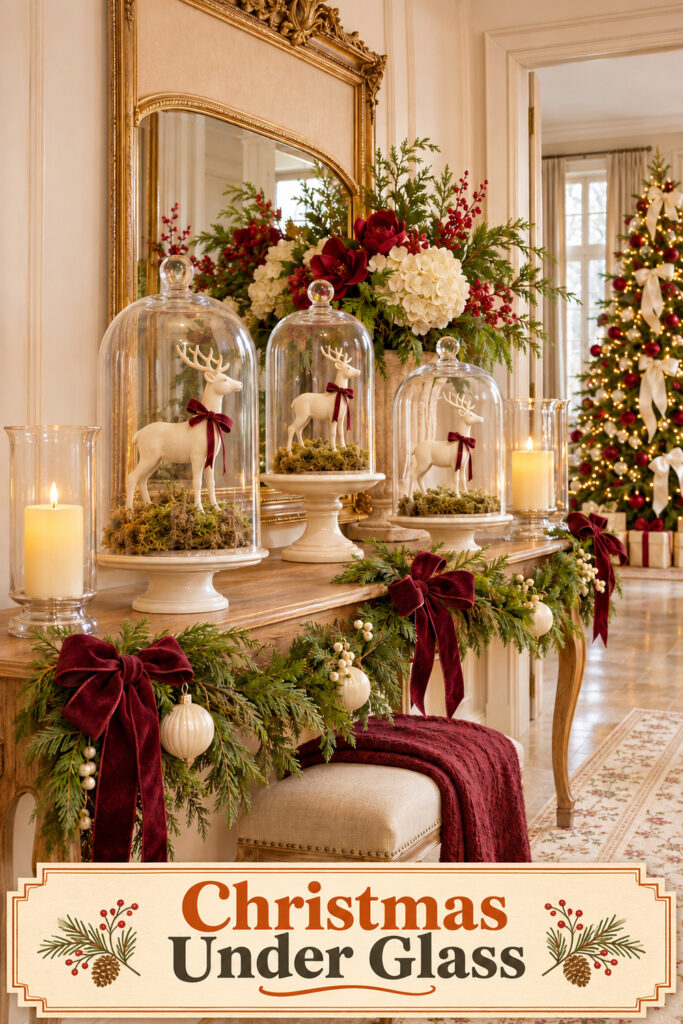
This image was generated with AI as decorating inspiration. Similar pieces can recreate its effect without matching the pictured objects exactly.
Give Each Reindeer Its Own Clear Outline
The glass separates the animals without cutting them off from one another. Ivory figures show gently against the darker moss below, and the repeated dome shape makes the collection feel planned. A small change in height keeps the group from becoming a rigid row.
Choose figures with related scale and simple shapes. Their antlers need enough room inside the covers that they don’t touch the sides or top. The dome should lift on and off freely, without requiring you to bend the figure or tilt it against the glass.
The individual scenes can stay quiet. Moss, a reindeer, and a narrow ribbon detail are enough inside each cover. The ornaments and fuller greenery belong around the group, where they can add Christmas color without making the little animals harder to see.
Match the Domes and Bases Before Decorating
Look for cloches that rest securely on their intended bases. A clear rim and a flat seating area matter more than an elaborate knob. The base should support the whole glass edge rather than leaving part of it hanging over a narrow ledge.
Set each empty pair on the console first. Check for rocking, cracks, and uneven surfaces, then lift the cover using the handling method suited to the piece. A decorative knob is not always a safe lifting handle, especially on an older or delicate cover.
The cream bases soften the transition between glass and oak. You can use a related set of plain wood or ceramic bases if their sizes suit the domes. Keep the finish simple enough that it doesn’t compete with the antlers and ribbon inside.
Vary the height with stable bases made for display, not hidden stacks of small objects. A low, broad riser can work when it fully supports the base above it. Keep the tallest scene toward the back and avoid raising it so far that it blocks the mirror or the other animals.
Make the Small Scenes Before Adding the Garland
Place a shallow layer of clean, dry decorative moss inside each base. Keep it away from the seating edge so the glass can close properly. The figure needs a firm position beneath it, not a deep nest that lets the legs sink at different angles.
Set the reindeer down gently and check that all its feet remain supported. If it leans, adjust the base layer before lowering the dome. Don’t use a fragile antler or another figure as a brace. The simple scene will look more graceful when the animal stands naturally.
The narrow burgundy neck ribbon repeats the larger bows outside. Keep its knot and tails small enough that they don’t cover the figure’s chest or catch the glass. You can omit that detail on a delicate piece and carry the color through the surrounding arrangement instead.
Lower the cover slowly, watching the antlers and rim. Once it is in place, look through the front and both sides. A small turn of the base can reveal a clearer profile without rearranging the whole scene. Keep enclosed displays unlit; the warm glow can come from separate lights nearby.
Use Greenery to Join the Three Displays
The fir garland makes one soft line across the console, with a controlled drop along the front edge. It links the pale bases while leaving their outlines clear. Burgundy velvet bows give the dark greenery a repeated point of color.
Keep the garland on its own suitable supports. It should not tug at a cloche, rest against a glass knob, or become wedged beneath a base. Fresh stems need suitable protection for the furniture, while artificial pieces should be checked for wire ends and loose material before being placed near delicate glass.
Leave some uncovered wood between the bases. That space gives each scene its own footing and helps the full arrangement look abundant rather than crowded. If the garland hides all the bases, shorten or redirect it before adding more ornaments.
The ivory ornaments outside the domes repeat the figures’ color at a smaller scale. Use a few that sit securely in the greenery and keep them away from the console edge. They should help connect the group, not create another collection in front of it.
Let the Hallway Supply the Larger Layers
The gilt mirror adds height and catches the tree lights from the doorway. Its warm frame suits the oak and burgundy without requiring more metal objects on the tabletop. Check the reflection from the hall’s usual approach so the collection has a calm background.
The separate hurricanes give the console its candlelit atmosphere. Suitable battery pillars keep the glow outside the enclosed scenes and away from the textiles. Leave enough space to reach their controls without lifting a glass cover or pulling the garland aside.
A smaller hall can use two cloches, or one generous scene with greenery beside it. Keep the glass collection within the console’s depth and clear of passing bags or sleeves. A narrow ledge that barely holds a dome is not a good place for this idea, even if it looks attractive from the front.
If you have another small winter figure, the same arrangement can work with it. Retain the separate clear spaces, pale bases, and surrounding Christmas layers. Avoid mixing too many unrelated characters inside the group; the repeated animal shape is part of its quiet charm.
Choose the Fit Before the Flourishes
Begin with compatible figures, covers, and bases. Add ribbon and greenery only after the glass sits securely around each scene.
Look for Clear Glass Cloches
Check their internal height and width against the figures. The covers need room around the antlers as well as a steady resting edge.
Look for Plain Display Bases
Choose a full supporting surface and a finish that lets the figures stand out. Use stable, purpose-made risers when a height change is needed.
Look for Narrow Velvet Ribbon
A small width will suit the animals without hiding their shape. Repeat the same color in a larger bow outside the domes if you want a stronger connection.
Check the Collection from the Hall Entrance
Make sure all three animals can be seen at once. Look for glare that hides a face, greenery covering a base, or a figure touching the glass. Then walk past the console and confirm that the display stays comfortably inside its surface.
Final Styling Tip
Turn the nearest reindeer slightly toward the other two. That small change connects the scenes while leaving each silhouette clear beneath its own dome.