*This post may contain affiliate links for which I earn commissions.*
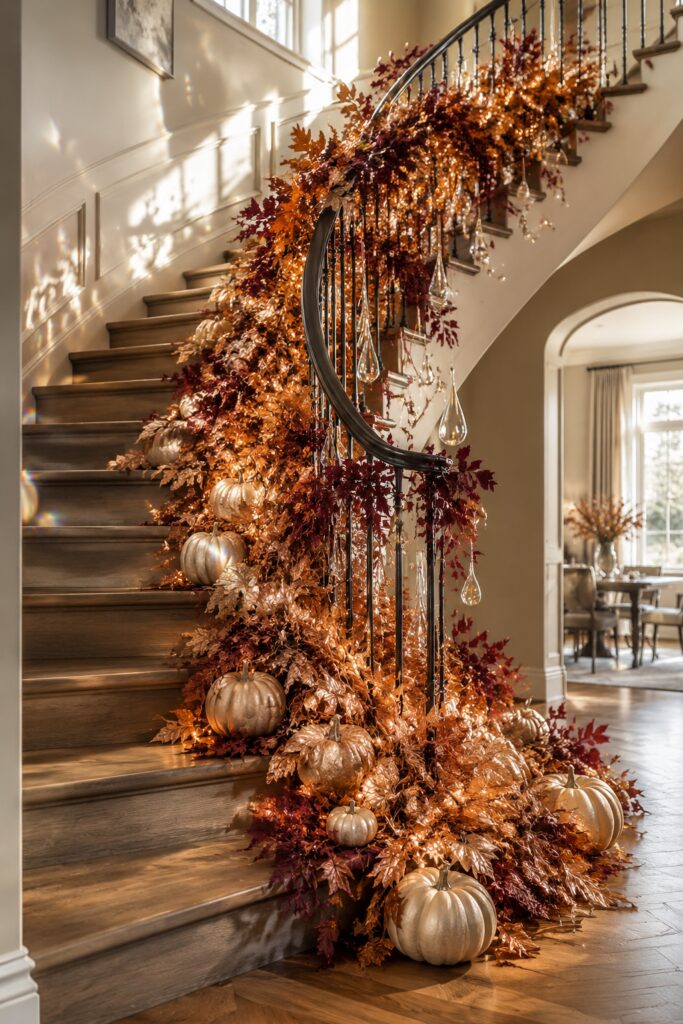
A staircase offers enough height and movement to support seasonal decorating on a grand scale. In this entryway, copper leaves, burgundy foliage, champagne pumpkins, warm lights, and clear hanging drops follow the entire curve of the railing.
The arrangement is more than a garland attached to a banister. It behaves like an abundant autumn installation, beginning high on the staircase, spilling down the steps, and gathering into a generous pool of foliage at the base.
Metallic finishes give the familiar fall palette a more polished character. Copper replaces conventional orange, burgundy provides shadow and contrast, and champagne pumpkins introduce softly reflective highlights.
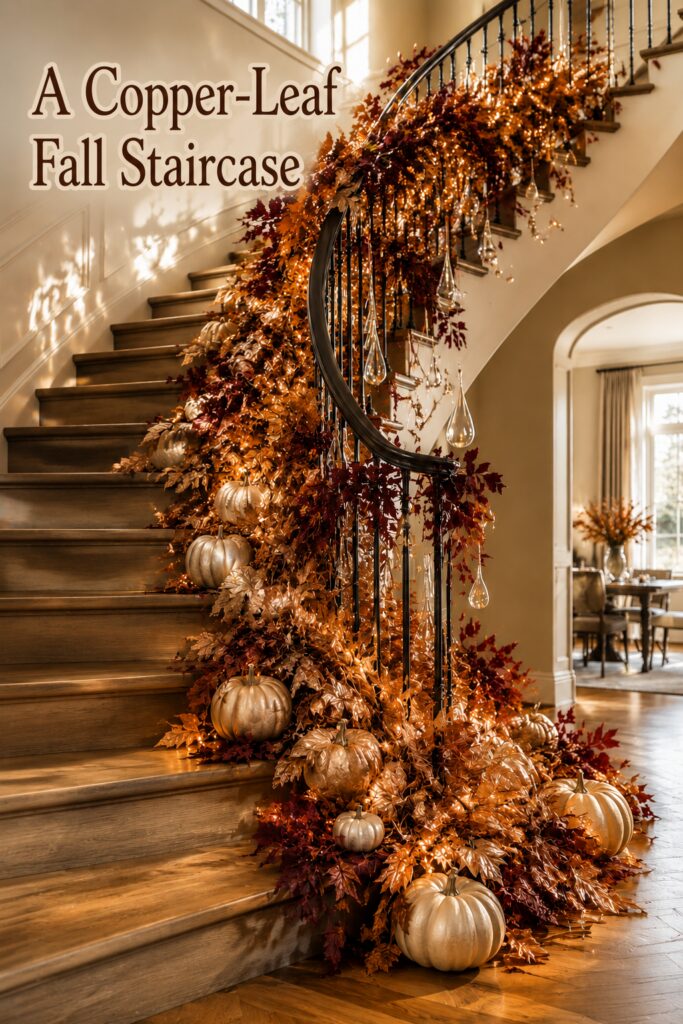
The inspiration image featured in this post was created with AI.
Why the Cascading Design Feels So Dramatic
The staircase naturally creates a strong diagonal line. Following that line with foliage emphasizes the architecture and guides the eye from the bottom of the stairs toward the upper landing.
Instead of keeping the garland at one consistent thickness, the arrangement expands and contracts. It is relatively narrow along parts of the handrail, fuller at the turn, and especially abundant near the lowest steps and newel post.
This variation is what gives the installation its cascading quality. A perfectly even garland would look more formal and restrained.
The decorations also extend vertically. Glass drops hang below the handrail, leaves reach above it, and pumpkins sit close to the floor. Using the space above, beside, and below the railing makes the arrangement feel dimensional.
Building the Copper and Burgundy Palette
Copper leaves establish the dominant color. Their reflective surfaces catch the tiny lights and the natural sunlight entering through the upper windows.
The metallic finish works best when it appears in several tones. Rose copper, burnished bronze, muted gold, and deeper penny shades make the foliage look layered rather than uniformly sprayed.
Burgundy leaves are woven through the copper in irregular clusters. These darker sections create visual pauses and help define the shape of the cascade. Without them, the lights and metallic foliage could merge into one glowing band.
When recreating the palette, begin with natural-looking fall garlands in rust or burgundy. Add metallic leaf sprays and copper garland as the upper layer. This approach creates more depth than using metallic foliage alone.
Warm Lights Woven Through the Leaves
Micro lights give the staircase its luminous character. The small bulbs are distributed throughout the foliage instead of sitting only along the outer edge.
Lights are easiest to add before the finished garland is secured to the staircase. Stretch the foliage across the floor, weave the wire through the central stems, and leave enough slack at the ends to reach a concealed battery pack or power source.
Choose warm white or soft golden light rather than cool white. Warm bulbs flatter copper, burgundy, cream, and wood tones while maintaining the autumn atmosphere.
If the staircase is used frequently, secure every section of wire so it cannot fall across a tread or catch on clothing. Keep battery boxes accessible but hidden behind foliage near a post or landing.
Champagne Pumpkins Among the Foliage
The pumpkins are nestled into the leafy cascade rather than lined up separately. Their pale champagne finish provides contrast while remaining part of the metallic color story.
Several sizes make the display more convincing. Larger pumpkins anchor the base and lowest steps, while smaller ones fill spaces higher along the staircase.
A mix of matte, satin, and lightly distressed finishes will look more dimensional than a collection in one highly reflective gold. Cream pumpkins can also be brushed or lightly painted with champagne metallic color if a close finished match is difficult to find.
Position pumpkins beside the railing rather than in the walking path. Museum putty, removable adhesive strips, or concealed wire can help stabilize lightweight pieces.
Clear Teardrops Add an Unexpected Detail
The suspended glass drops are what make this staircase especially distinctive. They hang from the railing at varied lengths and resemble large droplets of rain or dew beneath the glowing leaves.
Clear ornaments work because they introduce shine without adding another color. Their transparency also prevents the lower side of the railing from feeling visually heavy.
For a frequently used staircase, lightweight acrylic drops are a practical substitute for glass. They can still catch the light while reducing the chance of breakage.
Hang the drops on the outside of the balustrade, away from the stairs. Vary the lengths and leave open spaces between them so each one remains visible.
Key Pieces for Recreating the Staircase
Copper Metallic Leaf Garland
This forms the glowing outer layer and establishes the unusual metallic palette.
Burgundy Fall Foliage
Deep red leaves provide contrast, shadow, and the appearance of late-season foliage.
Warm Micro String Lights
Fine wire lights can disappear into the branches while illuminating the leaves and pumpkins.
Champagne-Gold Pumpkins
Assorted sizes create visual rhythm and help the cascade transition from the railing to the floor.
Clear Teardrop Ornaments
Hanging drops introduce movement and reflect points of light beneath the railing.
Reusable Garland Ties
Flexible ties hold the layered materials securely without requiring permanent changes to the staircase.
Arranging a Similar Fall Staircase at Home
Measure the usable length of the railing before purchasing garland. A full cascade generally requires more than the railing’s linear measurement because the material needs enough length to drape, overlap, and gather at the bottom.
Combine the copper and burgundy garlands on the floor first. Use the burgundy foliage as the base, then add copper leaves in uneven clusters. Weave the lights through both layers before lifting the arrangement.
Begin securing the garland at the upper landing and work downward. Attach it to sturdy posts or balusters rather than relying on the handrail alone. Keep the upper surface of the rail clear if people need it for support.
Increase the fullness near the curve and newel post. Additional leaf sprays can conceal joins and make these transition points look intentional.
Place the largest pumpkins at the bottom, where they provide visual weight. Tuck medium pieces among the lower garland and reserve the smallest pumpkins for wider stair edges or secure positions beside the railing.
Add the clear drops last. Step back frequently to compare their lengths and spacing.
Most importantly, preserve a safe walking route. Keep decorations tight to one side, leave the center of every tread unobstructed, and avoid trailing lights or loose foliage.
Shop Similar Pieces for the Copper Staircase
Shop Copper and Gold Leaf Garland
Look for wired garland that can be shaped around posts and layered with other foliage.
Add Burgundy Maple Leaves
Deep burgundy creates the contrast required to define the metallic cascade.
Weave in Warm Micro Lights
Select fine wire lights with a timer and an accessible power source.
Gather Champagne Pumpkins
Use several sizes and finishes to keep the arrangement from looking overly matched.
Hang Clear Teardrop Ornaments
Choose glass for a decorative staircase or lightweight acrylic for a busier household.
Secure the Arrangement With Garland Ties
Reusable ties make it easier to adjust and remove the installation without damaging the railing.
Final Styling Tip
Concentrate the greatest volume near the newel post and base of the stairs. That extra fullness makes the foliage appear to flow naturally downward while allowing the upper railing to remain graceful.