*This post may contain affiliate links for which I earn commissions.*
A historic library provides an unexpectedly wonderful setting for Thanksgiving. Warm wooden tables, rows of books, arched windows, green reading lamps, and an ornate ceiling give this room a sense of tradition. Against that scholarly backdrop, a spirited harvest table introduces teal, cranberry, orange, mustard, and green.
The finished tablescape feels formal enough for a special gathering but far from predictable. Patchwork pumpkins replace a conventional floral runner, jewel-toned goblets sparkle in the sunlight, and a tall maple-leaf arrangement reaches toward the library’s grand architecture.
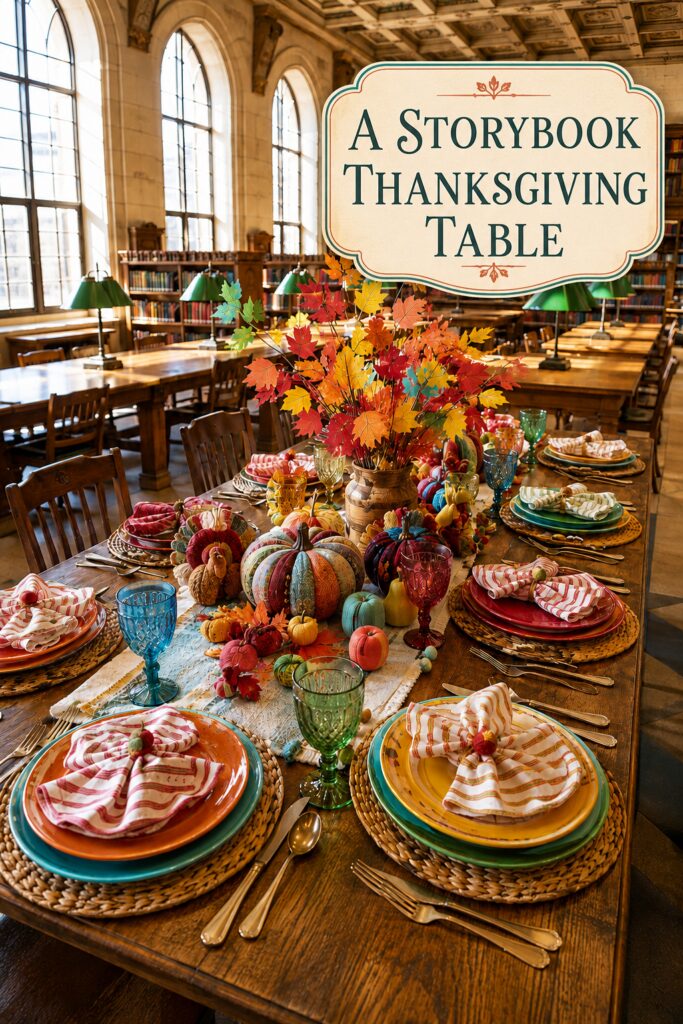
This inspiration image was created with AI. It is intended to offer decorating ideas that can be recreated with similar pieces rather than exact products from the scene.
What Makes This Library Thanksgiving Table Work
Traditional Surroundings Meet an Unexpected Palette
The library supplies a classic foundation through dark wood, vintage furniture, old books, and traditional architecture. Instead of repeating those quiet brown tones, the table introduces saturated fall colors.
Orange and cranberry provide familiar Thanksgiving warmth, while teal and turquoise make the composition distinctive. Mustard yellow, forest green, and burgundy connect the cooler shades to the wooden surroundings.
This type of palette works especially well in a room with brown furniture. Natural wood acts almost like a neutral, giving the stronger colors space to stand out.
A Tall Centerpiece Suits the Grand Room
The centerpiece begins with a substantial pottery vase filled with long maple branches. Its height is appropriate for the tall windows, high ceiling, and large bookcases.
The loose branching silhouette is important. Although the leaves are abundant, open spaces between the stems keep the arrangement from appearing like a solid block. Light can pass through it, and the architecture remains visible behind it.
At a real Thanksgiving meal, a tall arrangement may interrupt conversation. It can remain on the table while guests arrive and then be moved to a sideboard before dinner. Another option is to use a narrower vessel with branches that rise above seated eye level.
Color Travels Down the Entire Table
The leaf arrangement establishes the palette, but it does not carry the design alone. Those same colors are repeated in the pumpkins, turkeys, plates, glasses, napkins, and small decorative accents.
This repetition leads the eye from one end of the long table to the other. No single place setting feels disconnected because every color appears more than once.
For a smaller dining table, the same principle applies. Repeat each principal color in at least two or three locations instead of introducing a different shade with every new accessory.
Mixed Place Settings Follow a Consistent Formula
The plates are not identical in color. Some settings lean toward orange and teal, while others feature cranberry, yellow, or deep green. The consistent stacking method keeps the assortment organized.
Every place begins with a round woven charger. Dinner and salad plates are layered on top, followed by a striped cloth napkin gathered near the center. Embossed goblets provide another repeated shape.
Using one consistent charger and one napkin pattern is an easy way to unify mismatched or multicolored dishes already collected at home.
Fabric Pumpkins Add Storybook Texture
The largest pumpkins appear to be assembled from several patterned fabric panels. Their quilted appearance fits the old-school library setting because it feels handcrafted, nostalgic, and slightly whimsical.
Smaller fabric pumpkins and turkeys fill the spaces around them. The mixture of scales gives the centerpiece the abundance associated with a harvest display without relying on a single oversized decoration.
Soft fabric also balances the hard surfaces of the wooden table, ceramic plates, glass goblets, and metal flatware.
Natural Materials Keep the Table Grounded
Woven chargers and an ivory table runner provide quieter areas between the stronger colors. Their natural textures prevent the place settings from feeling too polished or formal.
The runner also defines a clear decorating zone. Pumpkins and leaves remain near the center, leaving sufficient space for plates, glasses, and flatware.
Key Pieces to Recreate the Look
Mixed Jewel-Tone Dinnerware
Look for plates in teal, orange, mustard, cranberry, and green. They do not need to come from one matching collection.
If you already own neutral dishes, add only a multicolored salad plate at each setting. This provides the visual effect without requiring an entirely new dinnerware set.
Round Woven Chargers
Natural woven chargers give every setting the same foundation. They also create a useful buffer between saturated plates and the dark wooden table.
Choose a flat or tightly braided design so dinner plates remain stable. A diameter of approximately 13 to 15 inches generally provides enough border around a standard dinner plate.
Striped Cloth Napkins
The ivory napkins feature narrow lines in warm harvest colors. Stripes add energy without competing with the patchwork pumpkins.
Use the same napkin at every seat, even when the plate colors differ. Gather each one loosely with a simple ring or a small seasonal accent.
Assorted Embossed Goblets
Blue, green, amber, and cranberry goblets catch the sunlight and distribute color above the plate level. Embossed or pressed-glass patterns suit the historic surroundings particularly well.
A coordinated assortment will create the look more easily than purchasing six separate colors. Clear goblets can also work if the dinnerware already provides enough variation.
Patchwork or Velvet Pumpkins
Use one or two medium fabric pumpkins as the center of the low arrangement. Surround them with smaller pumpkins, gourds, leaves, or fabric ornaments.
A true patchwork version can be made with several coordinating fabric remnants. For a simpler substitute, gather velvet pumpkins in teal, orange, burgundy, mustard, and green.
Tall Maple-Leaf Branches
A generous spray of maple branches gives the table its necessary height. Look for stems with several leaf sizes and natural bends instead of perfectly uniform branches.
Traditional red, orange, and yellow leaves can form the foundation. A few teal leaves may be added with decorative stems, painted faux foliage, or carefully selected craft leaves.
How to Style This Thanksgiving Table at Home
Start by spreading an ivory or oatmeal runner along the center of the table. It should be narrow enough to leave the wooden surface visible beneath the chargers.
Place the tallest vase at the midpoint. Add the long branches first, turning some outward so the arrangement has width as well as height. Step back frequently to check that one side is not noticeably fuller.
Arrange the largest fabric pumpkins near the vase. Continue outward with smaller pumpkins, gourds, fabric turkeys, and autumn leaves. Allow the decorations to become lower and sparser as they approach the ends of the table.
Build each place setting from the bottom upward. Begin with a woven charger, add two contrasting plates, and finish with a loosely gathered striped napkin. Alternate goblet colors around the table rather than grouping all the blue or green glasses together.
Leave enough empty space for serving dishes and drinks. The inspiration is abundant, but a usable dining table still needs breathing room.
Shop Similar Pieces for a Library-Inspired Table
Shop Mixed Jewel-Tone Dinnerware
Look for individual plates or assorted sets featuring teal, orange, yellow, green, and cranberry.
Add Round Woven Chargers
Natural water-hyacinth or rattan chargers provide the texture that anchors each layered place setting.
Look for Striped Cloth Napkins
Choose washable fabric napkins with an ivory background and narrow rust, gold, green, or cranberry stripes.
Shop Assorted Colored Goblets
Embossed goblets in several jewel tones will reproduce the light-catching quality seen across the table.
Find Fabric Pumpkins
Combine patchwork, knit, or velvet pumpkins in varied sizes to create the low harvest display.
Add Tall Autumn Branches
Look for maple stems with enough height and branching structure to form an open, graceful centerpiece.
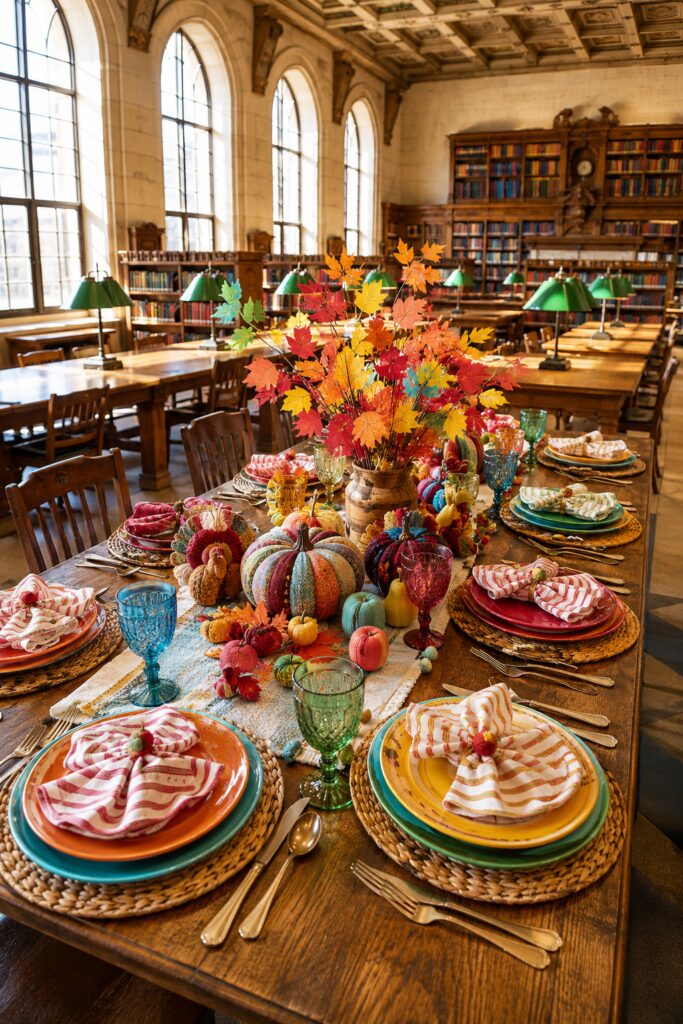
Final Styling Tip
Unify several strong colors by repeating one charger shape, one napkin pattern, and one centerpiece texture throughout the table.