*This post may contain affiliate links for which I earn commissions.*
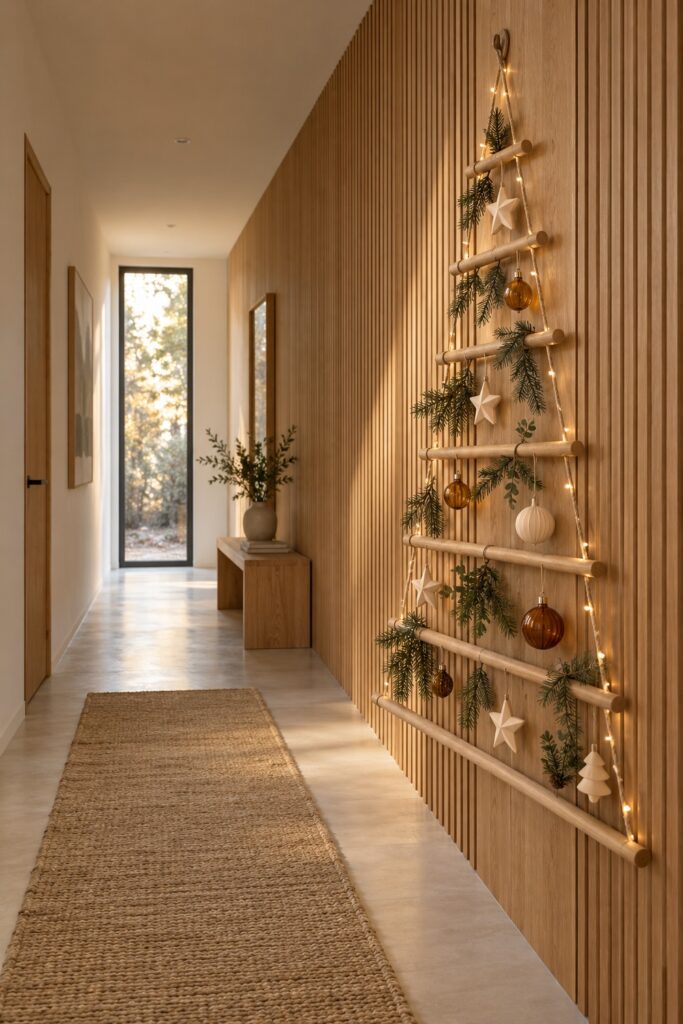
A Christmas tree made from graduated wooden rods takes advantage of the wall instead of the floor in this hallway inspiration. Cream stars, amber ornaments, scattered greenery, and small lights decorate the open structure, while the oak slats remain visible behind it.
The rods aren’t hidden beneath a thick garland. Their shape is the idea. That makes this a useful reference for a hallway where you want something seasonal but still need the passage clear. You can adapt the same combination to a plain wall, a stair wall with appropriate clearance, or a narrow room that has little space for a full tree.
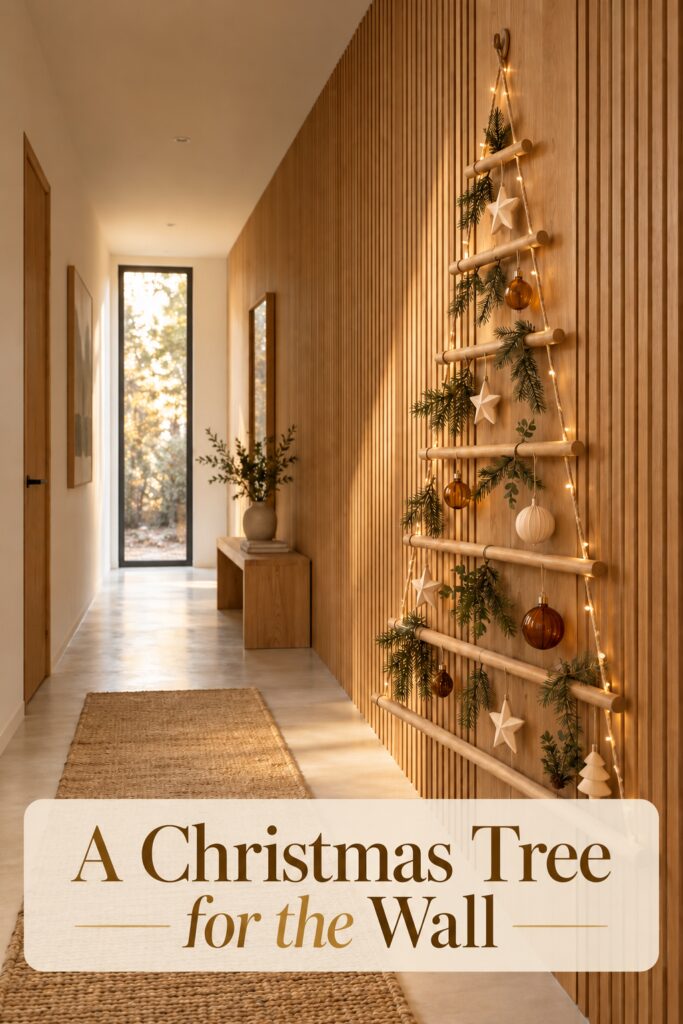
The inspiration image was created with AI and depicts an imagined decorating arrangement rather than a verified physical installation.
What Makes the Wall Tree Recognizable
The rods become longer as they move downward, forming a triangle with surprisingly little material. The connecting cords outline the sides, so the eye fills in the tree shape even though there are open spaces between the rows. Those spaces are important: they let the oak wall stay part of the display.
A small selection of ornaments does the seasonal work. Cream stars provide pale shapes, amber baubles repeat the wood’s warmth, and evergreen sprigs soften the straight rods. The decorations vary in size and position rather than sitting at the same point on every row.
The small lights follow the outline without turning it into a solid bright border. If you want a similar effect, let the light strand support the shape instead of wrapping every rod heavily. A lightly decorated structure is easier to recognize from the hallway entrance.
Find Hanging Wooden Christmas Trees
Browse current Amazon options that can help you recreate this look.
Browse Hanging Wooden Christmas Trees on Amazon →As an Amazon Associate I earn from qualifying purchases.
Key Pieces for a Wooden Wall Tree
A Graduated Wooden Ladder Tree
A hanging ladder style tree made from straight dowels is the closest starting point for this inspiration. Look for rods that increase evenly in length, with a sturdy cord connection and a hanging point suited to the finished weight. Pale natural wood will blend gently with oak while still showing its outline.
A branch version can be a useful substitute, but it will look less regular. Choose fairly straight branches if you want to preserve this image’s orderly structure.
Cream Star Ornaments
The pale stars break up the brown and green without introducing a strong new color. Look for lightweight versions with visible points and simple hanging loops. Matte paper, wood, or other light decorative materials can provide a similar effect, depending on the support you choose.
Use fewer stars than you initially think you need. Give each one enough open space to show its shape, and vary the hanging length slightly. If every star touches a rod or overlaps another ornament, the open wall tree starts to look much denser.
Amber Hanging Baubles
Amber ornaments bring a little shine to a mostly matte arrangement. Their rounded forms also contrast with the straight rods and pointed stars. The inspiration suggests translucent brown gold baubles, but you can borrow the color with lightweight shatter resistant ornaments where glass would be impractical.
Check the hanger and the ornament weight together. A delicate wall tree should carry small decorative pieces rather than heavy ornaments collected from a large floor tree. One or two amber pieces can make the color clear on a smaller version.
Small Evergreen Sprigs
Use short sprigs that leave most of each rod visible. Cedar style foliage works particularly well because its flatter sprays can hang beside the wood without forming a large round mass. A few slightly longer pieces can trail down between the rows.
Faux greenery is easy to position and avoids falling needles in a hallway. Attach it in a way that suits the tree’s construction and doesn’t damage the rods or cord. Keep wire ends tucked out of reach and avoid wrapping so tightly that the cord becomes distorted.
Fine Warm White Lights
Small lights can trace the sides of the triangle or run loosely through the greenery. Choose a strand appropriate for indoor use and the mounting arrangement, with a power source you can reach. The display should remain attractive when the lights are off, so don’t depend on them to conceal gaps or uneven spacing.
Keep the battery box accessible and support it separately if its weight would pull the tree crooked. For a plug-in strand, route the cable away from the walking path and follow the manufacturer’s guidance. Use lights as lights, not as the cord that holds the structure together.
Style the Tree for Your Available Wall
Measure the usable wall area before choosing the base. Include nearby switches, door swings, and any place where a coat, bag, or shoulder might catch the ornaments. The wall tree saves floor space, but hanging decorations still project into the room.
Test the approximate triangle with paper or removable tape suited to your wall finish. View it from the end of the hall as well as straight on. A tree that feels modest head-on may dominate a short passage when seen at an angle.
Install a suitable support for the combined tree and decoration weight. Follow the mounting instructions for both the hanger and the tree, and don’t assume a decorative cord loop makes any wall hook appropriate. The inspiration shows a finished visual idea, not a tested hanging system.
Once the base hangs evenly, add the greenery first. Place a few sprigs on alternating sides and keep their attachment points near the rods. You want enough green to suggest a Christmas tree without covering the graduated wooden shape that makes this one different.
Hang the largest star where there is a clear area around it, then place the smaller stars farther down. Check whether the points remain visible from the hallway approach.
Distribute the amber ornaments among the stars rather than grouping them all on one side. Let some hang a little below a rod and others closer to it. Watch the total weight on each row, particularly if the rods are tied rather than fixed in position.
Add the lights last so you can see where they are actually needed. Keep the strand loose enough to follow the structure without pulling on the cords or pressing ornaments against the wall.
On a plain painted wall, the same natural wood can become more prominent than it is against oak slats. Keep the ornament selection simple so the contrast remains pleasing. On a dark wall, cream stars may do more of the visual work than the rods.
If your hallway is narrow, choose a flatter base and shorter hanging loops. The look depends on the triangle and the small collection of colors, not on deep layers. Finish by walking past with the sort of bag or basket you normally carry and checking that the display stays comfortably out of the way.
Shop Similar Pieces
Look for Hanging Wooden Christmas Trees
Compare the rod lengths, cord connections, overall depth, and recommended load. A base with visible gaps will support this sparse decorating approach better than one already covered in dense greenery.
Shop Similar Cream Stars and Amber Ornaments
Match the color relationship before matching the exact material. Lightweight pale stars and warm brown gold baubles are useful companions, provided their scale suits the wooden rows.
Add Small Greenery Sprigs and Fine Lights
Choose greenery you can divide into modest pieces and a light strand with a reachable power source. You can skip the lights if your wall already has good evening illumination and the arrangement reads clearly without them.
Final Styling Tip
Leave at least a few rods mostly undecorated. Seeing the wood and cord is what makes this wall tree interesting, so let the structure share the spotlight with the ornaments.