*This post may contain affiliate links for which I earn commissions.*
A Halloween village does not need dark lighting, haunted figures, or an elaborate tabletop landscape to make an impression. This whimsical collection relies on a tightly controlled palette of ivory ceramic walls, glossy purple roofs, black doors, and warm orange windows.
Seven houses are arranged on three ivory shelves, creating a vertical display that gives every building room to be noticed. Their shapes vary from narrow townhouses to a turreted cottage and a tiny chapel silhouette. Black bottlebrush trees and curled purple velvet ribbon provide scale, contrast, and a little softness between the glossy ceramic pieces.
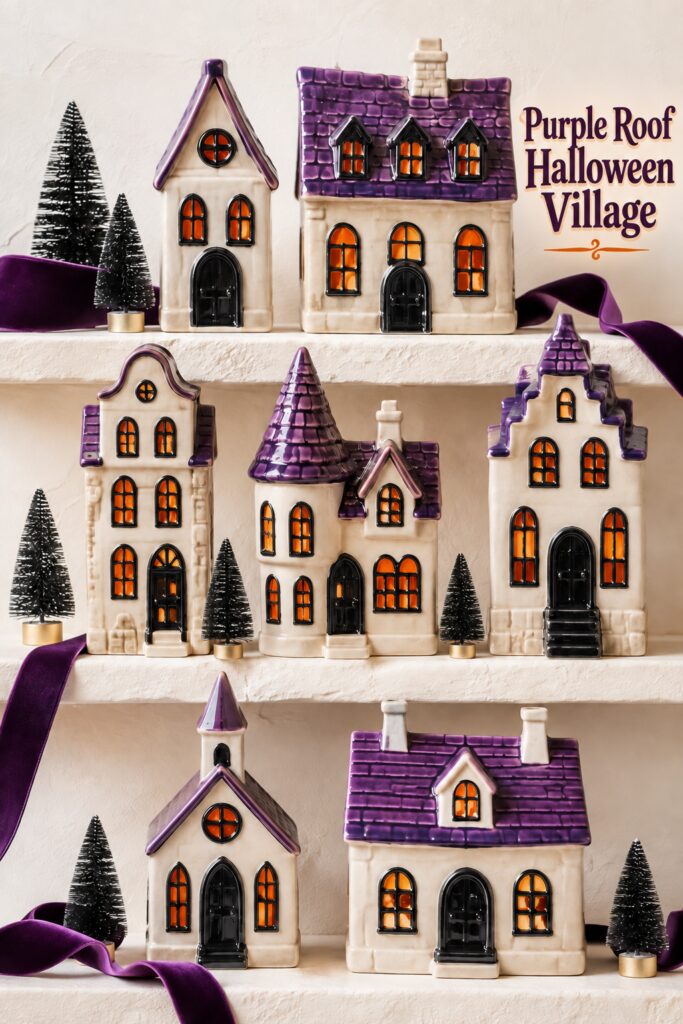
This inspiration image was created with AI and is intended to offer ideas for assembling a similar display with related decorative pieces.
A Limited Palette Makes Different Houses Feel Collected
The buildings do not share one identical shape, but they clearly belong in the same collection. Repeating four main colors is what makes that possible.
Ivory forms the body of every house. Purple defines the roofs, black outlines the doors and windows, and orange fills the window openings. Even when the rooflines, chimneys, windows, and building proportions change, the palette keeps the arrangement cohesive.
This is a useful approach when collecting seasonal houses over time. The pieces do not have to come from one set. Concentrating on a consistent palette can make individually found houses look intentional when displayed together.
Find Unpainted Ceramic Houses
Browse current Amazon options that can help you recreate this look.
Browse Village Pieces on Amazon →As an Amazon Associate I earn from qualifying purchases.
When comparing possible additions, consider their dominant colors before focusing on every architectural detail. An ivory building with black trim could blend into the collection even if its roof needs a small purple accent or its windows use a slightly different shade of orange.
Purple Roofs Give the Village Its Personality
The saturated purple roofs are the most distinctive elements in the image. Their glossy finish catches the light and brings out the molded shingles, tiles, ridges, and turrets.
Purple is strongly associated with Halloween, but it feels playful here rather than ominous. Pairing it with cream walls keeps the display light, while the orange windows provide a lively complementary contrast.
Look for houses with purple roofs already included, or consider unfinished ceramic village pieces that can be customized. A glossy purple ceramic-compatible paint could be used to update plain roofs, provided the finish and application method are appropriate for the original material.
Varying the roof architecture will make the collection more interesting. Combine steep gables, stepped profiles, flat townhouse roofs, towers, and small chimneys. Repeating the purple finish will keep those different shapes connected.
Orange Windows Supply Warmth Without a Dark Room
The orange windows appear luminous even though the display is photographed in strong ambient daylight. Their saturated inserts create the impression of warm interiors while allowing every ceramic detail to remain visible.
This effect keeps the display suitable for a bookshelf, kitchen hutch, mantel, or daytime entryway where dramatic nighttime lighting may not be practical.
When shopping for similar houses, look for translucent amber or orange window panels. If a house is designed to be illuminated, use only the lighting type recommended for that piece.
Battery-operated lights can produce a soft glow inside compatible open-backed houses. However, the windows do not need to be illuminated to contribute color. Orange translucent material, colored inserts, or painted window recesses can produce a similar daytime effect.
The orange should remain concentrated inside the windows. Spreading it across the roofs or walls would weaken the crisp four-color palette that makes the collection distinctive.
Black Trim Defines the Architecture
Glossy black frames make the windows and arched doors easy to recognize against the ivory walls. The strong outlines give each house a slightly storybook appearance.
Black also relates directly to the miniature bottlebrush trees. Repeating it in large doors, narrow window frames, and small trees distributes the darkest color throughout the shelves.
If assembling houses from different collections, black paint can sometimes help unify mismatched doors or trim. Any refinishing should be tested on an inconspicuous area and performed only with products appropriate for the surface.
Use black selectively. Keeping it on the architectural outlines allows the display to retain its light overall appearance.
Varied Silhouettes Keep the Shelves Interesting
The houses include several distinct architectural shapes. One is narrow and steeply gabled. Another resembles a broad townhouse with dormer windows. The center shelf features a prominent turret, while the lower shelf includes a small chapel-like building.
This variety creates a skyline on every level. A row of identical rectangular houses would not produce the same sense of movement.
Place the tallest or most unusual building near the center of a shelf, then balance it with one or two simpler structures. The pieces do not need to be arranged from shortest to tallest. Slightly uneven rooflines feel more village-like and give each shelf its own composition.
Leave some space between buildings. A narrow gap filled with one small tree is usually more effective than pressing every structure together.
Staggered Shelves Turn the Collection Into Wall Decor
The three thick ivory shelves nearly disappear against the cream wall, allowing the ceramic houses to receive most of the attention. Their staggered spacing creates separate scenes while still reading as one tall display.
A similar collection could be arranged on floating shelves, a bookcase, a mantel with risers, or several levels of a hutch. The important idea is to vary the height rather than placing every building in one long row.
On deeper furniture, use sturdy risers beneath the back row so the windows and rooflines remain visible. Cover the risers in a color similar to the shelf or wall to keep them visually quiet.
Check the weight rating of shelves before displaying ceramic pieces. Every house should sit fully on a stable surface rather than extending over an edge.
Black Bottlebrush Trees Provide Scale and Contrast
The miniature black trees help the houses feel like part of a village rather than unrelated ceramic objects. They also fill small openings without introducing another strong color.
Different tree heights are placed throughout the shelves. Larger trees stand beside taller buildings, while compact trees occupy narrow gaps or frame the lower houses.
Choose trees with slim profiles so they do not hide the orange windows. Matte or lightly textured black trees will contrast nicely with the glossy roofs and doors.
Gold bases add a small amount of warmth and relate to the orange windows. Black, brass-tone, or simple wood bases could also work if they support the established palette.
Purple Velvet Ribbon Softens the Hard Surfaces
Loops of purple velvet ribbon travel behind and in front of the houses. The fabric repeats the roof color while introducing a soft texture among the ceramic pieces and plaster shelves.
The ribbon is not tied into formal bows. Instead, it curls loosely through the display, making the shelves feel styled without creating another obvious focal point.
Use a wide ribbon that holds gentle curves. Place it after arranging the houses and trees so it can fill the remaining open spaces. Keep the ribbon below the windows and away from the front edges of the shelves.
The ribbon should appear occasionally rather than forming a continuous border. A few relaxed loops will be enough to connect the levels.
Similar Pieces to Consider
Shop Similar Ceramic Halloween Houses
Look for ivory or cream houses with black architectural trim, purple roofs, and orange windows. A mixture of building shapes will make the collection more interesting.
Look for Unfinished Ceramic Village Houses
Plain ceramic buildings can provide a starting point when the exact palette is difficult to find in finished pieces.
Add Purple and Black Ceramic Paint
Surface-appropriate paint can help coordinate roofs, doors, and window trim across houses obtained from different collections.
Shop Miniature Black Bottlebrush Trees
Choose several heights with narrow profiles so they can fill gaps without concealing the buildings.
Look for Purple Velvet Ribbon
Wide velvet ribbon can repeat the roof color and soften the hard surfaces when arranged in loose curls.
Add Ivory Display Risers or Floating Shelves
Neutral risers and shelves can establish multiple levels while allowing the ceramic colors and architectural shapes to remain the focus.
A Final Styling Thought
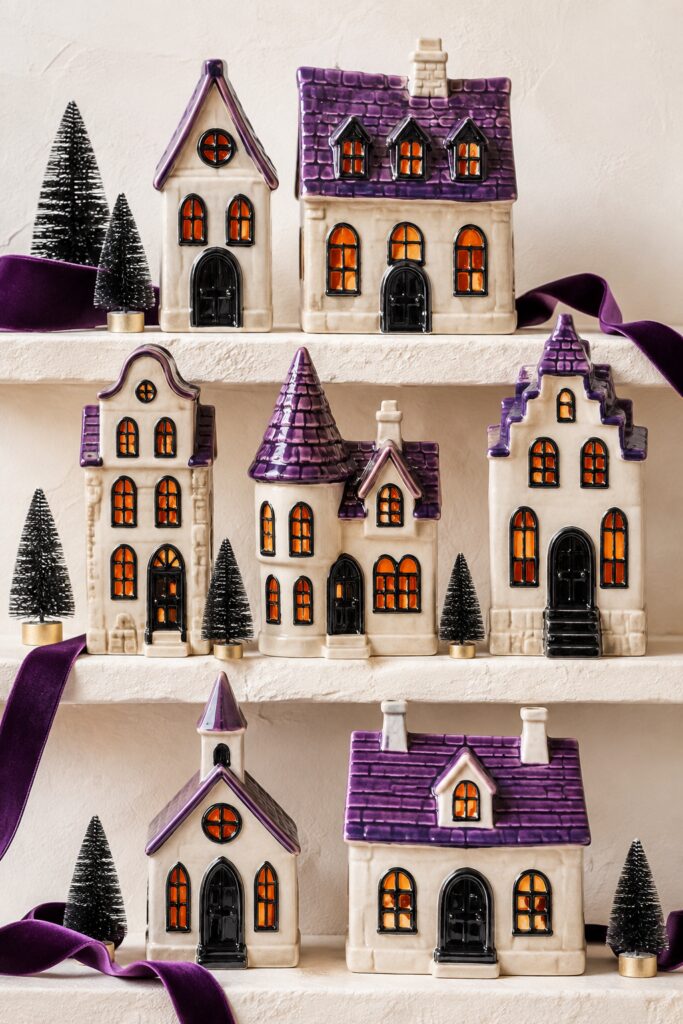
This Halloween village feels special because its pieces are coordinated without being identical. The repeated palette creates order, while the varied roofs, towers, doors, and windows give each building its own character. By limiting the supporting decorations to black trees and purple ribbon, you can make a collected display feel complete without surrounding the houses with unnecessary props.