*This post may contain affiliate links for which I earn commissions.*
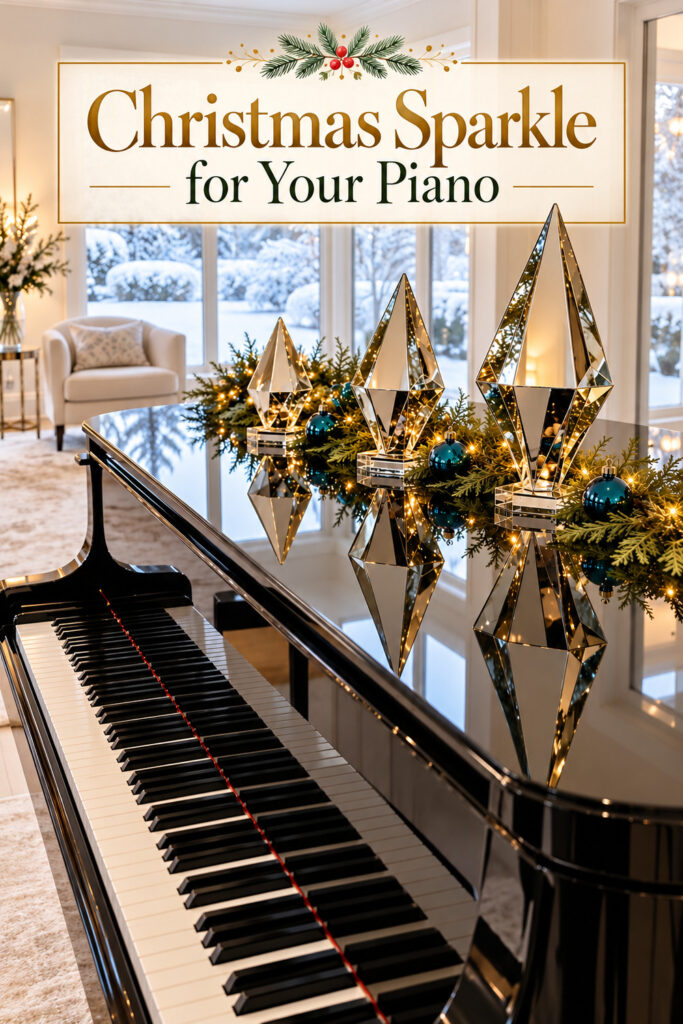
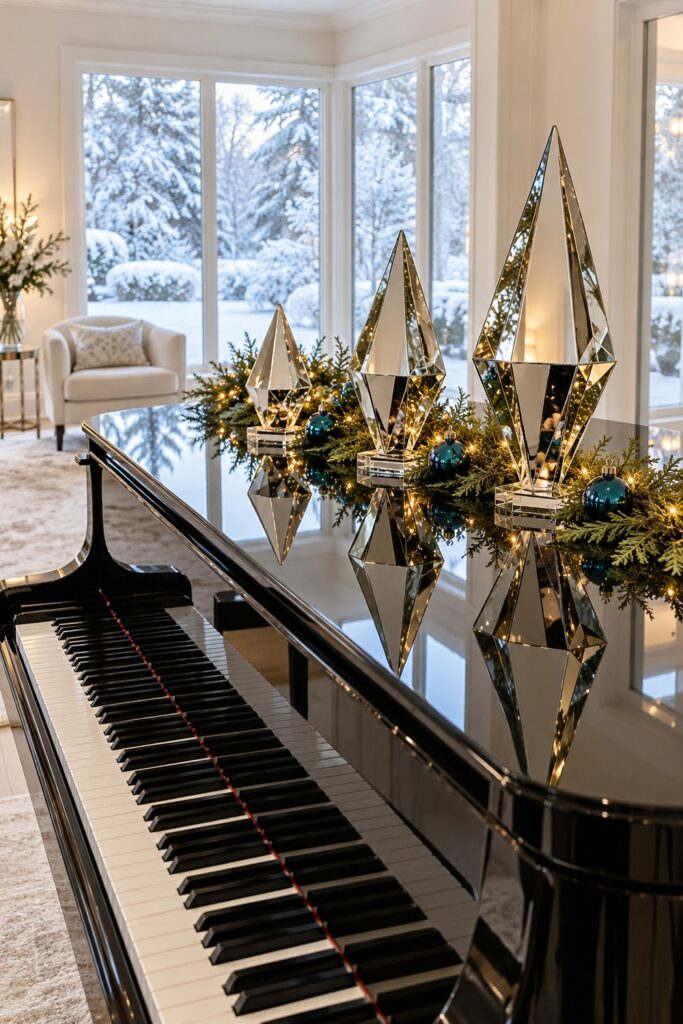
Three pointed mirror ornaments form a Christmas display across the closed lid of this black grand piano. Cedar, teal baubles, and tiny warm lights run around their bases, giving the angular shapes a softer setting. Their reflections appear on the piano surface, so a narrow arrangement has much more presence than its footprint suggests.
The idea is especially useful if you like Christmas decorations with strong shapes. You can recreate the contrast on suitable furniture without needing ornaments identical to these AI-inspired diamonds.
This inspiration image was created with AI.
What Makes the Piano Arrangement Work
The diamond forms rise in different heights, with the tallest near the right side of the image. That progression lets each ornament show its pointed outline. Their clear bases give the shapes a little separation from the greenery, which would otherwise hide the lower facets.
The black piano lid provides the strongest background. It reflects the ornaments and lights while keeping the overall display visually connected. The pale room and winter windows then make the dark furniture feel intentional rather than heavy.
Teal baubles are small compared with the mirrored diamonds, but the color is important. They interrupt the silver and black with a deeper jewel tone that still suits the cool reflections. Because the baubles sit low, they don’t compete with the main vertical shapes.
Cedar travels along the base instead of climbing up the ornaments. That keeps the seasonal layer narrow and preserves the faceted outline. The warm lights follow the greenery, so their glow appears in several places without becoming a separate bright object above the arrangement.
Find Geometric Mirrored Shapes
Browse current Amazon options that can help you recreate this look.
Browse Geometric Mirrored Shapes on Amazon →As an Amazon Associate I earn from qualifying purchases.
Key Pieces for a Sculptural Christmas Display
Freestanding Mirrored or Faceted Ornaments
Look for stable tabletop ornaments with angular surfaces. A pointed mirrored form is closest to the inspiration, but a faceted glass object or geometric metallic decoration could carry the same idea. The useful feature is a surface that catches light in several directions.
Choose pieces with a broad, reliable base. Tall pointed decorations should stand securely on their own, without being propped by greenery. Check the weight and underside of each object before deciding whether it belongs on a piano or on a sturdier nearby surface.
A Narrow Cedar Arrangement
A slim faux cedar garland or several short sprigs can make the low green line. Faux greenery avoids needles, sap, and moisture near the instrument. Inspect wire ends and any rough backing before setting it close to a finished surface.
Keep the greenery loose enough to reveal each ornament’s base. If it forms a deep mound, the reflected diamonds may look as though they are floating out of a hedge. A flatter line also makes the arrangement easier to remove when the piano needs to be used.
Teal Baubles in a Limited Group
Pick one teal tone and repeat it in a handful of small ornaments. In the inspiration, their glossy surfaces echo the mirrored forms without taking over the display. A mix of slightly different sizes can fit into gaps around the bases.
Use lightweight, shatter-resistant baubles where possible, and keep them from rolling. A shallow removable support or secured arrangement can help on suitable furniture. Don’t attach decorations directly to the instrument’s finish or wedge pieces near its moving parts.
Warm Battery Lights
Small battery lights can give the cedar a gentle glow. Choose a strand intended for indoor decorative use, and check how the battery pack will sit before arranging anything. A visible pack at the front would distract from the clean line of the display.
Keep the wiring clear of the keyboard and lid hinges. Turn the lights off when the arrangement is unattended and follow the product instructions. More bulbs won’t necessarily improve the effect. Too many points of light can make the mirrored surfaces difficult to read.
Surface Protection Suited to the Furniture
A piano finish deserves more care than an ordinary decorating shelf. Consult the instrument maker’s care guidance before placing anything on it. Some finishes can react poorly to rubber, adhesives, trapped moisture, or materials left in contact for extended periods.
If you can’t confirm a safe way to protect the lid, use a console beside the piano instead. You can preserve the black, mirror, cedar, and teal combination without making the instrument carry the display. The visual idea matters more than the exact location.
How to Style the Arrangement at Home
Begin with the three main objects on an empty, suitable surface. Arrange their heights so you can see each silhouette from the doorway. Let the tallest piece anchor one end, then place the other two with enough distance that their pointed tops don’t overlap completely.
Check the reflection before adding greenery. A shiny surface doubles visual clutter as well as ornaments. If two pieces look crowded in the reflection, increase their spacing or remove one. The arrangement should still read clearly below the bases.
Thread the cedar around the ornaments, keeping it mostly behind and between them. Leave portions of the dark furniture visible along the front. That strip of open surface helps the reflections stay recognizable and gives the group a defined edge.
Add teal baubles to a few gaps rather than spacing them at identical intervals. Keep them low and stable. A small ornament beside a taller diamond can make that diamond’s height more noticeable, while one tucked into the greenery connects the color to the seasonal layer.
Lay the lights through the cedar after you know where everything belongs. Avoid tightly wrapping wire around the mirrored forms. Their surfaces already reflect nearby light, so a strand at the base can provide enough sparkle without hiding the facets.
If the instrument is played regularly, make the display easy to remove and store it safely before opening the lid. Keep the keyboard, controls, and moving sections completely clear. Don’t treat the piano as permanent shelving just because the inspiration shows a closed lid.
On a small console, reduce the arrangement to two geometric pieces and a short cedar cluster. Keep the same difference in heights and repeat the teal once or twice. This preserves the important relationships without squeezing a piano-sized group onto a narrow piece of furniture.
Shop Similar Pieces for the Piano Display
Shop Similar Geometric Mirror Ornaments
Compare the base width, weight, and height before focusing on shape. A stable ornament with slightly different facets is a better choice than a close-looking piece that needs improvised support. Clear bases are optional if your alternative stands neatly on its own.
Look for Faux Cedar and Teal Christmas Baubles
Choose greenery with a fine texture that can lie fairly flat. For the baubles, a rich teal finish gives the silver a useful color companion. You can use existing ornaments if their scale leaves the main geometric pieces clearly visible.
Add Small Warm Battery Lights
Look for manageable wire, a conveniently placed battery pack, and instructions suited to your indoor display. Plan where the pack will rest before buying a strand. A quiet lighting layer works better here than a thick cable or large decorative bulbs.
Final Styling Tip
Protect the instrument first, then judge the arrangement from the doorway and in its reflection. If the mirrored points remain clear above a narrow cedar line, you have captured the idea. Move the display to nearby furniture whenever piano use or finish care makes that more sensible.