*This post may contain affiliate links for which I earn commissions.*
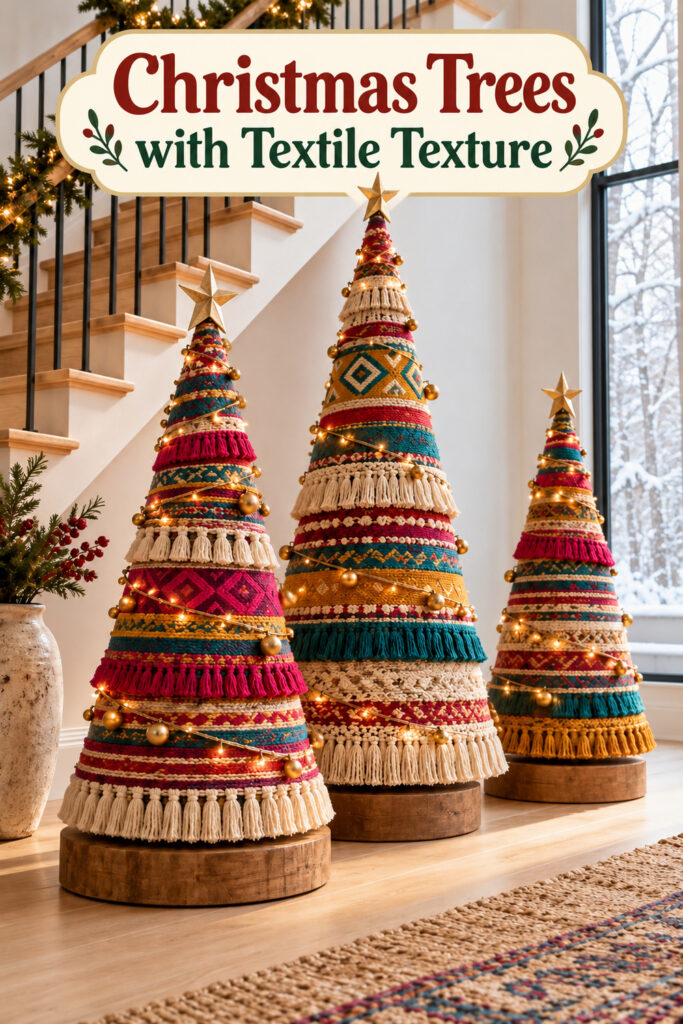
These Christmas trees are all about the fabric. Three cones stand beneath an open staircase, covered in bands of teal, fuchsia, saffron, and cream. Knotted fringe circles several tiers, and small gold ornaments and warm lights follow the shapes from bottom to top.
It’s a substantial display, but the narrow tree outlines keep the pattern organized. You could borrow the same combination for smaller tabletop cones if a floor arrangement would take up too much space. The important parts are the pointed shapes, the repeated textile colors, and enough separation to see where one tree ends and the next begins.
This inspiration image was created with AI.
What Makes These Textile Trees Work
The three heights create a loose triangle, with the tallest tree toward the middle and the smaller one at the right. That gives the group a clear outline against the pale wall. The staircase adds another diagonal above it, but the trees have enough blank wall behind them to remain easy to see.
The fabric bands alternate dense patterns with looser fringe. Some sections show diamonds and stripes, while others are mostly one color. That change in texture is useful. If every strip were equally busy, the decoration could turn into a blur of stitches. The cream fringe gives your eye a break and makes the darker teal and pink bands stand out.
Gold stays in a supporting role. The stars mark the tips, and smaller baubles repeat the finish down the trees. The tiny lights trace their surfaces instead of hiding the fabric. Greenery along the stair rail supplies a more familiar Christmas detail, which helps connect these unusual textile shapes to the season.
Key Pieces to Recreate the Look
Cone Forms in Related Sizes
Find craft cone forms
Browse current Amazon options that can help you recreate this look.
Browse craft cone forms on Amazon →As an Amazon Associate I earn from qualifying purchases.
Start with forms suited to the size and location you have in mind. The large floor cones in this inspiration suggest a substantial decorative structure, so don’t assume a small craft foam cone can simply be scaled up without support. A finished floor decoration with a stable base is the more practical starting point for that scale.
For a shelf or console, smaller craft cones can translate the same idea. Set the bare forms together before considering the fabric. Choose heights that let each outline show rather than arranging three nearly identical cones in a straight row. One tree can work on its own if you’re decorating a narrow surface.
Woven Fabric and Geometric Trim
Look for related colors across several pieces of fabric or wide decorative trims. The inspiration has strong woven texture, but you can achieve a similar layered effect with fabric remnants that include both plain and patterned sections. A tightly woven strip next to a nubbier one gives the surface more variety.
Avoid assuming that one rectangle will wrap smoothly around a tapering form. Fabric has to accommodate a cone that gets narrower toward the top. For a decorative adaptation, smaller overlapping pieces or shaped bands are easier to fit than a thick unshaped strip. Arrange any joins toward the back so the front keeps its clear horizontal layers.
Short Knotted Fringe
Fringe is what separates this idea from an ordinary fabric covered tree. Choose trim whose strands hang neatly and don’t overwhelm the width of the cone. Longer fringe can work near a broad bottom tier, while shorter strands make more sense higher up. Keep a few fabric bands uncovered so their patterns remain visible.
Cream is particularly useful because it connects several colored sections without introducing another strong hue. You could use mainly cream fringe and reserve fuchsia or teal for one tier. Before attaching anything, drape a short sample against the form and check whether it hides the entire band beneath it.
Broad Round Bases
The wood bases give each tree a clear place to stand. Their warm color also relates to the stair treads and floor. Use a base designed to support the chosen decoration securely; a cone balanced on a loose slice of wood isn’t the same as a supported floor display.
On a tabletop, an existing tray or sturdy decorative base can give smaller cones a similar grounded appearance. It should sit flat and leave room around the tree. If the surface is narrow, keep the base comfortably inside its edges instead of choosing a wider one just to match the photograph.
Gold Stars and Small Baubles
The star tops make the Christmas connection immediately recognizable. Keep their weight and size appropriate to the forms. A large heavy topper would be difficult to support on a small lightweight cone. For a modest version, a small lightweight star and a few little ornaments can give the same visual cues.
Spread the baubles out rather than covering every fabric change. In the image, the gold catches light between the stronger textile bands. Leaving some unadorned fabric visible lets the texture remain the main feature and keeps the display from looking like several unrelated decorations piled together.
Warm Decorative Lights
The fine light strands follow loose diagonals around the cones. Their small points let you see the woven surface between them. Choose lights suitable for the display and follow their instructions, including guidance about contact with fabrics. Keep battery packs or plugs accessible rather than sealing them beneath layers.
Lights are optional for a smaller adaptation. Gold ornaments and pale fringe can show well in ordinary room light. If adding a strand would mean a cable across the stair approach, leave it out or move the display to a spot where the power arrangement can be kept tidy and clear.
How to Arrange the Trees at Home
Choose the location before deciding the size of the trees. Beneath an open staircase can be useful, but the decoration must stay outside the stair path and away from any access point you use. Check the headroom too. A tall star that fits against the wall may sit awkwardly beneath a low stair tread.
Place the tallest cone first, then bring the others forward and to the sides. Leave enough space to distinguish their edges, even if the group overlaps slightly from the doorway. Turn the trees so the most interesting fabric sections face the usual view. Look from a seated position as well if the display is visible from nearby furniture.
Repeat the same few colors across the group. They don’t need matching bands in matching positions. A cream tier on one tree can relate to cream fringe on another, and a teal geometric strip can connect to a plain teal section nearby. This makes different remnants useful without forcing them into identical patterns.
Add ornaments after the fabric arrangement feels balanced. If one cone looks much busier, remove a bauble or shorten its visible light spiral before adding more to the others. The trees already have plenty going on.
Shop Similar Pieces
Look for Cone Forms and Stable Bases
Choose size, support, and intended use first. Check whether a finished form is suitable for floor display or only for lightweight tabletop crafts. Similar shapes are enough; the inspiration shouldn’t push you toward an unstable oversized adaptation.
Shop Similar Woven Trims and Fringe
Compare trim width and fringe length with your forms. Small samples can help you judge the colors together before committing to larger amounts. Fabric scraps you already own may supply the patterned bands, leaving only the fringe to find separately.
Look for Lightweight Gold Tree Details
Choose small stars, baubles, and suitable decorative lights that allow the textile surface to show. Repeated gold accents will connect the group.
Final Styling Tip
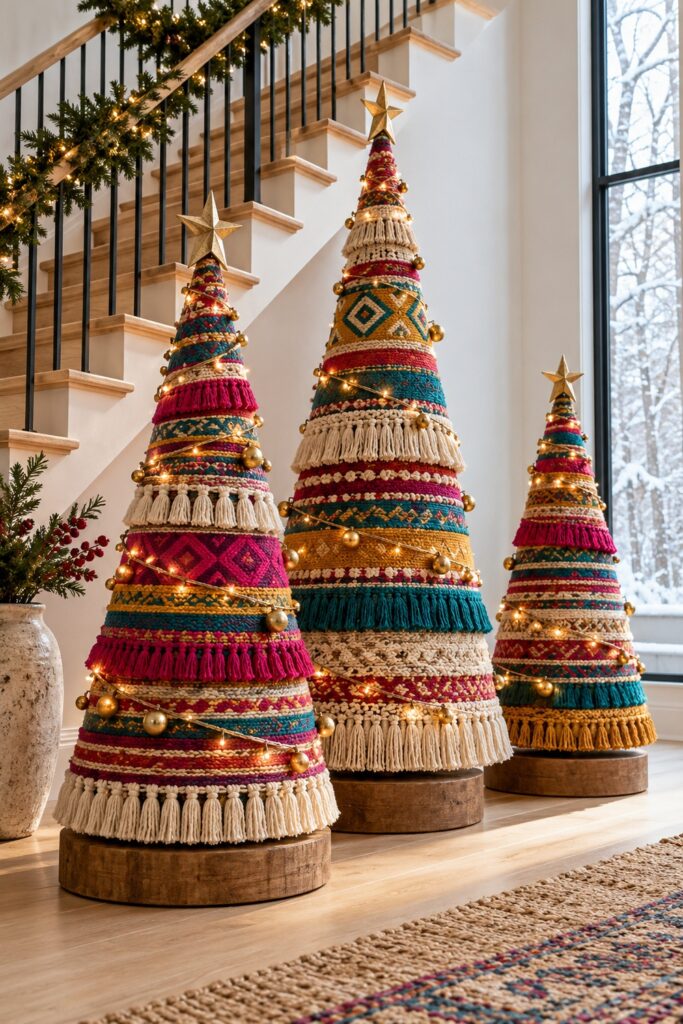
Keep one cream band or fringe tier clearly visible on each cone. That repeated light detail gives the strong pink, teal, and saffron somewhere to meet, even when the individual fabric patterns are different.