*This post may contain affiliate links for which I earn commissions.*
This Christmas window idea gives holly room to show its shape. Three separate stems rise from clear round bases, with pale sage leaves, red berry clusters, and warm metal branches outlined against the window. The broad serrated leaves are the feature, so the surrounding decorations stay low.
It’s a useful arrangement to study if you like seasonal greenery but want something more sculptural. You can recreate the spacing, stepped heights, and restrained red accents with similar decorative branches, without expecting to find the exact glass pieces pictured here.
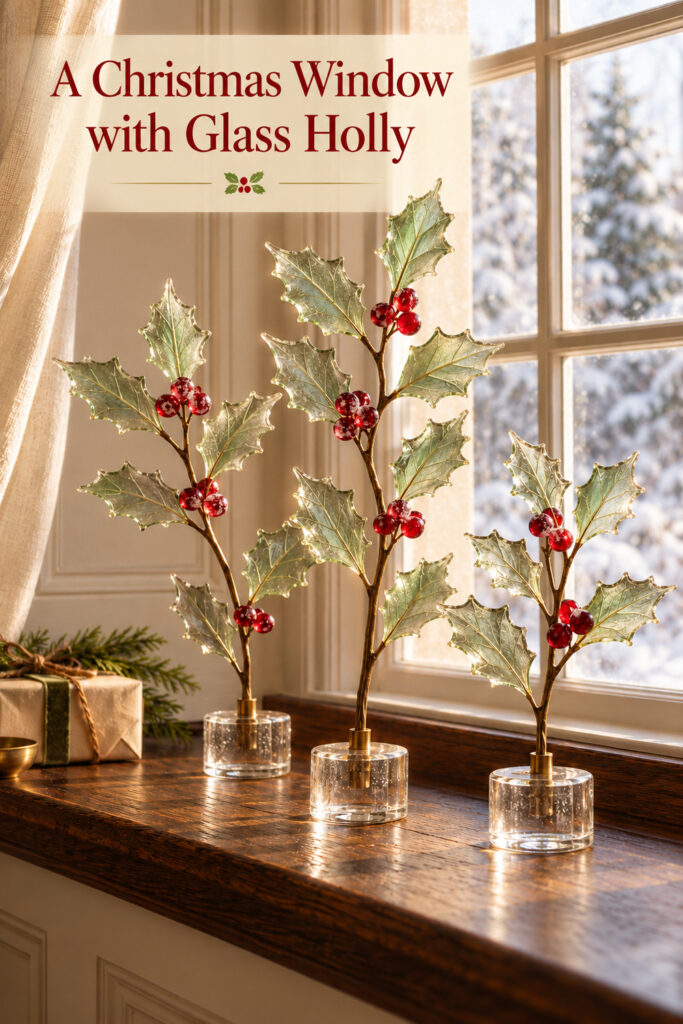
The inspiration image was created with AI.
What Makes the Window Arrangement Work
Each stem has its own base. That separation lets the branching forms spread without turning into a tangled bouquet, and it leaves visible windowsill between the pieces. The tallest stem sits in the middle, with the others rising to different heights on either side.
Find Weighted Bud Vases
Browse current Amazon options that can help you recreate this look.
Browse Weighted Bud Vases on Amazon →As an Amazon Associate I earn from qualifying purchases.
The dark wood beneath them makes the transparent bases easy to see. Above that, pale wall panels and window light provide two slightly different backgrounds for the leaves. You don’t need to duplicate the architecture, but it helps to notice how clearly each leaf edge separates from whatever is behind it.
Red appears in small, repeated berry clusters. Those little points of color make the subject read as Christmas holly even though the leaves are pale and glasslike rather than dark green. A package and short evergreen sprig remain secondary at one end, keeping the composition grounded near the sill.
Key Pieces for This Christmas Window
Holly Shaped Decorative Stems
Look for pointed leaves with a recognizable holly outline. The scalloped edges and visible vein pattern do more to identify the plant than the exact shade of sage. Similar metal, acrylic, or decorative faux stems can carry the idea if sculptural glass versions are unavailable.
Consider the weight of the upper branches before choosing a container. A tall, rigid stem with broad leaves needs more support than a flexible floral pick. Don’t assume a small decorative bottle can stabilize it just because the opening is the right size.
Clear Weighted Holders
The round bases in the image keep the display visually light at the bottom. A sturdy clear bud vase can suggest that effect, provided its proportions and opening suit the stem. A narrow neck can help guide placement, but the base still needs enough weight and width for stability.
Test one stem at a time on a level surface. If it leans or rotates unexpectedly, change the holder instead of hiding the problem with another decoration. The clean appearance depends on the branches standing securely without leaning on the window or on one another.
Small Ruby Red Accents
The berry groups repeat along the stems rather than forming a heavy red mass. Preserve that relationship if you’re choosing a substitute branch. A few clustered red details will often connect the arrangement to Christmas more effectively than filling the bases with loose red ornaments.
If your chosen stems have no berries, add a separate small red accent near the bottom of the display. Keep it clearly independent rather than trying to glue decorations onto fragile glass. One wrapped parcel with a red detail could establish the seasonal connection without altering the branches.
A Quiet Curtain and Low Supporting Decor
The cream curtain gives the left side a soft edge. If your window already has patterned fabric, pull it away from the main leaf shapes before deciding the display needs more color. You want the holly silhouette to be readable rather than competing with a print behind it.
Keep the supporting package below the lower branches. A tall stack would interrupt the change in height and make the arrangement feel cramped. You can use an empty wrapped box for styling, but place it where opening and closing the curtain won’t drag it against the stems.
Setting It Up on Your Own Sill
Start by checking the actual depth of the sill and the way the window operates. Handles, latches, and opening panels need clear space. If a decorative stem would obstruct any of them, use a nearby console or a shelf in front of a fixed wall instead.
Set the tallest holder near the middle, then position its companions a little farther apart than you first expect. Broad leaves take up more visual space than narrow twigs. Look through the gaps and adjust until you can see the outlines of the smaller stems without moving your head.
Turn each branch gently so that some leaves face the room and others sit at an angle. A completely flat arrangement can look like a screen, while too much rotation hides the leaf shape. The aim is a small amount of depth with enough broad surfaces visible to identify the holly.
Step back to the place where you normally see the window. From there, check whether the red clusters appear throughout the group or disappear behind the largest leaves. You may only need to shift one base sideways to make the color distribution feel more balanced.
Work with available daylight rather than trying to imitate a snowy view. A plain wall beside a window can give decorative glass a softer outline than a busy outdoor scene. If strong sun creates glare, move the arrangement slightly out of that direct beam and compare the result.
For a smaller sill, use one substantial holly stem in a stable holder and repeat the red nearby in a low package. You preserve the leaf shape and seasonal color without forcing a trio into a space that can’t support it. More branches won’t improve a display if their tips are pressed against the curtain.
Keep delicate stems away from places where children, pets, or everyday window use could knock them over. These are display objects rather than practical plant stems, and their materials may be heavier or more fragile than they first appear. Choose the location around that reality.
Check the branches against the window’s vertical and horizontal bars. A brass stem placed directly over a dark window divider may disappear, while a small shift can bring it back into view. You can also turn the base slightly so the broadest leaf sits against a calmer section of glass. Work from the room’s normal viewing position, since the clearest arrangement from close up may not be the clearest one across the kitchen.
Shop Similar Pieces
Look for Sculptural Holly Branches
Compare the leaf outline and branching pattern first. Similar stems don’t need matching numbers of leaves, but they should have enough open space to remain readable. Avoid assuming that a product described as glass has the same structure or weight as the AI inspiration.
Shop Similar Clear Bud Vases
Pay attention to the base diameter, opening, and total height. A squat holder can make the stem seem taller, which suits this idea, but stability comes first. Use a different container if the branches pull the whole arrangement off balance.
Add Simple Gift Wrapping
Plain cream paper and a narrow coordinating ribbon can repeat the image’s quiet supporting detail. Keep the parcel low and slightly apart from the bases. Its job is to connect the window to the holiday, not to become another focal point.
Final Styling Tip
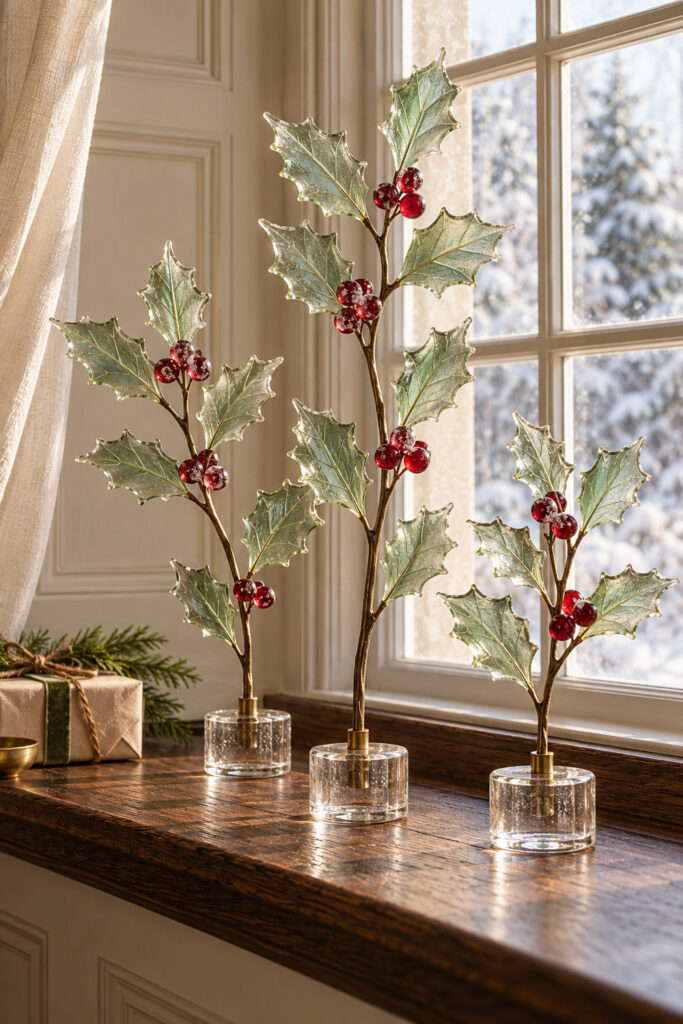
Judge the display by the gaps between the leaves. If those spaces stay open and the stems stand securely, the window will feel carefully arranged even with just one or two well chosen branches.