*This post may contain affiliate links for which I earn commissions.*
An enclosed sleeping porch offers something that an ordinary living room cannot quite reproduce. It sits between the house and the landscape, providing protection from the weather while still feeling connected to changing leaves, filtered sunlight, and cool autumn air.
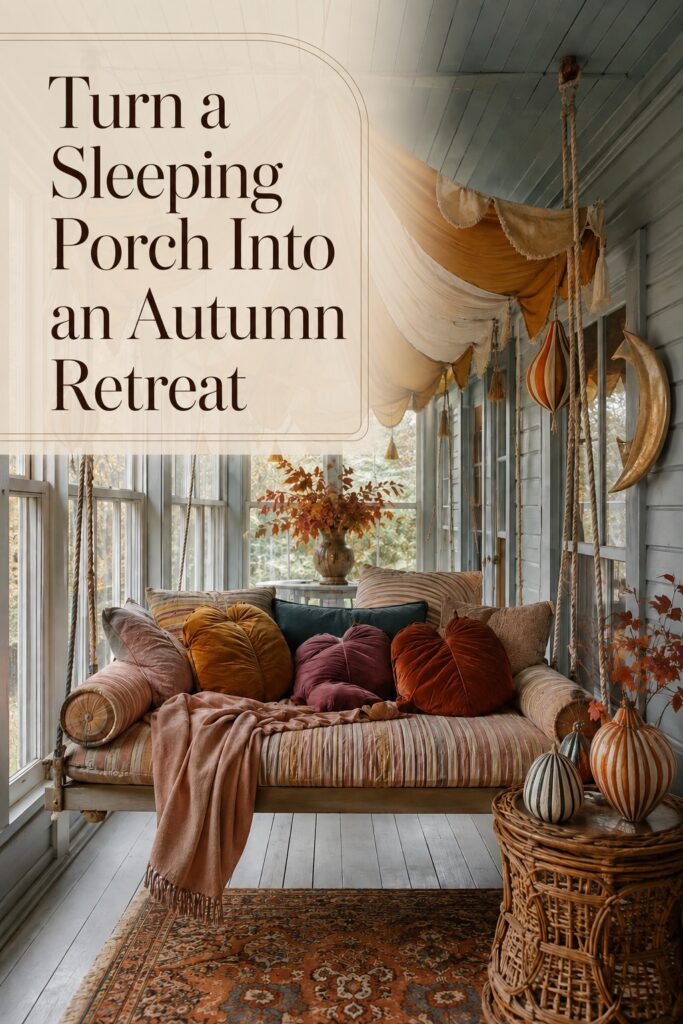
This porch turns that transitional quality into the basis for an immersive fall retreat. Sweeping amber and cream fabric transforms the ceiling, while velvet leaf pillows, paper stars, sculptural pumpkins, and a faded rug bring the same palette down to eye level.
The result feels theatrical without becoming overly themed. It is an inviting place to read, nap, watch the leaves fall, or spend a slow afternoon away from the busier rooms of the house.
Let the Canopy Define the Entire Room
The canopy is the unmistakable focal point. Fabric radiates outward from a central point, then falls into generous scallops along the sides of the porch.
Alternating amber and cream panels make the treatment easier to read than one uninterrupted expanse of fabric. The darker panels provide warmth and depth, while the lighter ones reflect window light and prevent the low ceiling from feeling oppressive.
To adapt the idea, begin with the room’s centerline. The fabric does not necessarily need to originate from the exact center of the ceiling, but the arrangement should feel balanced when viewed from the entrance.
Create broad, relaxed curves rather than small, tightly gathered swags. Fewer substantial scallops will look more intentional and require fewer attachment points.
Use Fabric That Drapes Without Becoming Too Heavy
A canopy needs enough softness to form deep folds, but its weight must remain manageable. Cotton gauze, lightweight linen blends, voile, and chiffon can all create flowing shapes.
Very thin fabric may appear flat when stretched across a large ceiling. Combining a lighter cream fabric with a slightly more substantial amber textile can produce the layered appearance seen here.
Before purchasing material, calculate the room’s dimensions and add considerably more length for draping. A panel that merely reaches from the center to the wall will not provide enough fabric for a deep curve.
Test one temporary panel before preparing the full canopy. This reveals how the material hangs, whether it filters too much light, and how much additional length each scallop requires.
Treat Installation as a Structural Project
The ceiling treatment may look soft, but the installation needs careful planning. Fabric becomes surprisingly heavy when used in large quantities, especially when trim and hanging decorations are added.
Do not assume that decorative hooks, adhesive strips, curtain hardware, or existing ceiling fixtures can safely hold it. The correct mounting method depends on the ceiling construction, the combined weight of the materials, and whether the porch is exposed to humidity or temperature changes.
A qualified installer can determine where structural support is available and whether the proposed arrangement is appropriate. This is particularly important around an occupied daybed, where a falling rod or attachment could cause injury.
Keep all fabric away from ceiling fans, heaters, light fixtures, electrical equipment, vents, windows, and doors. The canopy should never interfere with smoke alarms, sprinklers, exits, or other safety equipment.
Finish the Scallops With Soft Trim
Cream scalloped pieces outlined in fringe make the canopy look finished rather than improvised. They create a decorative border between the amber sections and repeat the pale upholstery below.
A simplified version could use tassel fringe sewn directly along the edge of each fabric panel. Another option is to create separate shallow valances that conceal the primary installation hardware.
Trim should be proportionate to the space. Long tassels can add character at a few prominent points, while short fringe works better along the broad curves. Using both gives the treatment rhythm without making every edge equally ornate.
If the fabric is washable, consider making the trim removable. Delicate fringe and tassels may require different care than the main panels.
Preserve the Pale Blue-Gray Background
The muted blue-gray ceiling and walls are an important part of the palette. They create a cool background for the amber, rust, plum, and cream furnishings.
A warm wall color could make the room feel overly saturated once the canopy is installed. Pale blue, foggy gray, softened sage, or weathered white allows the autumn tones to remain distinct.
There is no need to repaint a neutral porch simply to reproduce the image. The same warm decorations would work against white, cream, pale wood, soft gray, or faded green.
The goal is contrast. A quieter background gives the fabric and textiles room to make the seasonal statement.
Place One Comfortable Seat Beneath the Canopy
The suspended daybed serves as the room’s functional anchor. Its generous size makes the porch feel like a destination rather than a pass-through space.
A porch swing, stationary daybed, loveseat, or deep bench could provide the same effect. The best choice depends on the room’s structure and available clearance.
A suspended piece must be installed into appropriate structural supports using correctly rated hardware. Decorative ropes should never be treated as proof that a swing is safely supported. The ropes, ceiling anchors, frame, connectors, and seat all need to be suitable for the anticipated load.
If there is any doubt, use a stationary daybed or bench. It can provide nearly the same visual result with fewer structural considerations.
Allow enough space around the furniture for people to sit, stand, and walk safely. A swing also needs unobstructed clearance through its full range of motion.
Build the Pillow Palette Around Autumn Leaves
The large leaf-shaped pillows are the most distinctive accents on the daybed. Their forms introduce the season without relying on printed phrases or literal harvest graphics.
Ochre, plum, burnt orange, and deep green resemble leaves at different stages of their autumn transition. Velvet enhances the effect because its nap creates highlights and shadows that emphasize the stitched veins.
Use an odd number of shaped pillows, then add striped or textured rectangular pillows behind them for support. The structured background pillows keep the seating comfortable while the leaves supply the visual personality.
A practical arrangement might include three leaf pillows across the front, two larger rectangular pillows behind them, and one small bolster at each end. This keeps the daybed inviting instead of filling the entire seat with decoration.
Use Several Shapes Within One Palette
The room contains stars, crescents, elongated ornaments, leaves, pumpkins, tassels, and scallops. These shapes are unrelated, yet they feel coordinated because they share warm earthy tones and handcrafted textures.
Repeating shapes would make the display more predictable. Mixing them creates the feeling of an old-world tent, festival pavilion, or imaginative seasonal hideaway.
Choose one or two examples of each form rather than creating a large matching collection. A few paper stars, two suspended ornaments, and three sculptural pumpkins will feel more collected and less like a packaged decorating set.
The muted palette helps control the variety. Amber, cream, rust, plum, faded rose, olive, and deep teal can support many decorative forms without becoming chaotic.
Float Paper Stars Through the Middle of the Room
The hanging stars occupy the open area between the canopy and the daybed. They make use of vertical space while leaving the floor clear.
Vary their sizes and hanging heights to avoid creating a straight line. Place the largest star slightly off center, then position smaller ones around it.
Natural kraft, warm white, aged gold, and deep brown work particularly well with the canopy. Intricate perforations can create soft patterns when a battery-operated light is placed inside, although every lantern’s instructions should be checked before illumination.
Keep paper decorations away from moisture, heat, candles, bulbs that become hot, and any moving swing path. In a humid porch, unlit ornaments made from sturdier card stock may retain their shape better than delicate paper lanterns.
Add Movement With Tassels and Pendant Ornaments
Small tassels hang at intervals around the canopy, continuing its decorative edges into the room. Larger striped ornaments introduce stronger vertical shapes near the outer ropes.
These details work because they occupy different levels. Some sit close to the ceiling, others hover around the stars, and a few descend nearer to the seating.
Avoid suspending decorations directly above the places where people sit or walk. Move them toward the perimeter or use extremely lightweight materials. Every hanging object should be secured independently rather than attached casually to a canopy panel.
The striped ornaments could be recreated with paper, fabric, or lightweight collapsible decorations. Orange, cream, brown, and muted green will connect them to the pumpkins below.
Repeat the Stripes at Floor and Table Level
Striped upholstery, ribbed leaf pillows, and painted pumpkins repeat linear patterns throughout the room. This subtle connection keeps the tabletop accents from feeling unrelated to the daybed.
The pumpkins use bold cream-and-orange or cream-and-dark-green segments. Their elongated shapes make them feel more sculptural than conventional round pumpkins.
For a handmade version, paint lightweight craft pumpkins with alternating vertical sections. Slightly uneven stripes will suit the porch’s relaxed, handcrafted quality better than mathematically perfect lines.
Finish the stems in antique gold, brown, or muted copper. Group pumpkins in different heights on a sturdy tray so they can be moved when the table is needed.
Soften the Seat With a Dusty Rose Throw
The faded rose throw provides a quiet break between the darker pillows and striped upholstery. Its color is warm enough for the season but softer than conventional pumpkin orange.
Drape it loosely across one side of the daybed, leaving most of the seat visible. A throw should look available for use rather than arranged so elaborately that no one wants to disturb it.
Wool blends, brushed cotton, and soft acrylic can all work. Fringe echoes the canopy trim and helps the blanket relate to the rest of the room.
Keep loose fabric away from the moving parts of a swing. If the daybed moves, tuck the throw securely or remove it before use.
Ground the Porch With a Faded Rug
The vintage-style rug makes the pale floor feel warmer and visually defines the seating area. Rust, cream, muted blue, and dark brown connect the cool walls to the autumn furnishings.
A low-pile rug is generally easier to manage in an enclosed porch than a thick plush one. It allows doors to clear, collects less debris, and is easier to vacuum.
Measure the full movement area before placing a rug beneath or in front of a porch swing. The rug must not catch moving hardware, create a tripping edge, or prevent the furniture from operating safely.
A washable or easily cleaned design is useful in a room connected closely to the outdoors. A suitable nonslip pad can help keep it flat, provided it is compatible with the flooring.
Bring in Branches Instead of Large Floral Arrangements
Autumn branches at the far window and beside the wicker table extend the outdoor view into the porch. Their narrow silhouettes suit the limited floor space better than broad arrangements.
Choose branches with small rust, burgundy, or copper leaves. Place them in heavy vessels that will not tip easily, particularly if the porch swing creates air movement.
The arrangement at the end of the room becomes a distant focal point. The smaller branch display near the pumpkins balances it without making the two sides identical.
Artificial stems provide reliable color throughout the season. Fresh branches can be equally effective but should be checked for insects, moisture, and shedding before being brought indoors.
Keep the Wicker Table Light and Practical
The wicker table introduces another natural texture without visually closing off the porch. Its open weave makes it feel less massive than a solid cabinet or chest.
A round table also provides a useful contrast to the long rectangular room. It softens the corner and offers enough space for a few pumpkins, a book, or a cup of tea.
Keep the arrangement contained on a tray so the tabletop can be cleared quickly. Avoid placing fragile objects where they could be struck by the swing or caught by a blanket.
If the table sits near a window, confirm that it does not block access to locks, screens, or necessary ventilation.
Adapt the Canopy Idea Without Covering the Ceiling
A full-room canopy will not suit every porch. The same atmosphere can be created with a smaller treatment behind or above the daybed.
One option is to suspend two fabric panels from a properly installed rod, allowing them to frame the seat like curtains. Another is to create one scalloped valance across the end of the porch.
A fabric wall hanging can introduce the amber-and-cream palette without placing material overhead. Tassels, leaf pillows, stars, and striped pumpkins will still communicate the original idea.
This smaller version is easier to remove, requires less material, and allows more of the existing ceiling to remain visible.
A Simplified Version of the Retreat
The essence of the room can be captured with five additions:
- Amber and cream fabric framing the daybed
- Three velvet leaf pillows in different autumn shades
- Two or three natural paper stars
- A dusty rose fringed throw
- Several striped pumpkins on a wicker or wood table
A faded rug can be added if the floor needs greater warmth. The arrangement will still feel layered and transporting without recreating every suspended detail.
Why This Porch Feels So Immersive
The design does more than decorate the furniture. It changes how the architecture feels.
The canopy lowers the visual scale and makes the long porch more intimate. Hanging elements fill the otherwise empty middle of the room, while the rug, daybed, and wicker table anchor the lower half.
Warm fabrics appear especially rich against the cool-painted wood. Velvet, gauze, fringe, paper, wicker, and faded woven textiles give the setting depth without requiring a large amount of furniture.
Most importantly, the room offers a strong emotional promise. It feels removed from ordinary routines, even though it may be only a few steps from the rest of the house.
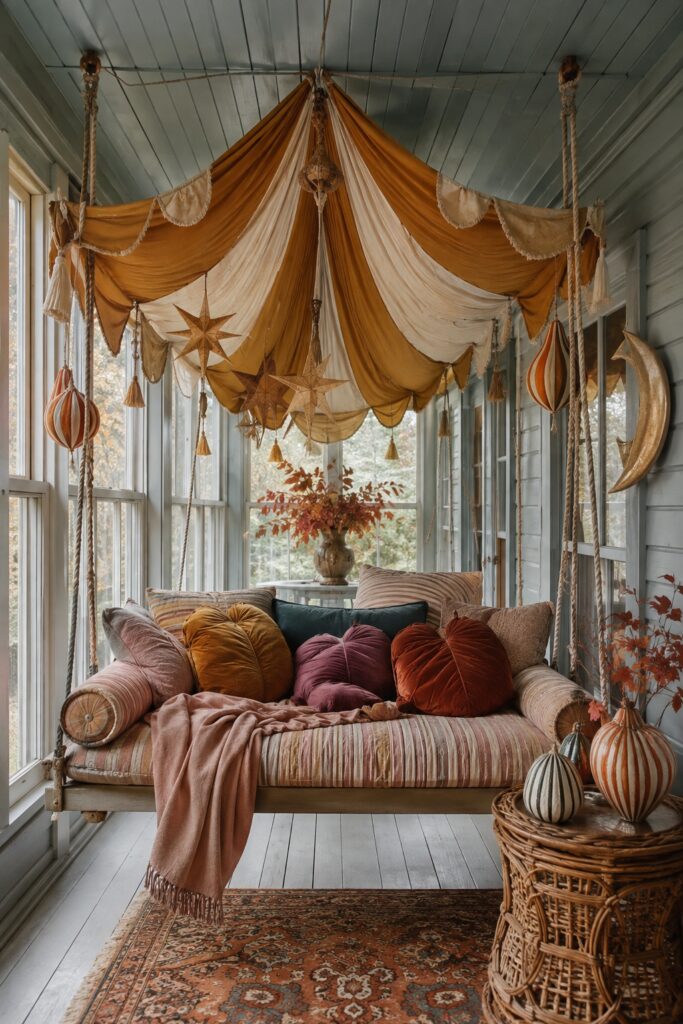
Image disclosure: This AI-generated image is presented as decorating inspiration. Suggested products are visual alternatives rather than claims that exact items shown are available. Product colors, dimensions, prices, ratings, and availability may change.