*This post may contain affiliate links for which I earn commissions.*
The strongest contrast on this winter hearth is between the pale woven basket and the black metal bucket. Both sit on limestone, but the white birch, the matte black finish and the raised weave keep their edges distinct. A blue throw on the chair nearby brings in a softer texture without making the stone itself feel crowded. It’s a useful look for an idle fireplace that can seem like a dark opening at this time of year. You can borrow the arrangement with a basket and a favorite blanket, even if the fireplace surround in your home looks entirely different.
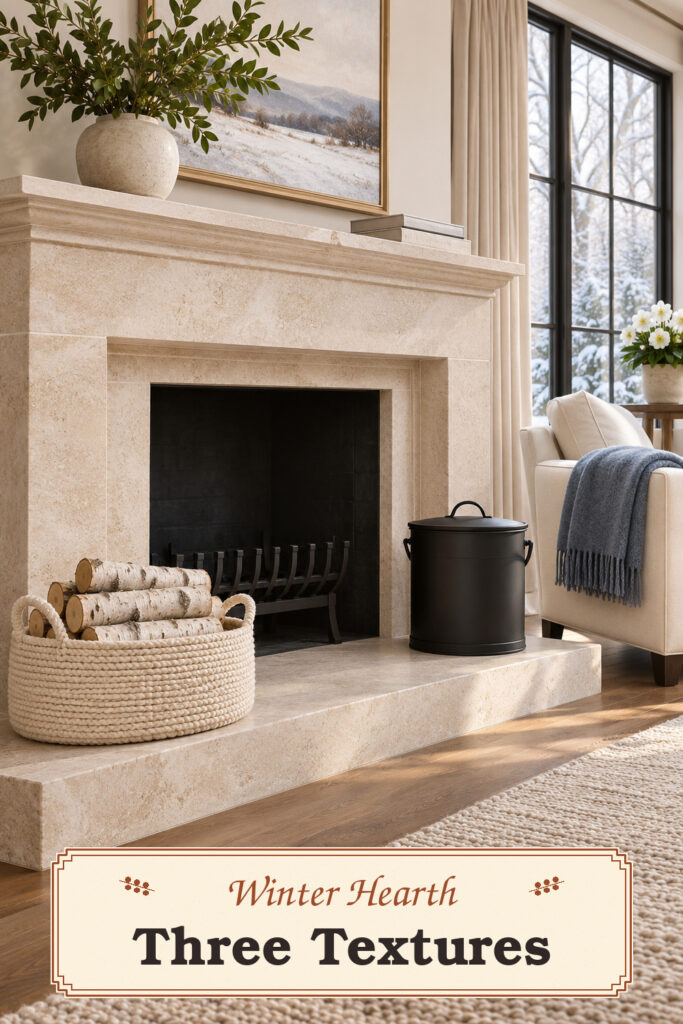
This image was created with AI as decorating inspiration. Similar pieces can help you recreate the look.
Give the black and pale pieces different jobs
The dark bucket sits off to one side, and the pale basket with logs takes the other. The two containers have different heights and edges. The basket is low and open, so you can see the white bark. The bucket has a dark lid and reads as one compact shape. Between them is the opening with the grate visible. That bit of empty space makes it easy to see both containers and leaves the stone as part of the arrangement.
Think about what you want each container to hold before choosing its size. A broad basket makes sense for a few short display logs if the hearth is purely decorative. A bucket with a lid can hold cold fireplace accessories or unrelated items when it’s used as decor. The pictured grouping is for an unlit display. If you use your fireplace, follow the appliance and local fire safety guidance and move the decorative grouping out of the hearth area before use. A basket beside a chair on the other side of the room can keep the same woven texture without sitting by the fireplace.
Check the base of the basket against the actual stone. It should sit fully on the surface without overhanging a step. Set the larger piece down first, then bring in the bucket. Look at the two from the far end of the room. If they look like one crowded shape because the hearth is narrow, take one off the stone and put it on a stable patch of floor where it won’t get stepped around.
Use the logs as a small area of pattern
The white birch logs are stacked low enough to keep the basket’s edge visible. Some cut ends face the room, which makes their round shapes stand out against the horizontal weave. You can get a similar rhythm with another pale wood, or use only a few logs and let more of the basket show. Look for pieces that fit inside the rim comfortably. A long piece resting at a steep angle can look as though it’s about to roll out.
Place the largest pieces across the bottom and build one short row above. Turn a bark surface toward the light and let a cut end show next to it. Keep the stack low and stable. If the pale bark is the only light texture on a dark fireplace, you can repeat it with an oatmeal basket rather than buying a second container in another finish. The wood will stand out even more clearly if the surface behind it is quiet.
A small basket can also hold rolled blankets away from the fireplace. Keep the logs in a separate holder if you use them, since rough wood can snag fabric. Look at how the basket will be carried if you plan to move it. Handles are useful only if you can grasp them when the basket is filled, so try lifting it empty and see where your hands go.
Pick up the texture again beside the chair
The blue throw on the chair gives the eye somewhere to go after the black bucket. It looks thick enough to use and stays neatly folded against pale upholstery. A blanket with a little fringe or a pronounced weave can be particularly effective beside smooth stone. Put it over one arm or fold it once on the seat where it’s easy to reach. Leave the rest of the chair clear.
If you have a dark chair, a cream or slate-blue throw can bring in enough contrast. If the upholstery is already patterned, use a plain wool-look cloth with a simpler edge. The pale basket and blue blanket will feel connected through their texture, even when their colors are quite different. You could repeat the throw color in one small cushion, but see what the chair looks like without it first. The layering at the fireplace is doing much of the work already.
The small pale flowers at the far edge are another soft detail. A matte vase on a nearby table is enough to add that touch if you already have a flower or cutting. Keep the foliage away from the dark bucket so its lid and handles are easy to distinguish. In a more compact room, leave the flowers out and let the blanket and woven basket be the softer elements.
Adapt the balance to your surround
On a dark hearth, a black bucket may disappear. Try a charcoal piece with a lighter edge or use one pale basket and a dark tray on a nearby side table. On a raised cream hearth, a black piece will have plenty of contrast with no extra accents. A basket with an open weave can add detail without introducing another color. Place it where side light will show the pattern.
A fireplace with almost no projecting ledge can still be the background for this idea. Shift both containers off the stone and arrange them to one side, keeping room to walk past. The stone, metal and woven surface can be read together without sharing a platform. A blanket on the chair opposite will complete the triangle.
Choose a few practical pieces
A low woven basket with strong handles
Look for a wide, stable base and a shape that keeps short pieces of wood inside the rim. Choose a weave with enough definition to show against the fireplace.
A matte black lidded bucket
A plain lid and compact body carry the dark accent without making the hearth busy. Check the footprint and the handle clearance before choosing a size.
A slate-blue throw
Pick a weight you’ll actually use while seated. A blue with a little gray in it sits comfortably beside natural stone and cream upholstery.
Review the space from the chair
Sit where you’d normally read or talk and check the space between the containers. Move the larger one sideways until the fireplace opening is visible. Test the walking route around the chair and fold the blanket so its edge won’t trail. Then turn off any strong overhead light and see how much of the texture remains in ordinary daylight or lamp light.
Final Styling Tip
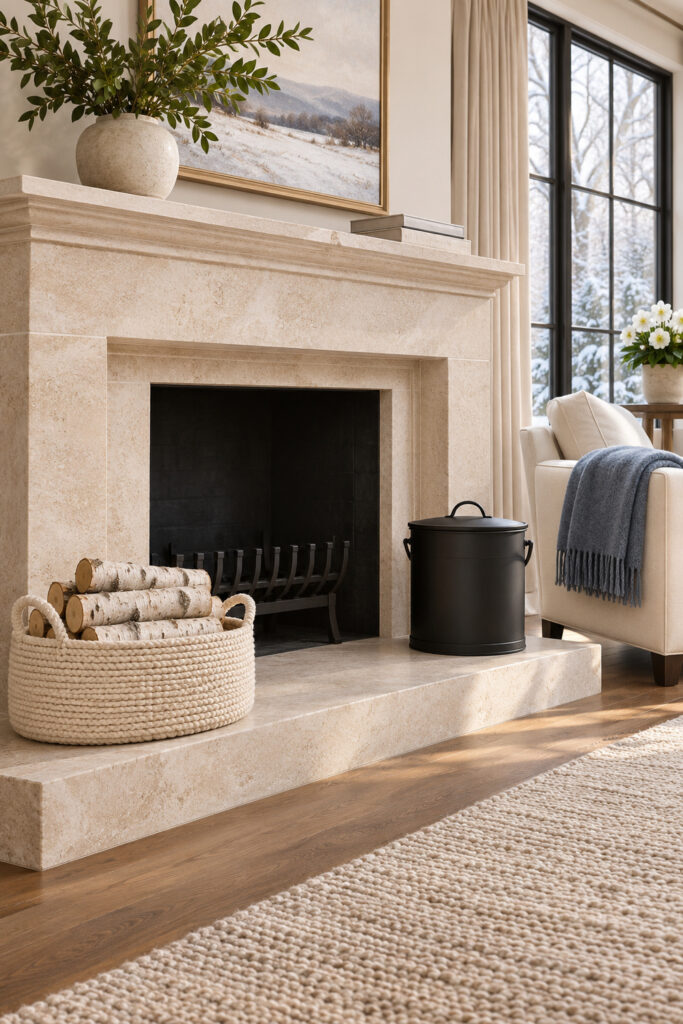
Turn one birch log so a pale strip of bark faces the chair. That small highlight is enough to make the weave beside it easier to see.