*This post may contain affiliate links for which I earn commissions.*
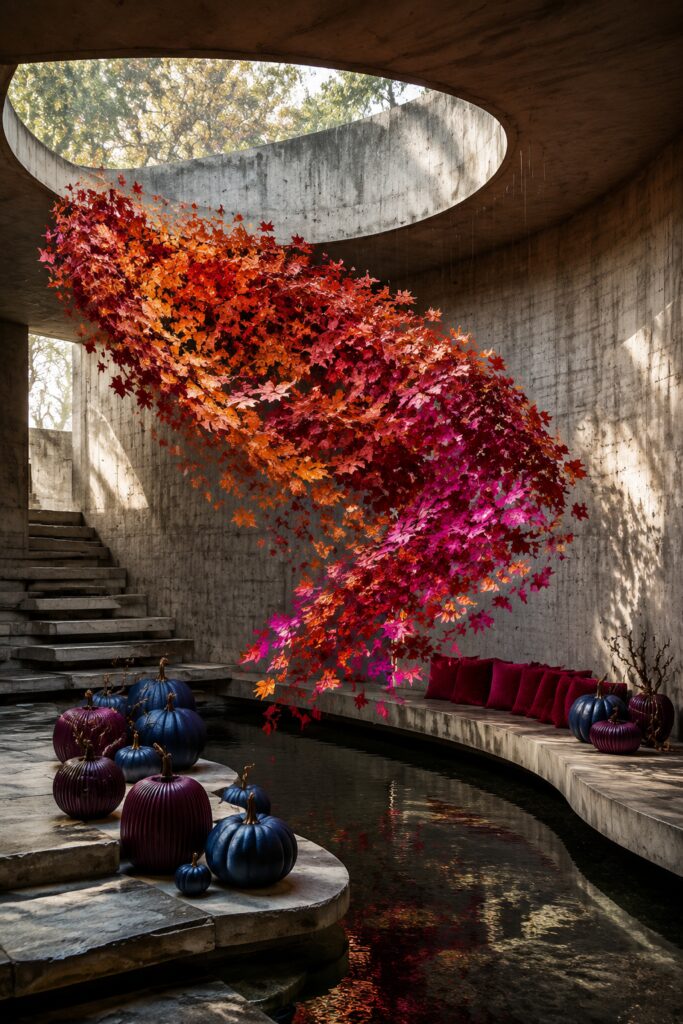
A sweep of orange leaves curls through this concrete courtyard, shifting into red, burgundy, and vivid magenta as it descends. Below it, navy and plum pumpkins gather beside dark water, while wine-colored cushions soften a curved bench.
The combination feels like autumn interpreted through sculpture. Familiar seasonal details are still there, but their placement makes them feel unexpected. Leaves become a floating focal point, pumpkins introduce deep pools of color, and the surrounding stone gives every shape room to stand out.
You can bring a version of this idea into a covered patio, entryway, or living room. The key is to borrow the movement and color relationships, then scale the arrangement to a space you actually use.
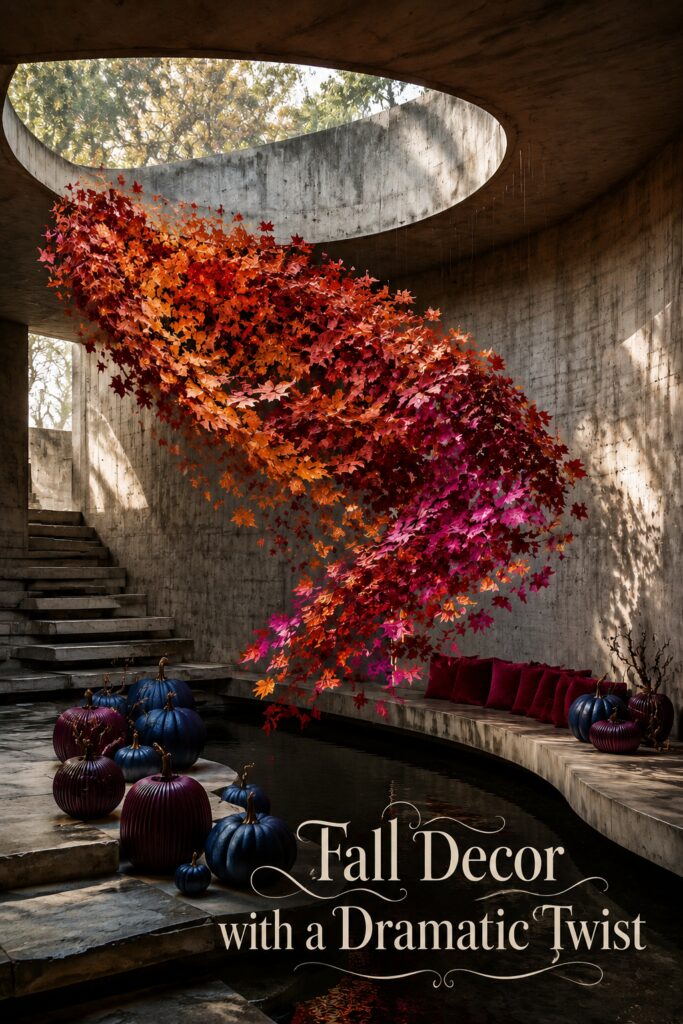
The inspiration image is AI generated. Its sculptural details are decorating concepts that can be interpreted with similar materials rather than exact finished products.
Follow the Curve of the Leaves
The leaf cloud has a broad upper section and a narrower trailing end. That change in volume makes it look as though a gust of wind has carried the foliage across the courtyard.
Its outline matters as much as its size. Some stems reach outward, others overlap densely, and small openings prevent the whole arrangement from reading as one solid block.
For a home version, think of a curved foliage swag with one generous shoulder and one tapered tail. It could frame the upper corner of a wall, sweep along a console backdrop, or climb one side of a sheltered doorway.
You do not need to reproduce the suspended installation. A supported arrangement against a wall can suggest the same movement while fitting more naturally into everyday decorating.
Give Orange an Unexpected Partner
Marigold orange establishes the autumn mood, but magenta makes this palette distinctive. Red and burgundy connect the two, creating a gradual shift rather than an abrupt division.
Try grouping related colors in loose sections. Begin with orange foliage, introduce red through the middle, and concentrate deeper pink and wine tones near one end. Allow a few stems to cross between sections so the transition feels relaxed.
Find the Perfect Fall Leaves
Browse current Amazon options for craft leaves in orange and red tones that can help you recreate this look.
Browse Craft Leaves on Amazon →As an Amazon Associate I earn from qualifying purchases.
The navy pumpkins provide a cool counterpoint beneath those warm leaves. Plum repeats the darker foliage shades without matching them exactly.
If you prefer a quieter interpretation, use mostly orange and burgundy with just a few magenta accents. The unexpected color will still register.
Gather the Pieces That Make the Composition
Autumn Garlands and Branching Leaf Sprays
Flexible faux leaf garlands can provide the continuous line of a smaller arrangement. Individual sprays add fullness and let you adjust the outline more precisely.
Choose varied leaf sizes rather than relying on a single repeated shape. The inspiration includes pointed, lobed leaves alongside finer foliage, which gives the cloud its layered surface.
Check intended placement before choosing materials. An indoor garland may suit an entryway, while a covered outdoor setting calls for pieces appropriate to the exposure they will receive.
Magenta and Burgundy Accent Foliage
Deep pink leaves may be harder to match than traditional fall colors. Burgundy foliage mixed with a few fuchsia botanical sprays can suggest the same effect.
Keep those substitutes close in scale to the surrounding leaves. Large, unrelated flower heads would change the character from a leaf cloud to a floral arrangement.
Lay the materials beside one another before attaching anything. This makes it easier to judge whether the pink feels integrated or needs another layer of red between it and the orange.
Navy and Plum Pumpkins
The pumpkins stay below the main display, where their rounded forms balance the cloud’s loose edges. Some are squat and broad, while others are taller with closely spaced ribs.
Look for a mix of profiles in deep blue and aubergine. Similar colors across different shapes will feel more collected than several identical pumpkins lined up together.
If finished pieces are difficult to find, paintable faux pumpkins offer another route. Choose paint suitable for their surface and intended location, then add a restrained gold-toned stem if desired.
Burgundy Cushions for a Bench or Chair
The cushions create a soft horizontal band beneath the foliage. Their deep red color connects the seating to the arrangement without introducing another competing pattern.
A pair of wine-colored cushions can make the same connection on a smaller bench. Leave usable sitting space rather than covering the entire seat.
For an exposed patio, choose outdoor cushion covers in a similar shade. Indoors, a plush fabric can echo the softness suggested in the image.
Shape a Manageable Foliage Feature
Start by choosing the footprint of your arrangement. Mark its approximate width and trailing length with removable paper guides so you can assess it from across the room.
Build a modest swag on a suitable reusable support, following the support and mounting hardware instructions. Add the garland first, then layer shorter sprays where you want the fullest section.
Turn the leaf faces in slightly different directions. That variation catches light and helps the arrangement feel dimensional.
Finish with a few longer stems at the narrow end. Resist filling every gap, especially around the edges. Small breaks let the background show through and preserve the impression of loose leaves.
The image’s large overhead cloud would require a properly designed installation. For an approachable home project, keep the feature smaller, securely supported, and away from walking routes or seating overhead.
Place the Pumpkins with Breathing Room
Gather three pumpkins beside a console or at the end of a bench. Combine a taller plum piece, a broad navy one, and a smaller accent to vary the outline.
Keep them on a stable surface outside the walking path. Although the inspiration includes stepped stone platforms, clear steps are more practical in a home.
Repeat one pumpkin elsewhere only if the room needs a visual connection. The main foliage feature should remain the first thing you notice.
The reflecting water is part of this courtyard’s atmosphere, but you do not need to add a water feature. An existing dark tabletop or subtly reflective tray can provide a small echo of the rich colors.
Similar Materials for This Fall Palette
Look for Flexible Leaf Garlands and Separate Sprays
Prioritize bendable stems, varied leaf sizes, and colors that blend from orange into wine. These qualities matter more than finding one oversized finished decoration.
Shop Similar Ribbed Pumpkins in Deep Tones
Compare silhouettes as well as color. A mixture of tall and rounded forms will recreate the contrast visible beneath the cloud.
Add Wine-Colored Cushion Covers
Use a small amount of soft fabric to connect the foliage to the seating. Existing neutral furniture can supply the rest of the background.
Let the Background Do Some of the Work
The bare concrete makes the leaves feel more vivid and the pumpkins more sculptural. Give your own arrangement a similarly quiet setting, whether that is a plain wall, an uncluttered console, or a simple porch corner. One expressive curve and a few grounded accents can be enough.