*This post may contain affiliate links for which I earn commissions.*
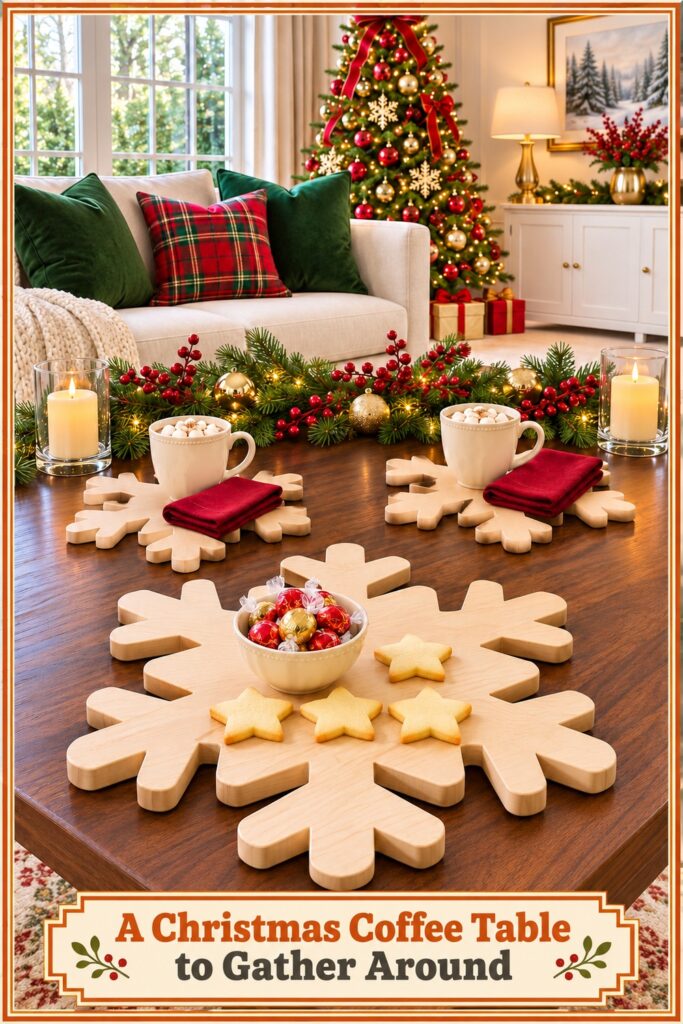
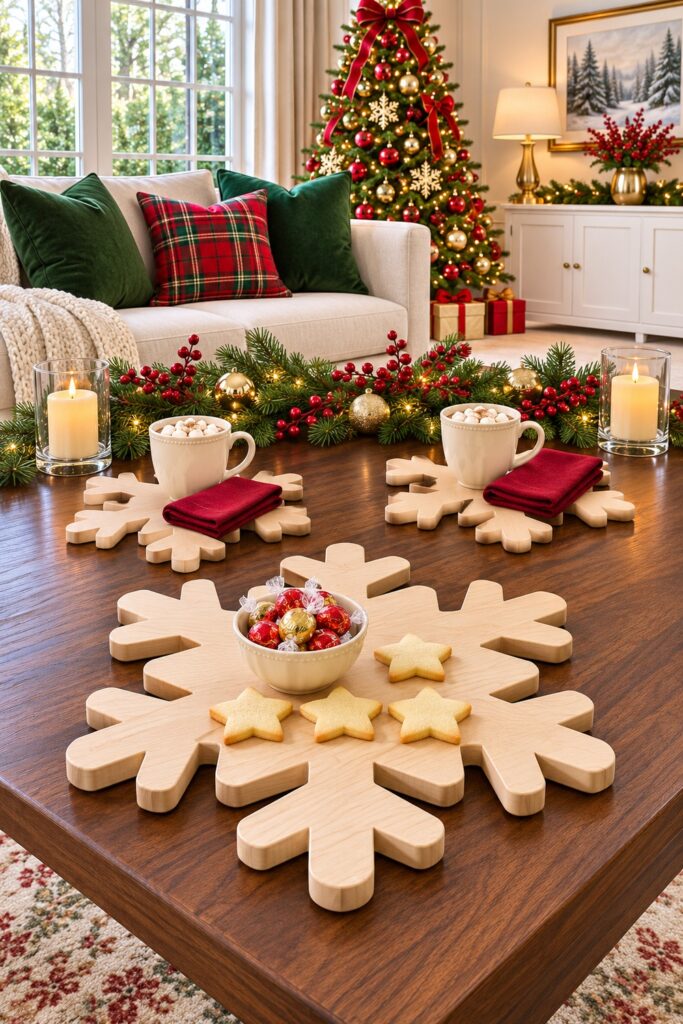
Pale wooden snowflakes give this Christmas coffee table a clear decorative theme without taking it out of use. A large board holds a small bowl of wrapped chocolates and a few star cookies, while two smaller companions carry cream cups and folded cranberry napkins. The dark table outlines their branching shapes, with fir and gold details gathered behind them.
The arrangement works as a low hosting setup where people can reach a drink or a little treat from the sofa. You can adapt the shapes with comparable serving pieces and a few coordinated textiles. Keep the useful surfaces stable, the food presentation appropriate to the actual materials, and enough open table around the decorations for guests.
This image was generated with AI as decorating inspiration. Similar pieces can be used to recreate the overall effect.
Choose the boards for serving before choosing the shape
A decorative wood shape isn’t automatically a food-serving surface. Check the real item’s intended use, finish, cleaning directions, and any heat or moisture limitations. Use appropriate plates, bowls, or liners when direct food contact isn’t suitable. The pictured idea can still work with the treats in small dishes, leaving the snowflake outlines visible underneath.
Place each board flat on the table and check that it doesn’t rock. Broad, blunt branches are more useful here than delicate projecting points. Keep the board fully supported rather than allowing a large arm to hang beyond the table edge. The shape should make the arrangement charming without introducing a wobbly place to set down a cup.
Find Decorative Snowflake Serving Boards
Browse current Amazon options that can help you recreate this look.
Browse Decorative Snowflake Serving Boards on Amazon →As an Amazon Associate I earn from qualifying purchases.
Give the largest snowflake the clearest position
Leave most of its outline uncovered
The main board sits nearest the front of the table, where its pale silhouette is easy to see against the walnut. The small bowl and cookies occupy only part of the surface. Keep that relationship when arranging a similar piece. Covering every branch with food would hide the feature that makes the setup different from an ordinary tray.
Choose a board size around the actual table, including the space needed to walk past it. A large coffee table can accommodate three shapes with open intervals between them. A smaller one may need only a single snowflake and a separate useful side table for drinks. You can preserve the focal idea without reproducing the exact number of pieces.
Use the smaller boards as companions
The two smaller shapes sit farther back, each with a cream cup and a folded napkin. Their repeated outline makes the group feel related while the height stays low. Position cups on stable broad areas, using suitable coasters or supports where the materials require them. Don’t balance a heavy drink on the narrow end of a decorative branch.
The boards don’t need to line up like place settings. Turn them slightly so the branches have visible space around one another, while keeping the cup handles accessible. Check the arrangement from the sofa seat, not only from above. A little rotation can make a handle easier to reach without changing the whole table layout.
Repeat cranberry in useful cloth
The napkins add a strong warm color against the pale boards and cream cups. Fold them to a size that fits the available surface without spilling into a cup’s base. They can sit beside the boards if there isn’t enough room. A napkin is most useful when it can be picked up without lifting another object first.
The same color appears in the sofa cushion and tree ornaments, which connects the hosting setup with the room. Use a similar repeat from your own decoration rather than matching every shade exactly. A plain cloth can be especially effective when the boards already have a detailed outline. The table doesn’t need several competing prints to feel festive.
Keep the greenery behind the serving pieces
The fir and berries run across the rear part of the table, creating a darker backdrop to the pale wood shapes. Keep this layer contained and separate from food and cup areas. Secure any loose decorative pieces appropriately and avoid placing small ornaments where they can roll toward the table edge. A shallow arrangement is easier to live with than one that reaches across the entire serving area.
Gold ornaments provide a few rounded highlights among the branches. Keep them gathered rather than scattered around every board. They should relate to the tree and the background decor without becoming loose obstacles in front of the cups. If you need more useful table space, remove a little greenery first instead of pushing the boards closer to the edge.
The candle-shaped lights sit in clear holders near the ends. Suitable battery-operated pieces can create a similar glow without an open flame near paper wrappers and greenery. Follow the actual products’ directions and use stable holders. Keep lighting separate from the places where guests reach across the table so the decorative layer stays undisturbed during ordinary use.
Make the sofa and tree support the table
The ivory sofa provides a pale backdrop, with green velvet and red plaid cushions repeating the Christmas palette. Keep the cushions comfortable and the throw folded where it can be used. The room should feel ready for people to settle in, rather than requiring them to relocate a decorative pillow collection before finding a seat.
The tree supplies the taller seasonal layer behind the low serving arrangement. Its red and gold ornaments echo the table without needing an exact match. If your tree is elsewhere, a smaller suitable Christmas detail on a side surface can carry the same connection. The boards should still make sense as the coffee table’s main decorating idea when the whole room isn’t visible.
Bright room lighting helps the pale wood and dark tabletop separate clearly. Check the setup under the lamps you expect to use while hosting. Guests need to see the cups, handles, and table edges easily. A little decorative glow can add warmth, but it shouldn’t leave the practical parts of the room in shadow.
Set the useful pieces before filling the decorative gaps
- Check the actual boards’ serving, care, and heat guidance, then choose any suitable dishes or supports needed.
- Place the largest board fully on the table, leaving the walking route and table edge clear.
- Add the smaller boards with cups and napkins, checking reach from the sofa and stable resting positions.
- Arrange the food in contained groups that leave the snowflake outlines visible.
- Add the low rear greenery and appropriate lights, then sit down and test the setup as a guest would use it.
Choose similar pieces by their useful surface area
Look for Decorative Snowflake Serving Boards
Compare the full diameter, thickness, branch width, and stated intended use. Some shapes may be decorative rather than designed for direct food contact. The look can be adapted with small dishes on top, provided the base remains stable. Choose a broad clear outline over fragile detail, especially where cups and serving bowls will be moved repeatedly.
Shop Similar Cream Cups and Small Bowls
Use familiar pieces that fit comfortably on the broad areas of the boards. A low bowl keeps wrapped treats contained without covering the entire snowflake. Cups should have handles that are easy to reach and enough room around their bases. Existing cream tableware can create the same related group without buying a special holiday service.
Look for Plain Cranberry Cloth Napkins
Choose a useful size and washable fabric suited to the actual gathering. Fold the cloth neatly but leave it easy to lift. Cranberry repeats the tree’s warm color while keeping the serving pieces simple. If your room uses another strong accent, use that shade instead and let the pale boards provide the consistent shape across the arrangement.
Final Styling Tip
Sit on the sofa and reach for a cup, a napkin, and a treat in turn. If those actions are comfortable and the snowflake edges remain clear, the setup is ready. Leave the extra decorations on another surface so this Christmas table stays as useful as it looks.